Many students and English learners feel confused when they see “agast” and “aghast.” These words look very similar, and the difference is just one extra letter “h.”
Because English spelling is not always simple, it is easy to think both forms are correct. Some people also write quickly and forget the “h,” which creates more confusion.
In this article, you will learn the correct spelling in very simple English, along with clear examples so you can use the word with confidence.
Quick Answer
Here is the simple and clear answer:
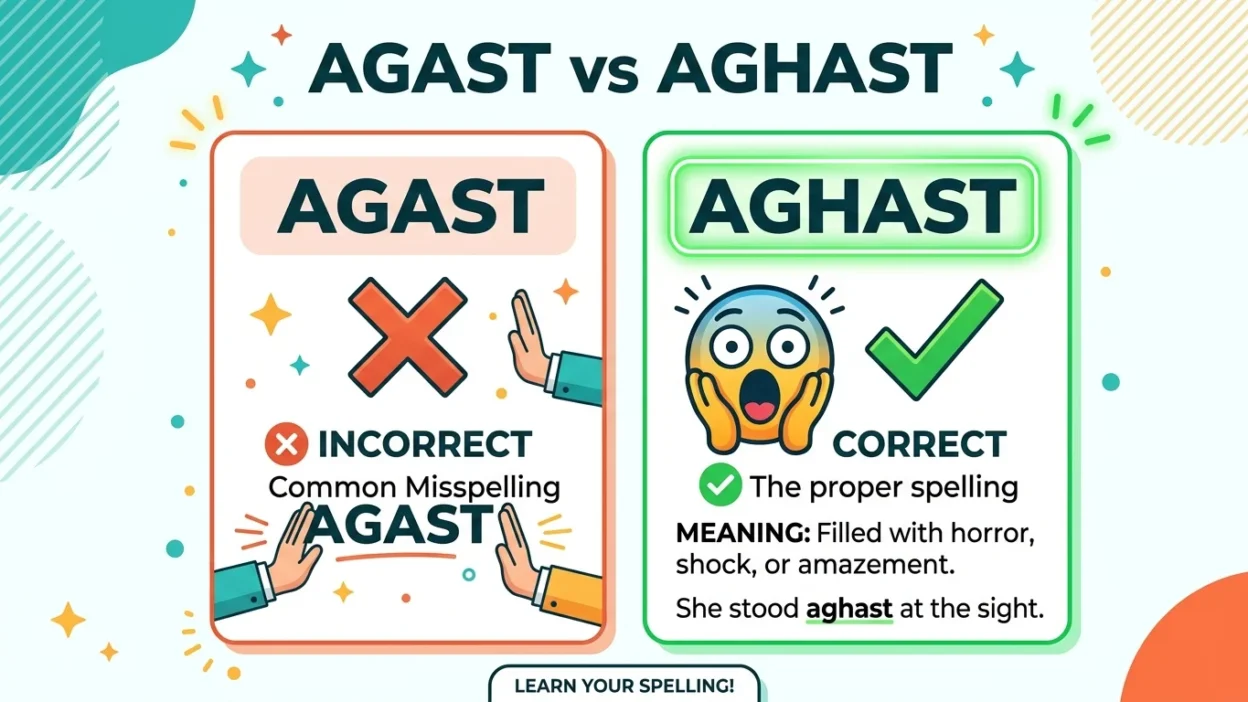
- Aghast is the correct spelling.
- Agast is not correct in standard English.
- Aghast means very shocked or surprised.
- Always include the letter “h”: aghast.
So the correct word is aghast.
Simple Background of the Word
The word aghast has been used in English for a long time. It originally meant:
- filled with fear
- shocked or surprised
Today, it is commonly used to describe a strong reaction when something is surprising, shocking, or unexpected.
For example:
- People feel aghast when they hear shocking news.
- Someone may look aghast after seeing something surprising.
The spelling has always included the letter “h.”
Clear Explanation of the Difference
Now let’s look clearly at both words.
Aghast
Aghast is the correct and standard word.
It is an adjective, and it means:
- very shocked
- very surprised
- filled with strong emotion (usually negative)
Examples:
- She was aghast at the news.
- He looked aghast when he saw the mistake.
- They were aghast by what happened.
This spelling is used in books, schools, and everyday English.
Agast
Agast is not correct in modern English.
People often write agast because:
- they forget the letter “h”
- they think the simpler spelling is correct
- they type quickly
However, removing the “h” makes the word incorrect.
So agast should not be used.
Comparison Table
| Feature | Aghast | Agast |
|---|---|---|
| Correct spelling | Yes | No |
| Has letter “h” | Yes | No |
| Used in formal writing | Yes | No |
| Meaning clear | Yes | No |
| Recommended to use | Yes | No |
This table clearly shows that aghast is the correct spelling.
Which One to Use and When
You should use aghast when describing strong shock or surprise.
Here are common situations.
Shock or Surprise
Example:
“I was aghast when I heard the news.”
Reaction to Something Bad
Example:
“She was aghast at the mistake.”
Emotional Response
Example:
“He stood there, aghast, unable to speak.”
In all these situations, the correct word is aghast.
Common Mistakes People Make
Many learners make similar mistakes with this word.
Forgetting the “H”
Incorrect:
“I was agast at the result.”
Correct:
“I was aghast at the result.”
Thinking Simpler Spelling Is Better
Some people remove letters to make words look simpler, but English spelling does not always work this way.
Typing Errors
Fast typing often leads to missing letters like “h.”
Always check your spelling carefully.
Everyday Real-Life Examples
Let’s see how aghast is used in daily communication.
Example in an Email
“I was aghast to hear about the issue.”
Example in School
“Students were aghast at the sudden announcement.”
Example in News
“People were aghast at the shocking event.”
Example on Social Media
“I’m aghast at what just happened!”
Example in Conversation
Person A:
“Did you hear the news?”
Person B:
“Yes, I’m completely aghast.”
These examples show how the word is used in real life.
Learning Tips for Students and Beginners
Here are two simple tricks to remember the correct spelling.
Remember the “H”
The correct word has an “h”:
aghast ✔
agast ❌
Connect It with “Shock”
Whenever you think of strong surprise or shock, remember the word aghast.
(FAQ)
Is agast a real English word?
No. Agast is not correct in standard English.
What is the correct spelling?
The correct spelling is aghast.
What does aghast mean?
Aghast means very shocked or surprised.
Why do people write agast?
They often forget the letter “h” or type quickly.
Is aghast used in formal writing?
Yes. It is used in both formal and informal English.
Can aghast describe emotions?
Yes. It describes strong feelings like shock or surprise.
Is aghast common in daily conversation?
Yes, especially when reacting to surprising news.
Can I use aghast in sentences?
Yes.
Example:
“I was aghast at the mistake.”
Conclusion
The difference between agast and aghast is simple.
Aghast is the correct spelling and means feeling very shocked or surprised.
Agast is incorrect because it is missing the letter “h.”
To avoid mistakes, remember this simple rule:
Always write aghast, not agast.
Once you remember the extra “h,” using the correct word becomes easy and natural.