Many students and English learners feel confused when they see the words “cancell” and “cancel.” These two spellings look very similar, and the difference is only one extra letter “l.”
This confusion often happens because English sometimes uses double letters, and sometimes it does not. For example:
- call → called
- travel → travelled (in some forms of English)
Because of patterns like these, learners may think cancell is correct. However, this is not true.
In this article, everything will be explained in very simple English so you can clearly understand the correct spelling and avoid mistakes.
Quick Answer
Here is the simple and clear answer:
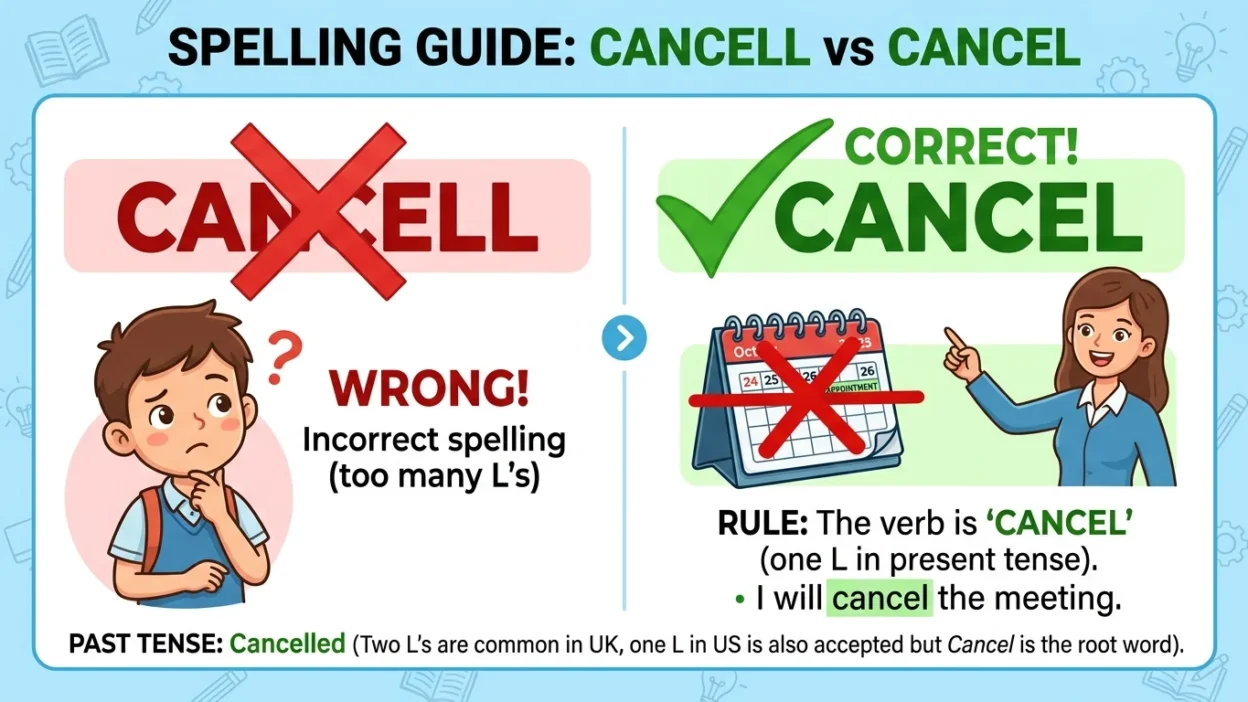
- Cancel is the correct spelling.
- Cancell is not correct in standard English.
- The base word always has one “l”: cancel.
- Cancell is usually a spelling mistake.
So whenever you write this word, you should always use cancel.
Simple Background of the Word
The word cancel has been used in English for many years. It comes from older words that meant to cross out, remove, or stop something.
Today, cancel is a very common verb. It means:
- to stop something
- to decide something will not happen
- to remove or end something
Examples:
- cancel a meeting
- cancel a ticket
- cancel an order
The base form of the word is always spelled with one “l”:
cancel
Clear Explanation of the Difference
Now let’s look clearly at both spellings.
Cancel
Cancel is the correct and standard word.
It is a verb, and it means:
- to stop something from happening
- to end a plan
- to remove something
Examples:
- I need to cancel my appointment.
- They decided to cancel the event.
- Please cancel my order.
This spelling is used in dictionaries, schools, and everyday writing.
Cancell
Cancell is not correct.
People often write cancell because:
- they think the word needs double l
- they confuse it with other words
- they type quickly and add an extra letter
However, the correct base word always has one “l.”
So cancell should not be used.
Comparison Table
| Feature | Cancel | Cancell |
|---|---|---|
| Correct spelling | Yes | No |
| Found in dictionaries | Yes | No |
| Used in formal writing | Yes | No |
| Common spelling mistake | No | Yes |
| Recommended to use | Yes | No |
This table clearly shows that cancel is the correct spelling.
Which One to Use and When
You should always use cancel when talking about stopping or ending something.
Here are common situations where the word is used.
Appointments
Example:
“I need to cancel my doctor’s appointment.”
Events
Example:
“They decided to cancel the concert.”
Orders
Example:
“Please cancel my online order.”
Plans
Example:
“We had to cancel our trip.”
In all these situations, the correct spelling is cancel.
Important Note About Other Forms
While the base word is cancel, some forms may look different depending on spelling style.
American English
- cancel
- canceled
- canceling
British English
- cancel
- cancelled
- cancelling
So the double l appears in some forms, but not in the base word cancel.
Common Mistakes People Make
Many learners make small mistakes with this word.
Adding an Extra “L”
Incorrect:
“I will cancell the meeting.”
Correct:
“I will cancel the meeting.”
Confusing With Other Forms
People sometimes see cancelled and think the base word is cancell, which is not correct.
Correct base form:
cancel
Typing Quickly
Sometimes people add an extra letter by mistake.
Always check your spelling and remove the extra l.
Everyday Real-Life Examples
Let’s see how cancel is used in daily communication.
Example in an Email
“I would like to cancel my subscription.”
Example in School
“The teacher had to cancel the class.”
Example in News
“The airline decided to cancel several flights.”
Example on Social Media
“We had to cancel our plans because of the weather.”
Example in Conversation
Person A:
“Are you going to the event?”
Person B:
“No, I had to cancel.”
These examples show how common the word cancel is in everyday English.
Learning Tips for Students and Beginners
Here are two simple tricks to remember the correct spelling.
Remember “One L” Rule
The base word has only one “l”:
cancel ✔
cancell ❌
Think of Common Phrases
You often see:
- cancel order
- cancel booking
- cancel meeting
Seeing these phrases helps you remember the correct spelling.
(FAQ)
Is cancell a real English word?
No. Cancell is not a correct word in standard English.
What is the correct spelling?
The correct spelling is cancel.
What does cancel mean?
Cancel means to stop something or decide it will not happen.
Why do people write cancell?
People often confuse it with words that have double l or type quickly.
Is cancel used in formal writing?
Yes. It is used in both formal and informal writing.
Why does “cancelled” have double l?
In British English, cancelled has double l, but the base word is still cancel.
What is the past tense of cancel?
- American English: canceled
- British English: cancelled
Can cancel be used in daily conversation?
Yes.
Example:
“I need to cancel my plan.”
Conclusion
The difference between cancell and cancel is very simple.
Cancel is the correct spelling and is used when you want to stop or end something.
Cancell, on the other hand, is a spelling mistake caused by adding an extra l.
To avoid confusion, remember this simple rule:
Always write cancel with one “l.”
Once you remember this rule, spelling the word correctly becomes easy and natural.