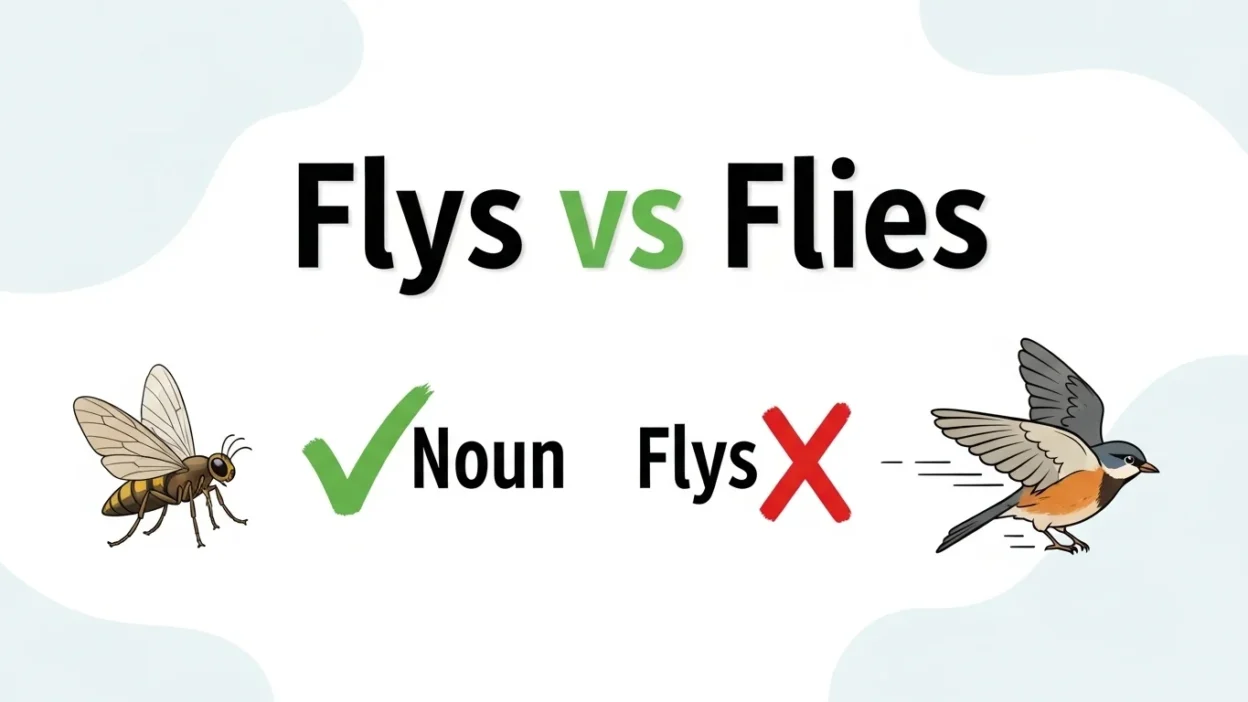
Many students and English learners get confused about flys vs flies. These two words look almost the same. They both come from the word “fly.” But only one of them is correct in most situations.
The confusion happens because English changes some words when we add -s or -es. Sometimes we just add s, and sometimes we change the spelling first.
If you have ever asked:
- Is it flys or flies?
- Why does the spelling change?
- When should I use flies?
This guide will explain everything in very simple English so you can understand it easily.
Quick Answer
Here is the clear and simple answer:
- ✅ Flies = Correct spelling (usually)
- ❌ Flys = Incorrect spelling (in standard grammar)
We use flies:
- When talking about more than one fly (the insect)
- When talking about “he/she/it flies” (present tense of the verb)
If you remember one rule, remember this:
When a word ends in consonant + y, change y to i and add es.
Simple Background Rule
Let’s understand the grammar rule step by step.
When a word ends with:
consonant + y
We:
- Remove the y
- Add ies
Example:
- baby → babies
- city → cities
- story → stories
- fly → flies
This is why “flys” is incorrect.
Clear Explanation of the Difference
Let’s look at both words clearly.
What Is “Flies”?
“Flies” is correct in two main situations.
1. Plural Noun (More Than One Fly)
Singular:
- One fly
Plural:
- Two flies
Example sentences:
- The flies are buzzing.
- There are many flies in the kitchen.
- Flies can spread germs.
Here, “flies” means more than one insect.
2. Verb Form (He/She/It)
We use “flies” when talking about:
- He flies
- She flies
- It flies
Examples:
- He flies to Dubai every month.
- She flies a plane.
- The bird flies high.
- The airplane flies at night.
This is the correct third-person singular form of the verb “fly.”
What Is “Flys”?
“Flys” is not correct in standard English.
It:
- Breaks the spelling rule
- Is considered a grammar mistake
- Should not be used in school or professional writing
If you write:
- ❌ He flys to London.
- ❌ There are many flys here.
These sentences are incorrect.
Comparison Table
Here is a simple table to help you understand quickly:
| Feature | Flies | Flys |
|---|---|---|
| Correct spelling? | ✅ Yes | ❌ No |
| Plural of fly? | Yes | No |
| Used with he/she/it? | Yes | No |
| Follows grammar rules? | Yes | No |
| Acceptable in formal writing? | Yes | No |
Simple rule:
👉 Always use flies.
👉 Never use flys.
Which One Should You Use?
Use flies in these situations:
1. When Talking About Insects
- The flies are annoying.
- I killed two flies.
- Flies are common in summer.
2. When Talking About Travel
- He flies every week.
- She flies internationally.
- The pilot flies the plane safely.
3. When Talking About Birds or Planes
- The bird flies over the tree.
- The airplane flies above the clouds.
- Superman flies in the movie.
In all these examples, the correct spelling is flies.
Why Do People Write “Flys”?
Here are common reasons.
1. Adding Only “S”
Some learners think all words just add “s” to make them plural or third-person verbs.
Example:
- book → books
- car → cars
So they write:
- fly → flys
But this is wrong because of the spelling rule.
2. Not Knowing the “Y” Rule
If a word ends in:
consonant + y
You must change y to i before adding es.
3. Fast Typing
Sometimes it is just a typing mistake. Always check your spelling in important writing.
Common Mistakes People Make
Let’s look at wrong and correct examples.
❌ He flys to London.
✅ He flies to London.
❌ There are many flys here.
✅ There are many flies here.
❌ The bird flys high.
✅ The bird flies high.
Remember the spelling change every time.
Everyday Real Life Examples
Here are examples you might see in daily life.
In News
- The airline flies to 50 countries.
- The helicopter flies over the city.
- Flies spread diseases.
In School Writing
- The eagle flies very high.
- The character flies across the sky.
- Flies are attracted to food.
In Work Emails
- He flies to Karachi tomorrow.
- The manager flies frequently for meetings.
On Social Media
- She flies every weekend!
- I hate flies in summer.
- The drone flies smoothly.
You will always see “flies,” not “flys,” in correct English.
Short Learning Section for Students and Beginners
Here is an easy way to remember.
Step 1: Check the Ending
Does the word end in consonant + y?
Fly ends with:
- l (consonant)
- y
So we change it.
Step 2: Apply the Rule
Remove y
Add ies
fly → flies
Step 3: Practice With Other Words
Try these:
- try → tries
- cry → cries
- carry → carries
They follow the same rule.
Quick Practice
Choose the correct word:
- The bird ______ high.
- a) flys
- b) flies
- There are many ______ in the room.
- a) flies
- b) flys
Answers:
- b) flies
- a) flies
(FAQ)
1. Is “flys” ever correct?
No. In standard English, it is incorrect.
2. Why does fly change to flies?
Because it ends in consonant + y, and we follow the “change y to i + es” rule.
3. Is flies a noun or a verb?
It can be both.
- Noun: plural of fly
- Verb: he/she/it flies
4. What is the plural of fly (insect)?
Flies.
5. What is the correct form for “he fly”?
He flies.
6. Does this rule apply to all words ending in y?
Only when y comes after a consonant.
Example:
- boy → boys (not boies)
Because “y” comes after a vowel.
7. Is this mistake common?
Yes, especially among beginners and ESL learners.
Final Conclusion
The difference between flys vs flies is simple:
- ✅ Flies is correct.
- ❌ Flys is incorrect.
When a word ends in consonant + y, change the y to i and add es.
If you remember one clear rule, remember this:
Fly becomes flies — never flys.
Now you can write confidently and use the correct spelling every time.