Many learners feel confused between “goodmorning” and “good morning.” The words look very similar, and when spoken, they sound exactly the same. Because of this, it’s easy to think both forms might be correct.
This confusion usually happens because English sometimes joins words together (like “notebook”), but sometimes keeps them separate. In this case, the rule is simple and once you learn it, you won’t make this mistake again.
Quick Answer
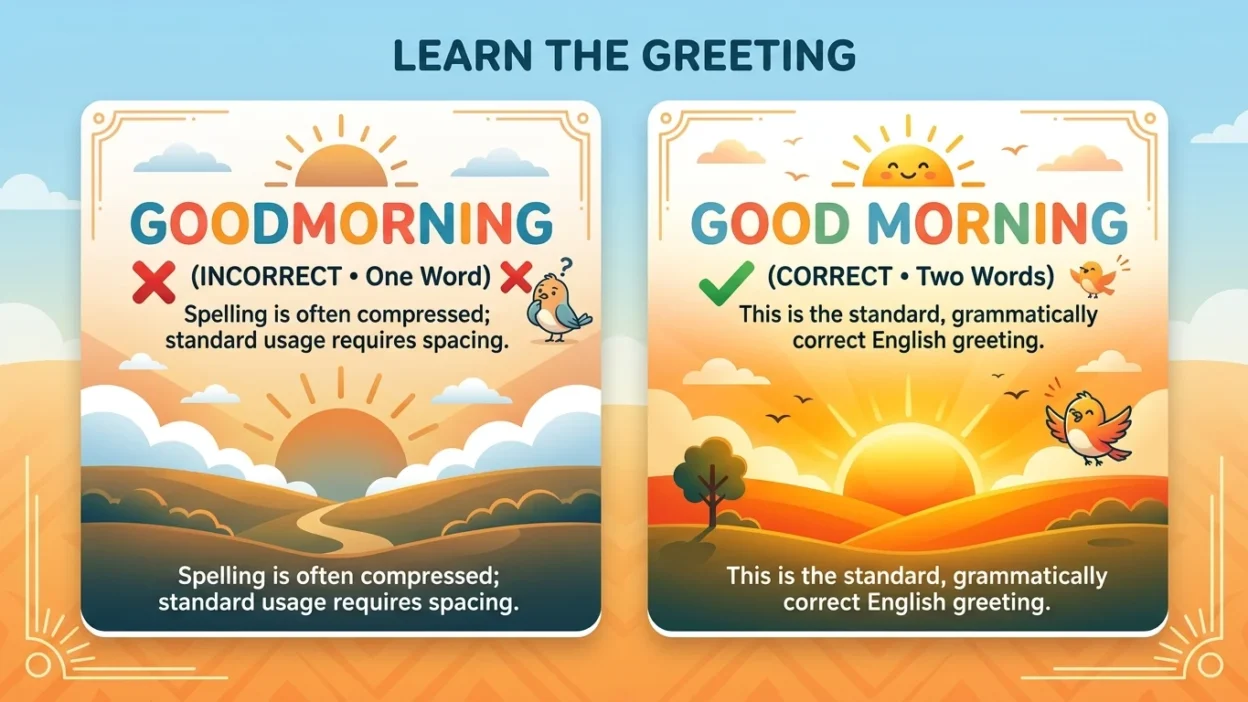
- “Good morning” is correct.
- “Goodmorning” is incorrect.
- Always write it as two words.
👉 Simple rule: Use “good morning,” never “goodmorning.”
Simple Origin or Background
The phrase “good morning” is made of two separate words:
- good = positive or kind
- morning = early part of the day
In English, greetings like this are usually written as two words, such as:
- good afternoon
- good evening
That is why we write good morning, not “goodmorning.”
Clear Explanation of the Difference
Here is the key idea:
👉 There is no real difference because “goodmorning” is not a correct word.
What does “good morning” mean?
“Good morning” is a greeting used:
- At the start of the day
- To say hello politely
Examples:
- Good morning! How are you?
- I said good morning to my teacher.
What about “goodmorning”?
- It is a wrong spelling
- It is not used in correct English
- It should never be written
Comparison Table
| Feature | Goodmorning | Good Morning |
|---|---|---|
| Correct spelling | ❌ No | ✅ Yes |
| Meaning | None | Greeting |
| Usage | Incorrect | Correct and common |
| Word form | One word (wrong) | Two words (correct) |
| Recommended use | Never use | Always use |
Which One to Use and When
👉 Always use “good morning.”
Use it when:
- Greeting someone early in the day
- Writing emails or messages
- Speaking politely
Examples:
- Good morning, everyone.
- I wish you a good morning.
- She said good morning with a smile.
👉 Never use “goodmorning.”
Common Mistakes People Make
Joining the words
❌ goodmorning
✔ good morning
Copying from informal typing
Sometimes people write “goodmorning” in chats, but it is still incorrect.
Not knowing the rule
Learners may not realize greetings are usually two words.
Typing quickly
It can also be a simple typing error.
👉 Tip: Remember that greetings stay separate.
Everyday Real Life Examples
In conversations
- Good morning! How are you?
- She said good morning to everyone.
In emails
- Good morning, Sir.
- Good morning, I hope you are well.
In school
- The teacher said good morning.
- Students replied, “Good morning, teacher!”
In daily life
- I wish you a good morning.
- He greeted me with a good morning.
On social media
- “Good morning everyone 😊”
- “Wishing you a good morning!”
👉 In all these examples, “goodmorning” would be incorrect.
Short Learning Section for Students and Beginners
Step 1: Learn the phrase
Good morning
Step 2: Understand the rule
👉 It is always two words
Step 3: Avoid the mistake
❌ goodmorning
✔ good morning
Easy memory tip
👉 “All greetings stay separate: good morning, good evening.”
Practice
Fill in the blanks:
- ______, how are you?
- She said ______ to the class.
✔ Answers:
- Good morning
- good morning
FAQ
Is “goodmorning” a real word?
No, it is not correct.
Is “good morning” correct?
Yes, it is the correct form.
Why is it written as two words?
Because it is a greeting made of two separate words.
Can I write “goodmorning” in messages?
No, it should be avoided even in informal writing.
Are similar greetings also two words?
Yes, like “good afternoon” and “good evening.”
Is “good morning” formal or informal?
It can be used in both formal and informal situations.
How can I remember this?
Remember: “Good morning is always two words.”
Is it important for exams?
Yes, correct spelling matters in writing.
Conclusion
The difference between “goodmorning” and “good morning” is very simple. “Good morning” is correct, and “goodmorning” is a spelling mistake.
Even though they sound the same, only the two-word form is accepted in proper English.
👉 If you remember one rule, remember this: Always write “good morning” as two words.