Many students and English learners get confused between “insue” and “ensue.” These words look very similar, and the difference is just the first letter: i or e.
This confusion happens because:
- Both spellings sound similar when spoken
- English has many words that start with in- and en-
- Learners sometimes guess the spelling instead of remembering it
Because of this, people often write insue by mistake when they actually mean ensue.
In this article, you will learn the correct spelling in very simple English so you can use it confidently.
Quick Answer
Here is the simple and clear answer:
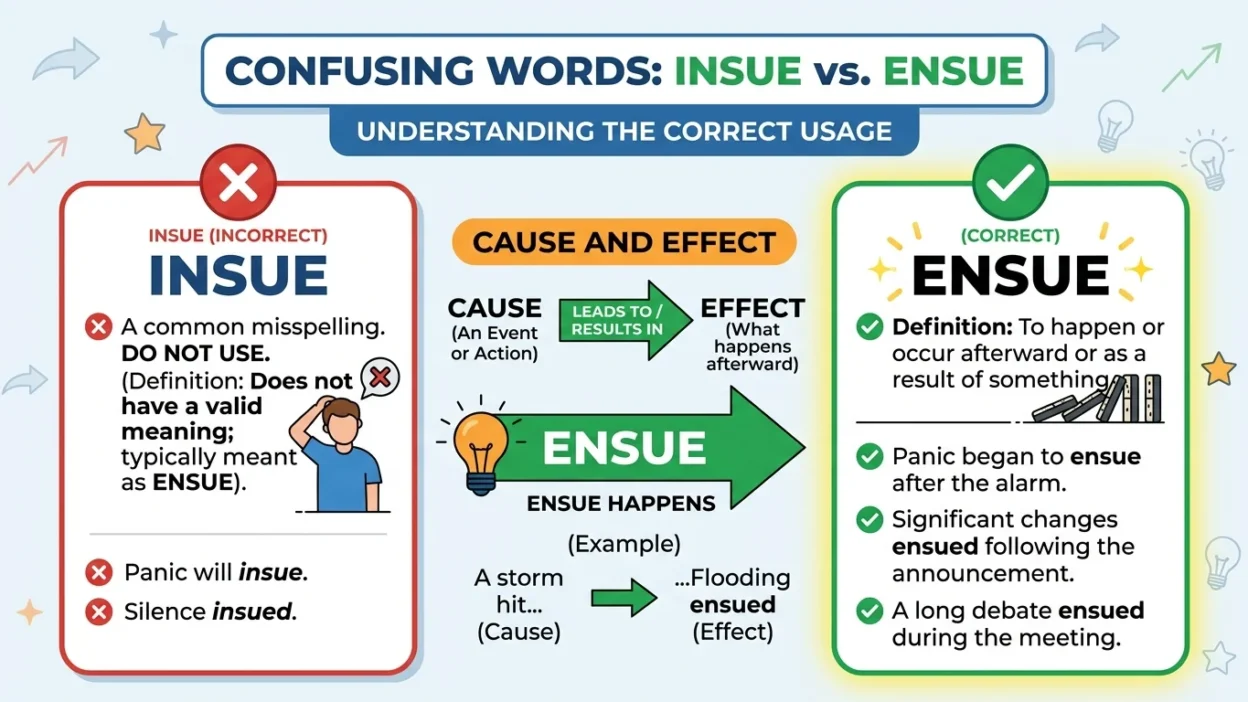
- Ensue is the correct spelling.
- Insue is not correct in standard English.
- Ensue means to happen after something.
- Always use ensue.
So the correct word is ensue.
Simple Background of the Word
The word ensue has been used in English for a long time. It comes from older forms that meant:
- to follow
- to happen next
Today, ensue is used to describe something that happens as a result of something else.
Example idea:
First something happens → then something else ensues
Clear Explanation of the Difference
Now let’s look clearly at both words.
Ensue
Ensue is the correct and standard word.
It is a verb, and it means:
- to happen after something
- to follow as a result
Examples:
- A fight may ensue after an argument.
- Confusion will ensue if instructions are not clear.
- Silence ensued after the announcement.
This spelling is correct in books, schools, and everyday English.
Insue
Insue is not correct.
People often write insue because:
- they confuse in- and en-
- they spell based on sound
- they are unsure of the correct form
However, insue is not accepted in standard English.
Comparison Table
| Feature | Ensue | Insue |
|---|---|---|
| Correct spelling | Yes | No |
| Found in dictionaries | Yes | No |
| Used in formal writing | Yes | No |
| Meaning clear | Yes | No |
| Recommended to use | Yes | No |
This table clearly shows that ensue is the correct word.
Which One to Use and When
You should use ensue when talking about something that happens after something else.
Here are common situations.
After an Event
Example:
“Heavy rain started, and flooding ensued.”
As a Result
Example:
“If you skip practice, problems may ensue.”
In Stories or News
Example:
“A heated debate ensued during the meeting.”
In all these situations, the correct word is ensue.
Common Mistakes People Make
Many learners make similar mistakes with this word.
Writing “insue”
Incorrect:
“Chaos will insue.”
Correct:
“Chaos will ensue.”
Spelling Based on Sound
The word sounds like in-soo, so people write insue, but this is incorrect.
Confusing Prefixes
English has many words with in- and en-, which causes confusion.
Correct form:
ensue
Everyday Real-Life Examples
Let’s see how ensue is used in daily communication.
Example in an Email
“Please follow the rules, or problems may ensue.”
Example in School
“Loud talking continued, and noise ensued.”
Example in News
“Protests broke out, and violence ensued.”
Example on Social Media
“If this continues, drama will ensue.”
Example in Conversation
Person A:
“What happens if we don’t fix this?”
Person B:
“More issues will ensue.”
These examples show how the word is used in real life.
Learning Tips for Students and Beginners
Here are two simple tricks to remember the correct spelling.
Remember “E for Event”
Think:
Ensue → happens after an Event
This can help you remember the correct starting letter.
Learn the Whole Word
Instead of guessing, remember the full word:
ensue
(FAQ)
Is insue a real English word?
No. Insue is not correct in standard English.
What is the correct spelling?
The correct spelling is ensue.
What does ensue mean?
Ensue means to happen after something or as a result.
Why do people write insue?
They often spell the word based on how it sounds.
Is ensue used in formal writing?
Yes. It is common in formal and informal English.
What is the past form of ensue?
The past form is ensued.
Example:
“A discussion ensued.”
Can ensue be used in daily conversation?
Yes.
Example:
“Problems will ensue if we ignore this.”
Is ensue a common word?
Yes, especially in writing, news, and formal speech.
Conclusion
The difference between insue and ensue is very simple.
Ensue is the correct spelling and means something that happens after another event.
Insue is incorrect and should not be used.
To avoid confusion, remember this simple rule:
Always write ensue, not insue.
Once you remember this word, using it correctly becomes easy and natural.