Many learners feel confused when writing layed off and laid off. Both seem possible because many English verbs form the past tense by adding -ed. So it is easy to think “layed” is correct.
But English is not always regular. Some verbs change in special ways—and “lay” is one of them. This creates confusion, especially in common phrases like “laid off.”
This article will make everything clear in very simple English. By the end, you will know exactly which form is correct and how to use it confidently.
Quick Answer
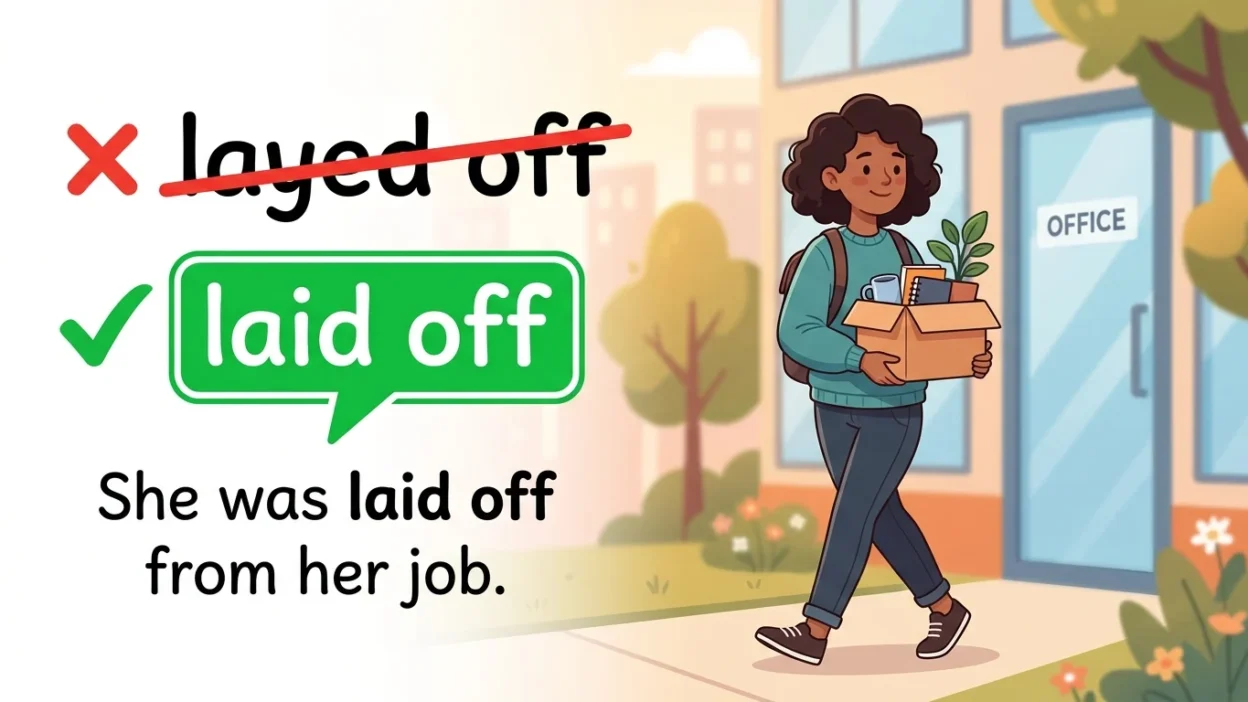
- ✅ Laid off = correct
- ❌ Layed off = incorrect
- Use laid off when talking about losing a job
Simple Background Explanation
Let’s start with the verb “lay.”
- Base form: lay
- Past form: laid
This is an irregular verb, so it does not follow the normal -ed rule.
Now, when we add “off,” we get a common phrase:
- lay off → laid off
What does “laid off” mean?
It usually means:
- someone lost their job
- the company stopped employing them
Example:
- The company laid off many workers.
Clear Explanation of the Difference
What is “laid off”?
- It is the correct past form
- It is used in real English
- It means someone lost their job (usually not their fault)
Example:
- He was laid off last year.
What is “layed off”?
- It is a wrong spelling
- It is not used in correct English
Even though it looks similar to words like “played” or “stayed,” it is incorrect.
Comparison Table
| Feature | Laid Off ✅ | Layed Off ❌ |
|---|---|---|
| Correct spelling | Yes | No |
| Used in English | Yes | No |
| Meaning | Lost a job | Not correct |
| Grammar | Past of “lay off” | Incorrect form |
| Example | She was laid off | Not correct |
Which One to Use and When
Always use laid off.
Use “laid off” when:
- Talking about losing a job
- Describing something that already happened
Examples:
- He was laid off due to budget cuts.
- Many workers were laid off last month.
- She got laid off from her company.
Never use:
- ❌ layed off
Common Mistakes People Make
1. Adding “-ed” automatically
Many learners think:
- lay → layed
Because:
- play → played
- stay → stayed
But “lay” is irregular:
- lay → laid
2. Confusing “lay” with other verbs
English has many similar-looking verbs, so learners mix them up.
3. Writing based on sound
“Layed” and “laid” sound similar, so people spell it incorrectly.
4. Forgetting it is a fixed phrase
“Laid off” is a very common expression. It should be remembered as a complete phrase.
Everyday Real-Life Examples
In Emails
- I was laid off last month due to company changes.
- Several employees were laid off recently.
In News
- The company laid off hundreds of workers.
- Many people were laid off during the crisis.
In Social Media
- Sadly, I got laid off today.
- He was laid off but found a new job quickly.
In Daily Conversation
- She was laid off from her job.
- He got laid off last year.
- They were laid off without warning.
Short Learning Section for Students and Beginners
Easy Rule
- Lay → Laid
- So: Lay off → Laid off
Memory Trick
Think:
“Lay changes to laid in the past”
Quick Practice
Fill in the blanks:
- He was ______ off last week.
- Many workers were ______ off.
- She got ______ off from her job.
Answers:
- laid
- laid
- laid
FAQ Section
1. Is “layed off” ever correct?
No. It is always incorrect.
2. Why is “laid off” correct?
Because “laid” is the correct past form of “lay.”
3. What does “laid off” mean?
It means someone lost their job, usually not because of their mistake.
4. Is “laid off” formal or informal?
It is used in both formal and informal English.
5. Can I say “he layed off workers”?
No. The correct sentence is:
- He laid off workers
6. What is the present form?
- lay off
Example:
- The company may lay off workers.
7. What is the difference between “fired” and “laid off”?
- Fired = because of performance or behavior
- Laid off = because of company reasons
8. How can I remember this easily?
Just remember:
- lay → laid
Conclusion
The difference between layed off and laid off is very simple:
- Laid off is correct
- Layed off is incorrect
Even though “layed” looks natural, it is not used in proper English. The verb “lay” is irregular, so its past form is laid.
If you remember this one rule, you will avoid a very common mistake and sound more confident in English.