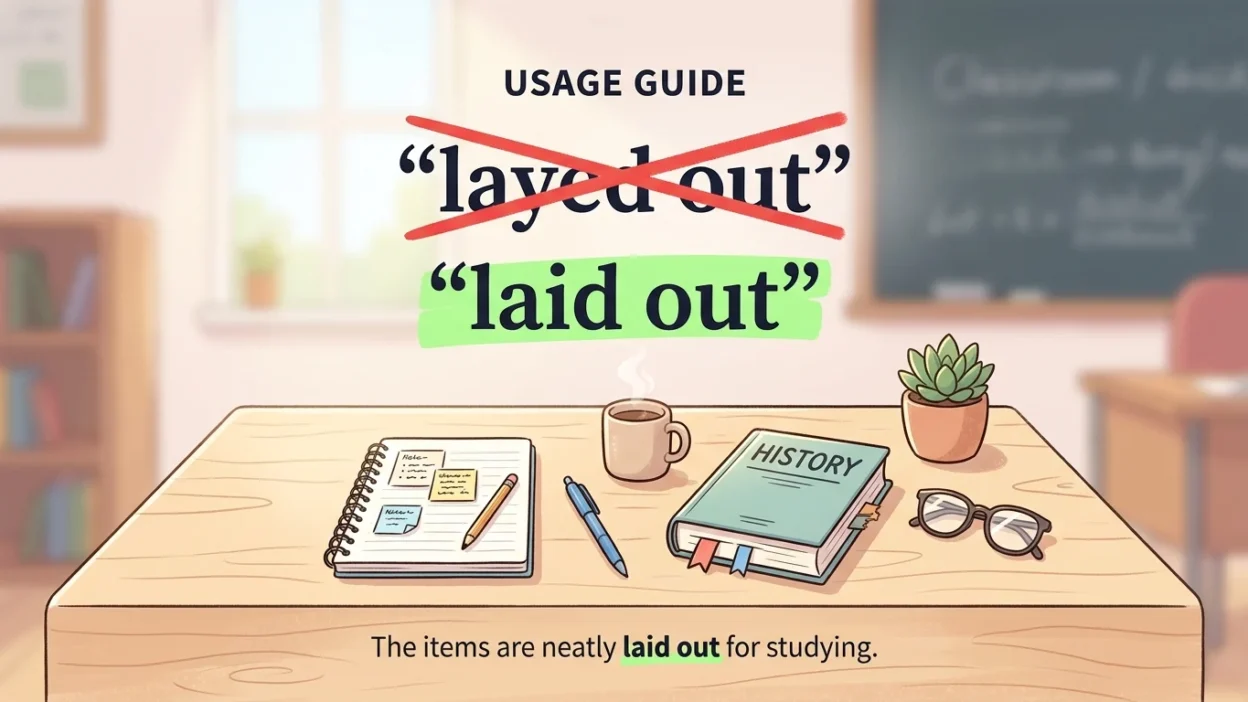
Many learners feel unsure when choosing between layed out and laid out. Both look correct at first glance, especially because many English verbs form the past tense by adding -ed.
But English has irregular verbs, and “lay” is one of them. This is why the confusion happens. The phrase “laid out” is very common in daily English, so it is important to use it correctly.
In this guide, you will learn the correct form, understand why it is correct, and see simple examples you can use in real life.
Quick Answer
- ✅ Laid out = correct
- ❌ Layed out = incorrect
- Use laid out when you mean “arranged,” “placed,” or “explained clearly”
Simple Background Explanation
Let’s begin with the verb “lay.”
- Base form: lay
- Past form: laid
This is an irregular verb, so it does not follow the normal -ed rule.
Now we add “out” to form a phrasal verb:
- lay out → laid out
What does “laid out” mean?
It can have a few simple meanings:
- to arrange something neatly
- to spread something out
- to explain something clearly
Examples:
- She laid out the clothes on the bed.
- He laid out the plan step by step.
Clear Explanation of the Difference
What is “laid out”?
- It is the correct past form
- It is used in real English
- It shows something was arranged or explained
Example:
- She laid out the documents on the table.
What is “layed out”?
- It is a wrong spelling
- It is not used in correct English
Even though it looks like “played out,” it is incorrect.
Comparison Table
| Feature | Laid Out ✅ | Layed Out ❌ |
|---|---|---|
| Correct spelling | Yes | No |
| Used in English | Yes | No |
| Meaning | Arranged / explained | Not correct |
| Grammar | Past of “lay out” | Incorrect form |
| Example | He laid out a plan | Not correct |
Which One to Use and When
Always use laid out.
Use “laid out” when:
- You arranged something
- You spread something
- You explained something clearly
Examples:
- She laid out the clothes for tomorrow.
- He laid out the steps of the process.
- They laid out the tools on the table.
Never use:
- ❌ layed out
Common Mistakes People Make
1. Adding “-ed” automatically
Many learners think:
- lay → layed
But this is wrong.
Correct:
- lay → laid
2. Confusing with regular verbs
Words like:
- play → played
- stay → stayed
make learners think “layed” is correct—but it is not.
3. Writing based on sound
“Layed” and “laid” sound similar, so people spell it wrong.
4. Forgetting it is a common phrase
“Laid out” is a very common expression, especially in work, school, and daily life.
Everyday Real-Life Examples
In Emails
- I laid out the plan in the document.
- She laid out all the details clearly.
In Social Media
- Just laid out my outfit for tomorrow!
- He laid out everything we need for the trip.
In News
- The report laid out the main issues.
- The government laid out a new plan.
In Daily Conversations
- I laid out the books on the table.
- She laid out the food for guests.
- He laid out the steps for the project.
Short Learning Section for Students and Beginners
Easy Rule
- Lay → Laid
- So: Lay out → Laid out
Memory Trick
Think:
“Lay changes to laid in the past”
Quick Practice
Fill in the blanks:
- She ______ out the clothes.
- He ______ out the plan clearly.
- They ______ out the tools.
Answers:
- laid
- laid
- laid
FAQ Section
1. Is “layed out” ever correct?
No. It is always incorrect.
2. Why is “laid out” correct?
Because “laid” is the correct past form of “lay.”
3. What does “laid out” mean?
It means arranged, spread, or explained clearly.
4. Is “laid out” formal or informal?
It is used in both formal and informal English.
5. Can I say “he layed out the plan”?
No. The correct sentence is:
- He laid out the plan
6. What is the present form?
- lay out
Example:
- She will lay out the details.
7. Does “laid out” have more than one meaning?
Yes. It can mean arrange, spread, or explain.
8. How can I remember this easily?
Just remember:
- lay → laid
Conclusion
The difference between layed out and laid out is simple:
- Laid out is correct
- Layed out is incorrect
Even though “layed” looks like many regular verbs, it is not correct because “lay” is an irregular verb.
Remember this one rule:
- Lay → Laid
With practice, you will use laid out naturally and confidently in everyday English.