Many students and English learners get confused about minuscule vs miniscule. These two words look almost the same. They sound almost the same when spoken. The only difference is one small letter: “u” or “i.”
Because the difference is tiny, people often spell it wrong without noticing. Even native English speakers sometimes make this mistake.
If you have ever wondered:
- Is it minuscule or miniscule?
- Are both spellings correct?
- Which one should I use in school or exams?
Don’t worry. This guide will explain everything in very simple English so you understand it clearly the first time.
Quick Answer
Here is the clear and simple answer:
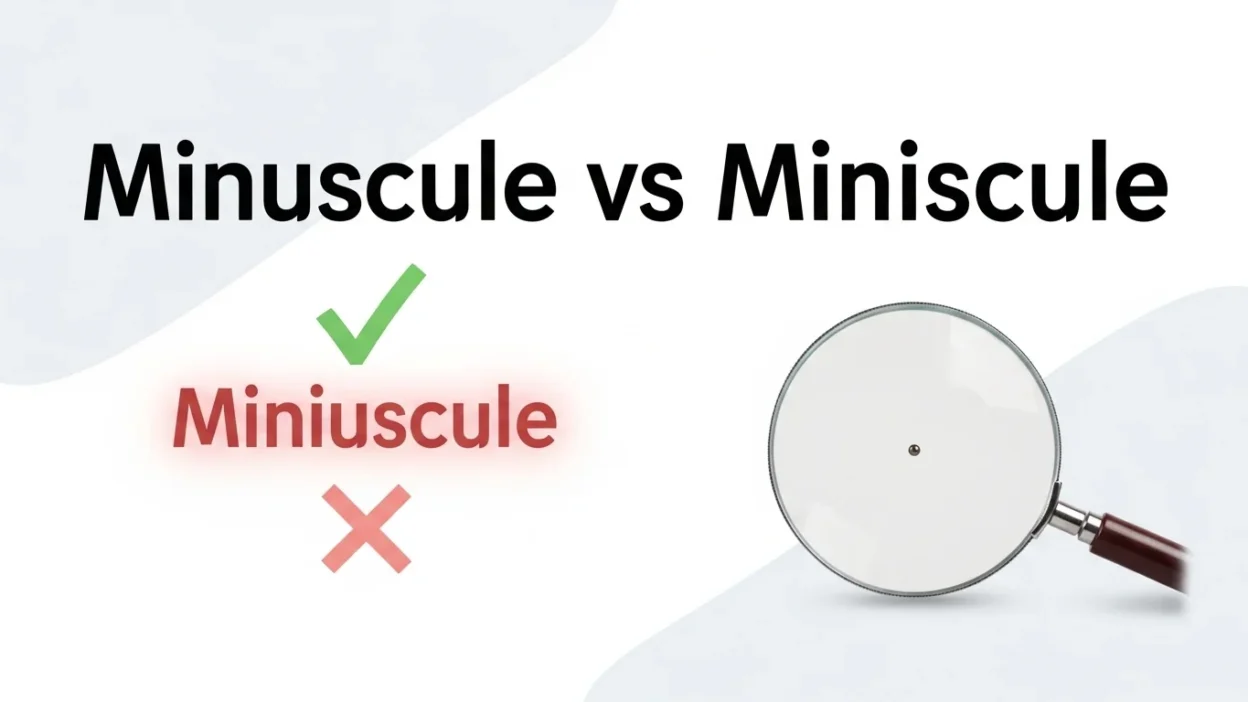
- ✅ Minuscule = Correct spelling
- ❌ Miniscule = Incorrect spelling
- “Minuscule” means very small
- “Miniscule” is a common spelling mistake
If you remember one rule, remember this:
The correct word has a U after the N — M I N U S C U L E.
Simple Background of the Word
The word minuscule has been in English for many years. It comes from older languages where it meant “small.” That meaning has not changed.
Over time, many people started spelling it as “miniscule” because it sounds similar to the word mini, which also means small.
But this spelling change was a mistake.
The correct and standard spelling has always been:
minuscule
Clear Explanation of the Difference
Let’s look at both words clearly.
What Is “Minuscule”?
“Minuscule” is an adjective. An adjective describes something.
It means:
- Extremely small
- Very tiny
- So small it is almost hard to see
Examples:
- The bug was minuscule.
- There was a minuscule amount of sugar left.
- The difference was minuscule.
- She made a minuscule mistake.
In all these sentences, “minuscule” means very small.
What Is “Miniscule”?
“Miniscule” is not the correct spelling in standard English.
It:
- Is considered a spelling error
- Does not appear as the main spelling in dictionaries
- Should not be used in formal writing
If you write “miniscule” in:
- School exams
- Essays
- Professional emails
- Reports
It will usually be marked wrong.
Some people use it by mistake because it looks like “mini,” but it is not correct.
Comparison Table
Here is a simple table to help you see the difference quickly:
| Feature | Minuscule | Miniscule |
|---|---|---|
| Correct spelling? | ✅ Yes | ❌ No |
| Real English word? | Yes | No (common mistake) |
| Meaning | Very small | No official meaning |
| Used in formal writing? | Yes | No |
| Found in dictionaries? | Yes | Listed as incorrect or variant |
Simple rule:
👉 Always use minuscule.
👉 Avoid miniscule.
Why Do People Spell It “Miniscule”?
There are a few common reasons.
1. Influence of the Word “Mini”
We often see the word “mini” in English:
- mini car
- mini bag
- mini version
Because “mini” means small, people think “miniscule” must be correct.
But this is just a spelling mistake.
2. Pronunciation Confusion
When spoken quickly, “minuscule” can sound like “miniscule.” This makes learners spell it the way they hear it.
English spelling does not always match pronunciation exactly.
3. Careless Typing
Sometimes it is just a typing mistake. Always double-check your spelling in important writing.
Which One Should You Use?
You should use minuscule whenever you want to describe something very small.
Use It For:
- Size
- Amount
- Difference
- Details
Examples:
- The scratch on the car was minuscule.
- There is a minuscule chance of rain.
- The improvement was minuscule.
- She noticed a minuscule crack in the wall.
In all these cases, the correct word is minuscule.
Never write:
- ❌ The change was miniscule.
- ❌ There is a miniscule chance.
Common Mistakes People Make
Let’s look at typical errors.
Mistake 1: Replacing “U” with “I”
Wrong:
- The difference was miniscule.
Correct:
- The difference was minuscule.
Mistake 2: Thinking Both Are Correct
Some people believe both spellings are acceptable. In formal English, only minuscule is correct.
Mistake 3: Mixing It With “Mini”
Remember:
- mini = small
- minuscule = extremely small
They are different words.
Everyday Real Life Examples
Here are examples you might see in daily life.
In News
- Scientists found a minuscule particle.
- The change in price was minuscule.
- The damage was minuscule compared to last year.
In School Writing
- The character made a minuscule mistake.
- There was a minuscule amount of water left.
- The difference between the two answers was minuscule.
In Work Emails
- The error is minuscule.
- The delay was minuscule.
- The cost increase is minuscule.
On Social Media
- I have a minuscule chance of winning!
- That bug is minuscule!
- The improvement is minuscule but helpful.
You will notice that professional writing always uses minuscule, not “miniscule.”
Short Learning Section for Students and Beginners
Here is an easy way to remember.
Step 1: Focus on the U
The correct spelling has a U after the N:
M I N U S C U L E
Think of the two U letters in the word.
Step 2: Break It Into Parts
Mi – nus – cule
Say it slowly when spelling.
Step 3: Memory Trick
Think:
“Minuscule has a U because it is unusually small.”
The word “unusually” starts with U. That can help you remember.
Quick Practice
Choose the correct spelling:
- The crack was ______.
- a) miniscule
- b) minuscule
- The change was ______.
- a) minuscule
- b) miniscule
Answers:
- b) minuscule
- a) minuscule
(FAQ)
1. Is “miniscule” ever correct?
In standard English, no. It is considered a spelling mistake.
2. What does “minuscule” mean?
It means extremely small.
3. Is minuscule formal or informal?
It can be used in both formal and informal writing.
4. Is minuscule an adjective?
Yes. It describes something.
5. Why do people spell it wrong?
Because it sounds similar and looks like the word “mini.”
6. Is the pronunciation different?
No. Both spellings sound the same when spoken.
7. How can I remember the correct spelling?
Remember that it has a U after the N:
M I N U S C U L E.
Final Conclusion
The difference between minuscule vs miniscule is simple:
- ✅ Minuscule is correct.
- ❌ Miniscule is incorrect.
“Minuscule” means extremely small. It always contains the letter U after N.
If you remember one clear rule, remember this:
Tiny word, big mistake — always spell it with a U.
Now you can write confidently and avoid this very common spelling error.