Many English learners and writers become confused when they see the words “mobil” and “mobile.” These two spellings look almost the same, and when spoken quickly, they may sound similar.
Because of this, some people accidentally remove the last letter “e” and write mobil instead of mobile. This often happens when typing fast, guessing the spelling, or hearing the word in conversation.
The word mobile is very common today, especially when talking about phones, technology, and things that move easily. Because it is used so often, it is important to know the correct spelling.
In this article, everything will be explained in very simple English so students, beginners, and general readers can clearly understand the difference.
Quick Answer
Here is the simple answer:
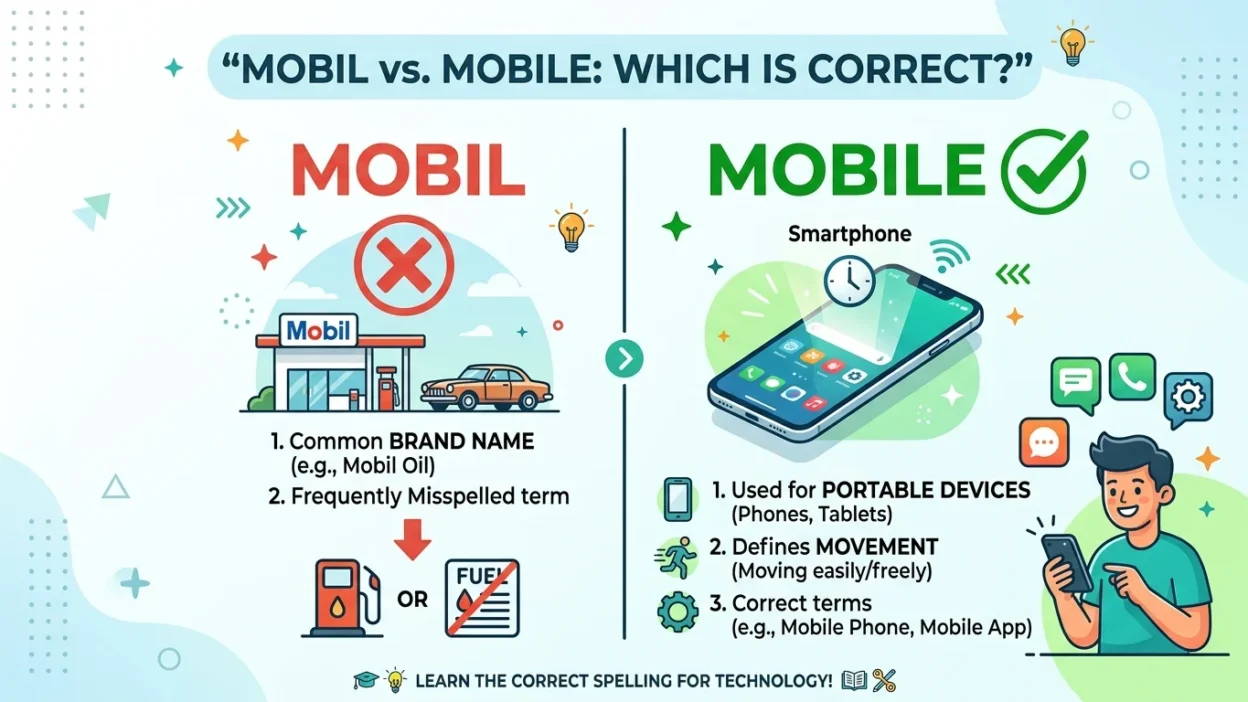
- Mobile is the correct spelling in English.
- Mobil is not the standard English spelling of the word.
- Dictionaries and formal writing always use mobile.
- Mobil is usually a spelling mistake.
So when writing this word, you should always choose mobile.
Simple Background of the Word
The word mobile has been used in English for many years. It originally came from older Latin and French words that meant movable or able to move.
Because of this meaning, the word mobile describes something that can move easily from one place to another.
Over time, the word became very common in modern technology, especially with mobile phones.
Examples:
- mobile phone
- mobile device
- mobile network
The spelling mobile with the final “e” became the standard form used in dictionaries and everyday writing.
Clear Explanation of the Difference
Now let’s look at both spellings clearly.
Mobile
Mobile is the correct and standard word.
It can be used as an adjective or noun.
It usually means:
- something that can move easily
- a portable device
- a phone used for communication
Examples:
- mobile phone
- mobile device
- mobile application
Example sentences:
- I forgot my mobile phone at home.
- The company created a new mobile app.
- The doctor needs a mobile clinic for remote areas.
This spelling is used in dictionaries, books, schools, and business writing.
Mobil
Mobil is not the standard English spelling for this word.
People often write mobil by mistake because:
- they forget the last letter “e”
- they type quickly
- they guess the spelling based on pronunciation
However, the correct spelling always includes the final “e.”
So when writing about phones, devices, or things that move easily, you should always use mobile.
Comparison Table
| Feature | Mobile | Mobil |
|---|---|---|
| Correct spelling | Yes | No |
| Found in dictionaries | Yes | No |
| Used in formal writing | Yes | No |
| Common typing mistake | No | Yes |
| Recommended spelling | Yes | No |
This table clearly shows that mobile is the correct spelling.
Which One to Use and When
You should always use mobile in situations where something can move or when referring to modern devices.
Here are common examples.
Phones
Example:
“I bought a new mobile phone yesterday.”
Technology
Example:
“The company launched a mobile application.”
Communication
Example:
“You can contact me on my mobile.”
Movement
Example:
“The robot is mobile and can move around easily.”
In all these situations, the correct spelling is mobile.
Common Mistakes People Make
Many learners make small mistakes when writing this word.
Removing the Final “E”
Incorrect:
“I lost my mobil phone.”
Correct:
“I lost my mobile phone.”
The word always ends with e.
Typing Too Fast
Sometimes people accidentally delete the final letter while typing.
Incorrect:
“The mobil network is slow.”
Correct:
“The mobile network is slow.”
Copying Incorrect Spelling
Sometimes incorrect spellings appear online or in informal writing. If you see mobil, it is usually a mistake.
Always follow the correct spelling: mobile.
Everyday Real-Life Examples
Let’s see how mobile appears in daily communication.
Example in an Email
“Please contact me on my mobile if you need more information.”
Example in School
“Students are not allowed to use mobile phones during exams.”
Example in News
“The company introduced a new mobile device this year.”
Example on Social Media
“I just downloaded a new mobile game.”
Example in Conversation
Person A:
“Where is your phone?”
Person B:
“I left my mobile in the car.”
These examples show how common the word mobile is in everyday English.
Learning Tips for Students and Beginners
Here are two easy tricks to remember the correct spelling.
Remember the Final “E”
The word always ends with e:
mobil ❌
mobile ✔
Thinking about the full spelling can help avoid mistakes.
Think of “Mobile Phone”
The phrase mobile phone is very common. Seeing it often helps you remember the correct spelling.
Examples:
- mobile phone
- mobile app
- mobile device
These phrases make the spelling easier to remember.
(FAQ)
Is mobil a real English word?
No. Mobil is not the standard spelling when referring to phones or things that move.
What is the correct spelling?
The correct spelling is mobile.
What does mobile mean?
Mobile means something that can move easily or a portable device like a phone.
Why do people write mobil?
People often forget the final “e” or type quickly.
Is mobile used for phones?
Yes. Mobile phone is a common term for a portable phone.
Is mobile used in technology?
Yes. It is used in phrases like mobile apps, mobile devices, and mobile networks.
Can mobile describe movement?
Yes.
Example:
“The machine is mobile and easy to move.”
Is mobile used in formal writing?
Yes. It is widely used in business, academic writing, and everyday communication.
Conclusion
The difference between mobil and mobile is very simple.
Mobile is the correct and standard spelling used in English. It describes something that can move easily or refers to portable devices like mobile phones.
Mobil, on the other hand, is usually a spelling mistake that happens when someone forgets the final “e.”
To avoid confusion, remember this simple rule:
Always spell the word mobile with the final “e.”
Once you remember this pattern, the correct spelling becomes easy to recognize and use in everyday writing.