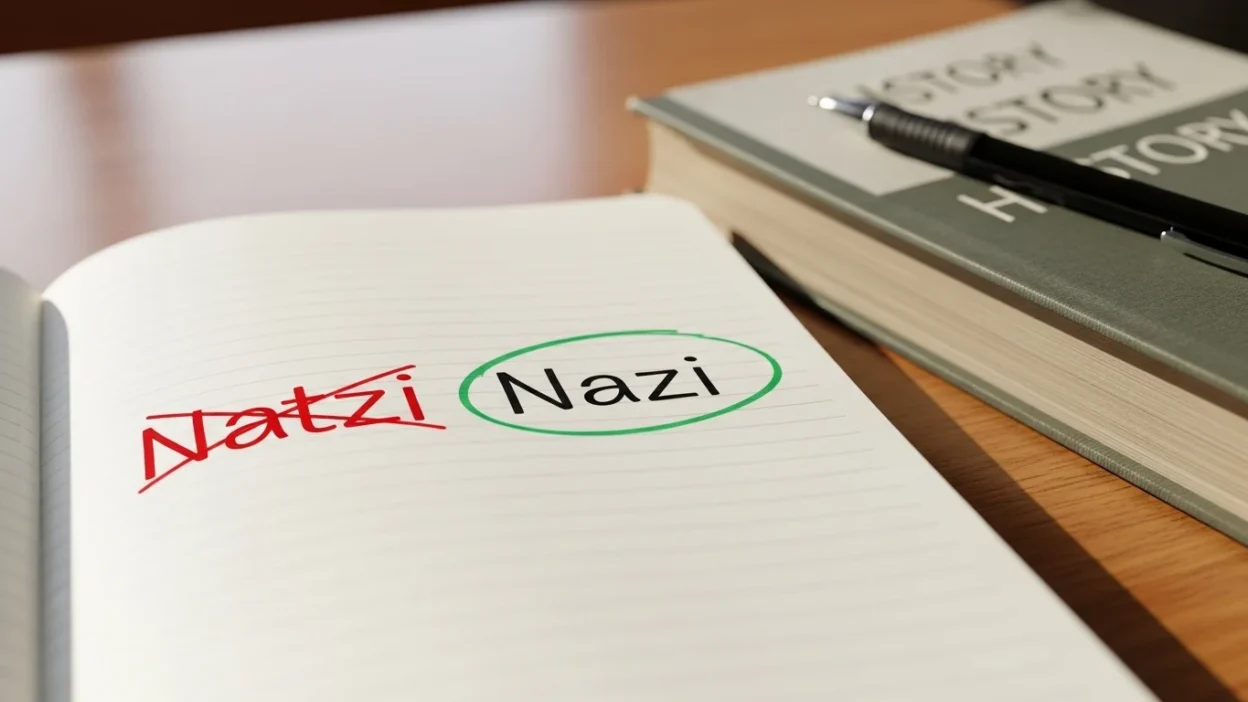
Many people feel confused about natzi vs nazi.
Both words look very similar. When people type quickly or hear the word in conversation, they sometimes spell it incorrectly.
However, there is an important difference. Only one of these words is correct in English and in history.
Because the topic is connected to world history, it is important to spell the word correctly and understand what it means.
This guide explains everything in very simple English, so students and beginners can understand it easily.
Quick Answer
- Nazi ✅ is the correct spelling.
- Natzi ❌ is incorrect.
- “Natzi” is only a spelling mistake.
- The correct word is Nazi, which refers to a political group in German history.
Simple rule:
Always write Nazi, never natzi.
Simple Origin and Background
The word Nazi comes from German history.
It is a short form of the German name:
National Socialist German Workers’ Party
In German, the party was called:
Nationalsozialistische Deutsche Arbeiterpartei
Because the full name was very long, people started using the short name Nazi.
This political party became powerful in Germany in the 1930s under the leadership of Adolf Hitler.
The Nazi government ruled Germany from 1933 to 1945.
During this time, the government started World War II, which caused great destruction across Europe and the world.
Because of this history, the word Nazi is connected to a very serious and important time in history.
Clear Explanation of the Difference
Let’s clearly explain each word.
What is “Nazi”?
Nazi is a real historical word.
It refers to:
- A member of the Nazi Party in Germany
- A supporter of the political ideas of that group
- Something connected to that government during the 1930s and 1940s
Examples:
- Nazi soldiers
- Nazi government
- Nazi ideology
The word is always written with a capital letter because it is a proper noun.
What is “Natzi”?
Natzi is not a real word.
It is simply a spelling mistake.
People sometimes add the letter t by accident when typing or writing.
However:
- It is not correct English.
- It does not appear in history books.
- It should never be used in formal writing.
So remember:
Nazi = correct
Natzi = incorrect
Comparison Table
| Word | Correct? | Meaning | Should You Use It? |
|---|---|---|---|
| Nazi | ✅ Yes | Member or supporter of the Nazi Party in Germany | Yes |
| Natzi | ❌ No | No real meaning | No |
This makes the difference very easy to understand.
Which One to Use and When
You should use Nazi when talking about history, especially events related to Germany in the 1930s and 1940s.
Examples:
- Nazi Germany
- Nazi leaders
- Nazi policies
This word often appears in lessons about:
- European history
- World War II
- The history of Germany
Never use natzi in any situation.
It is simply a spelling error.
Common Mistakes People Make
Here are some common mistakes people make with this word.
1. Adding an extra letter
Many people accidentally type:
natzi
instead of
nazi
This usually happens during fast typing.
2. Not capitalizing the word
Because “Nazi” refers to a specific political group, it should start with a capital letter.
Wrong:
- nazi soldiers
Correct:
- Nazi soldiers
3. Not understanding the history
Some learners think the word is just another regular word.
But it actually refers to a specific historical movement in Germany.
Because of this, it should be used carefully and correctly.
Everyday Real Life Examples
Let’s look at how the word appears in real life.
In History Books
Correct:
- The Nazi government controlled Germany during World War II.
Wrong:
- The Natzi government controlled Germany.
In School Assignments
Correct:
- Students study how the Nazis rose to power in Germany.
Wrong:
- Students study how the Natzis rose to power.
In News Articles
Correct:
- The museum shows objects from the Nazi period.
Wrong:
- The museum shows objects from the Natzi period.
On Social Media
Correct:
- I watched a documentary about Nazi Germany.
Wrong:
- I watched a documentary about Natzi Germany.
Correct spelling helps people understand the topic clearly.
Learning Section for Students and Beginners
Here are some simple ways to remember the correct spelling.
Memory Trick
Think about the word:
Na + zi
Only four letters.
N-A-Z-I
There is no letter T in the word.
So if you see:
natzi
you immediately know it is wrong.
Simple Practice
Choose the correct spelling.
- ______ Germany ruled during World War II.
- The museum explains the rise of the ______ party.
- Students learned about ______ history.
Answers:
- Nazi
- Nazi
- Nazi
Quick Writing Tip
If you are not sure about the spelling:
Write the four letters slowly:
N → A → Z → I
That is the correct form.
FAQ
1. Is “natzi” a real word?
No. It is only a spelling mistake.
2. What does “Nazi” mean?
It refers to a member or supporter of the Nazi Party in Germany during the 1930s and 1940s.
3. Why is the word “Nazi” important in history?
It is connected to the government in Germany that led the country during World War II.
4. Should “Nazi” be capitalized?
Yes. It should always start with a capital letter.
5. Why do people write “natzi”?
Usually because of typing mistakes or because they do not know the correct spelling.
6. How many letters are in “Nazi”?
Four letters: N-A-Z-I.
7. Is the word still used today?
Yes. It is used in history lessons, books, documentaries, and discussions about World War II.
8. What country was connected to the Nazis?
The movement started in Germany.
Conclusion
The confusion between natzi vs nazi is simple to solve.
Only one spelling is correct.
- Nazi ✅ is the real historical word.
- Natzi ❌ is just a spelling mistake.
The word Nazi refers to a political group that ruled Germany during the time of World War II.
Because it is an important historical term, it should always be spelled correctly and written with a capital letter.
If you remember the simple four-letter spelling N-A-Z-I, you will never make this mistake again.
Now the confusion between natzi vs nazi is completely clear.