Many English learners and even native speakers get confused between “panic” and “panick.” At first glance, both words look almost the same. The only difference is one extra letter “k.”
Because English spelling sometimes changes when words form new versions, people often think “panick” might be another correct form.
But this small spelling change creates a lot of confusion.
Students writing essays, people posting on social media, or someone typing a quick message may accidentally write “panick.” It may look correct, but in standard English, the situation is much simpler.
In this guide, you will clearly learn:
- Which spelling is correct
- Why the confusion happens
- When to use the word correctly
- Common mistakes to avoid
By the end, you will never be confused between panic vs panick again.
Quick Answer
Here is the simple truth:
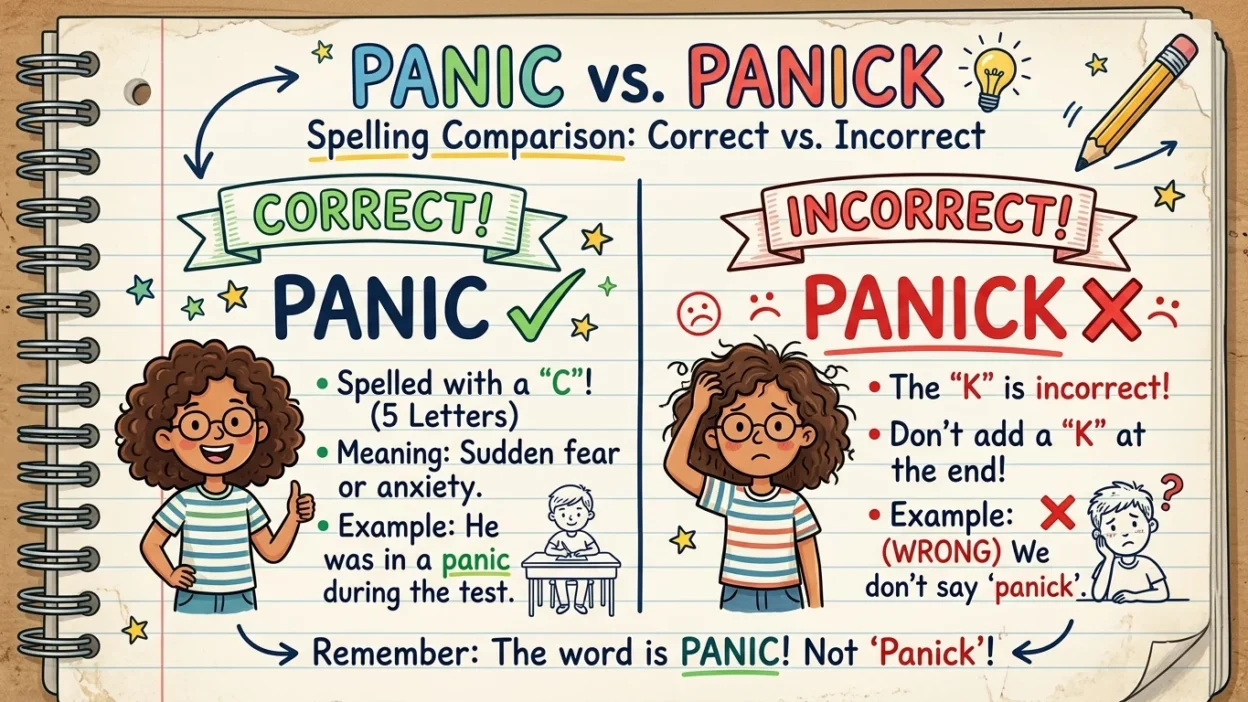
- Panic ✅ Correct spelling
- Panick ❌ Incorrect spelling in modern English
Key points:
- Panic is the only correct base word.
- It can be used as a noun or a verb.
- Panick is a misspelling and should not be used.
- Some forms of the word may add “k” (like panicked or panicking), which is where the confusion starts.
So remember:
Use “panic.” Never write “panick.”
Simple Background of the Word
The word panic has a long history.
It comes from the Greek word “panikos.” This word was related to sudden fear or terror. In ancient stories, people believed that a god named Pan could create sudden fear in crowds or travelers.
Over time, the word entered English and became panic, meaning:
a sudden strong feeling of fear that spreads quickly.
For example:
- People may panic during an emergency.
- A crowd may feel panic during danger.
English kept the spelling panic, and it has stayed the same for hundreds of years.
The spelling panick never became part of standard English.
The Real Difference Between Panic and Panick
The difference is actually very simple.
Panic
Panic is a real English word.
It can work in two ways:
1. As a noun (a thing)
It describes a feeling of sudden fear.
Example:
- There was panic in the crowd.
2. As a verb (an action)
It means to suddenly feel strong fear.
Example:
- She began to panic during the storm.
Panick
Panick is not a correct spelling.
It sometimes appears because people think the word should follow spelling rules that add k at the end.
But English dictionaries do not accept panick as a standard word.
So whenever you write it, you should change it to panic.
Comparison Table
| Feature | Panic | Panick |
|---|---|---|
| Correct spelling | Yes | No |
| Used in modern English | Yes | No |
| Found in dictionaries | Yes | No |
| Used as noun | Yes | No |
| Used as verb | Yes | No |
| Recommended in writing | Yes | Never |
The table makes it clear:
Panic is correct. Panick is incorrect.
Which One Should You Use and When?
You should always use panic.
Here are the common situations where the word appears.
When describing fear
Example:
- The loud noise caused panic.
When talking about someone becoming afraid
Example:
- Do not panic during the exam.
When describing a public reaction
Example:
- The news created panic in the city.
When giving advice
Example:
- Stay calm and do not panic.
In every case, the correct spelling stays panic.
Why People Accidentally Write “Panick”
The confusion usually happens because of spelling changes in verb forms.
When English adds endings like ed or ing, sometimes a k appears.
For example:
- panic panicked
- panic panicking
Notice something important.
The k appears before the ending, not in the base word.
Correct forms:
- panic
- panicked
- panicking
Because people see panicked, they sometimes think the base word must be panick, but that is not true.
The correct base word is still panic.
Common Mistakes People Make
Here are some mistakes learners often make.
Mistake 1: Adding an extra “k”
Incorrect:
- I started to panick.
Correct:
- I started to panic.
Mistake 2: Confusing the base word with verb forms
Incorrect:
- She felt panick during the meeting.
Correct:
- She felt panic during the meeting.
Mistake 3: Thinking both spellings are acceptable
Some learners believe both forms are correct.
But standard English accepts only panic.
Mistake 4: Typing quickly
Sometimes the mistake happens simply because of fast typing.
Always check your spelling if you are unsure.
Everyday Real Life Examples
Here are examples of how panic appears in daily life.
In emails
- Please do not panic. We will solve the problem soon.
- There is no need to panic about the deadline.
In news
- The sudden earthquake caused panic in the town.
- Officials asked people not to panic.
On social media
- Everyone started to panic when the website stopped working.
- Do not panic, the game update is coming soon.
In school
- Many students panic before exams.
- Try to stay calm and avoid panic.
In daily conversations
- I thought I lost my phone and started to panic.
- The loud alarm created panic in the building.
In all of these examples, the spelling remains panic.
A Short Learning Section for Students
If you are learning English, here is a simple way to remember the rule.
Memory tip
Think of this sentence:
“Do not panic.”
You will see this sentence often in English books and conversations.
Notice that the word ends with C, not CK.
Simple practice
Fill in the blank:
- Do not during the test.
- The loud noise caused in the crowd.
- Many people during emergencies.
Answers:
- panic
- panic
- panic
This small exercise helps your brain remember the correct spelling.
FAQ
1. Is “panick” a real English word?
No. Panick is not a correct spelling in modern English.
2. Why do some people write “panick”?
They see words like panicked and think the base word must have k, which is incorrect.
3. Is “panic” a noun or a verb?
It can be both.
Examples:
- Noun: There was panic in the crowd.
- Verb: People began to panic.
4. Why does “panicked” have a k?
The k helps keep the correct pronunciation when adding -ed or -ing.
Example:
- panic panicked
- panic panicking
5. Is “panicing” correct?
No.
Correct spelling:
panicking
The k must appear before -ing.
6. Should I ever use “panick” in formal writing?
No. Always use panic.
7. Do dictionaries include “panick”?
Standard dictionaries list panic, not panick.
8. How can I remember the correct spelling?
Just remember the common phrase:
“Don’t panic.”
It will help you remember the correct form.
Conclusion
The difference between panic and panick is very simple.
- Panic is the correct and accepted English word.
- Panick is a spelling mistake and should not be used.
The confusion usually happens because other forms like panicked and panicking include the letter k, but the base word itself remains panic.
To avoid mistakes:
- Always write panic when using the base word.
- Remember that panick is incorrect.
- Think of the phrase “Don’t panic.”
Once you remember this small rule, you will never mix up these spellings again.
Clear spelling helps your writing look more confident, accurate, and professional.

Weston Maddox is both an author and administrator at SpellCorrect. He oversees site operations while creating accurate, easy-to-understand content focused on correct spelling and proper word usage, helping readers improve writing clarity, precision, and confidence across academic, professional, and everyday English communication.