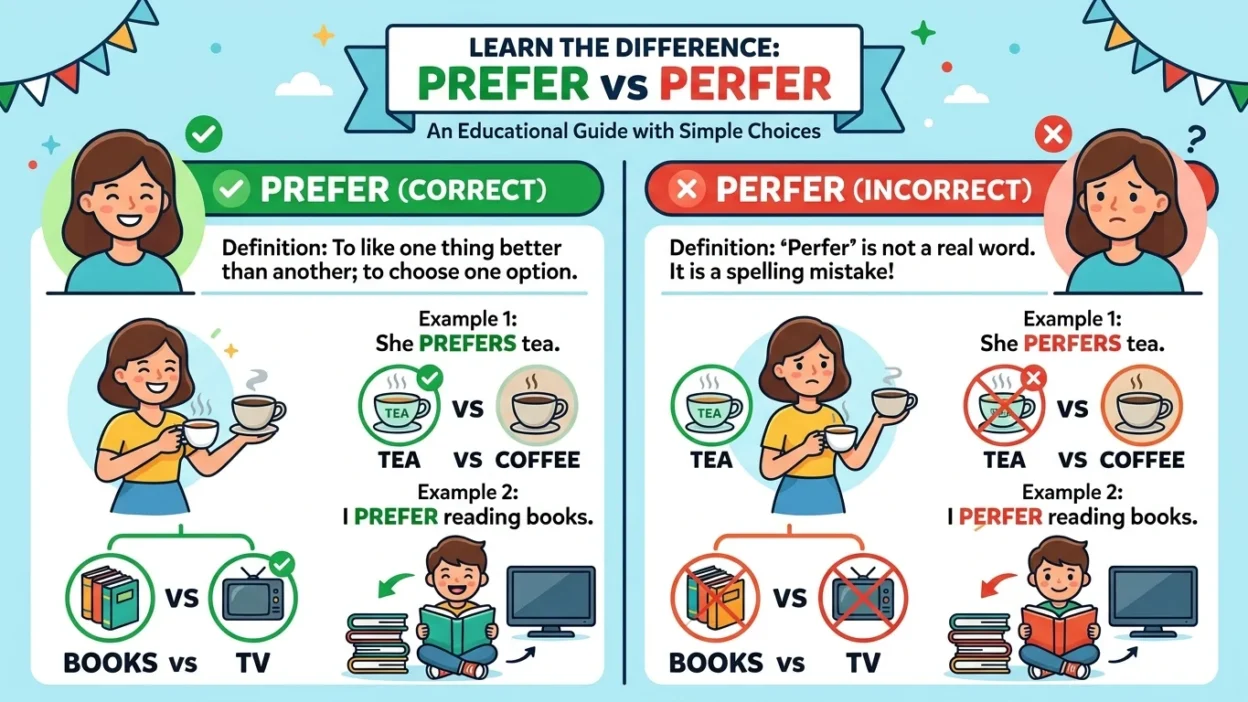
Many learners feel confused between “perfer” and “prefer.” The words look very similar, and when spoken quickly, they can sound almost the same. Because of this, it is easy to mix them up while writing.
This is a very common spelling mistake, especially for students and beginners. The good news is that the rule is simple. Once you understand it, you will not make this mistake again.
Quick Answer
- “Prefer” is correct.
- “Perfer” is incorrect.
- Always use “prefer.”
👉 Simple rule: Use “prefer,” never “perfer.”
Simple Origin or Background
The word “prefer” comes from Latin and means “to like something more than another thing.”
It has been used in English for a long time and follows standard spelling rules.
The spelling “perfer” is just a common mistake where the letters are placed in the wrong order.
Clear Explanation of the Difference
Here is the key idea:
👉 There is no real difference—because “perfer” is not a correct word.
What does “prefer” mean?
“Prefer” means:
- To like one thing more than another
- To choose something over something else
Examples:
- I prefer tea over coffee.
- She prefers reading to watching TV.
What about “perfer”?
- It is a wrong spelling
- It has no meaning in correct English
- It should never be used
Comparison Table
| Feature | Perfer | Prefer |
|---|---|---|
| Correct spelling | ❌ No | ✅ Yes |
| Meaning | None | Like something more |
| Usage | Incorrect | Correct and common |
| Found in dictionary | ❌ No | ✅ Yes |
| Recommended use | Never use | Always use |
Which One to Use and When
👉 Always use “prefer.”
Use “prefer” when you want to:
- Show a choice
- Compare two things
- Express what you like more
Examples:
- I prefer coffee.
- Do you prefer tea or juice?
- They prefer quiet places.
👉 Never use “perfer.”
Common Mistakes People Make
Mixing the letters
❌ perfer
✔ prefer
Spelling based on sound
The word may sound confusing when spoken fast.
Typing quickly
This mistake often happens while typing.
Not remembering the correct order
The letters must be in the correct order: pre-fer, not per-fer.
👉 Tip: Break the word into parts: pre + fer.
Everyday Real-Life Examples
In conversations
- I prefer coffee.
- Do you prefer tea?
In school
- Students prefer simple lessons.
- I prefer studying in the morning.
In daily life
- She prefers walking to driving.
- We prefer healthy food.
In emails
- I would prefer a meeting tomorrow.
- I prefer to discuss this later.
On social media
- “I prefer this style!”
- “Which one do you prefer?”
👉 In all these examples, “perfer” would be incorrect.
Short Learning Section for Students and Beginners
Step 1: Learn the correct word
👉 Prefer
Step 2: Understand the meaning
Prefer = like more
Step 3: Avoid the mistake
❌ Perfer
✔ Prefer
Easy memory tip
👉 “Prefer starts with ‘pre’ (like pre-test).”
Practice
Fill in the blanks:
- I ______ tea over coffee.
- She ______ reading books.
✔ Answers:
- prefer
- prefers
FAQ Section
Is “perfer” a real word?
No, it is not correct.
Is “prefer” correct?
Yes, it is the correct spelling.
What does “prefer” mean?
It means to like something more than another thing.
Why do people write “perfer”?
Because of spelling confusion or typing mistakes.
Is “prefer” commonly used?
Yes, it is very common in daily English.
How can I remember it?
Remember: “Prefer starts with pre.”
Can I use “perfer” in informal writing?
No, it should always be avoided.
Is this important for exams?
Yes, correct spelling matters in writing.
Conclusion
The difference between “perfer” and “prefer” is very simple. “Prefer” is correct, and “perfer” is a spelling mistake.
Even though they may sound similar, only “prefer” is accepted in proper English.
👉 If you remember one rule, remember this: Always use “prefer” with the correct letter order.