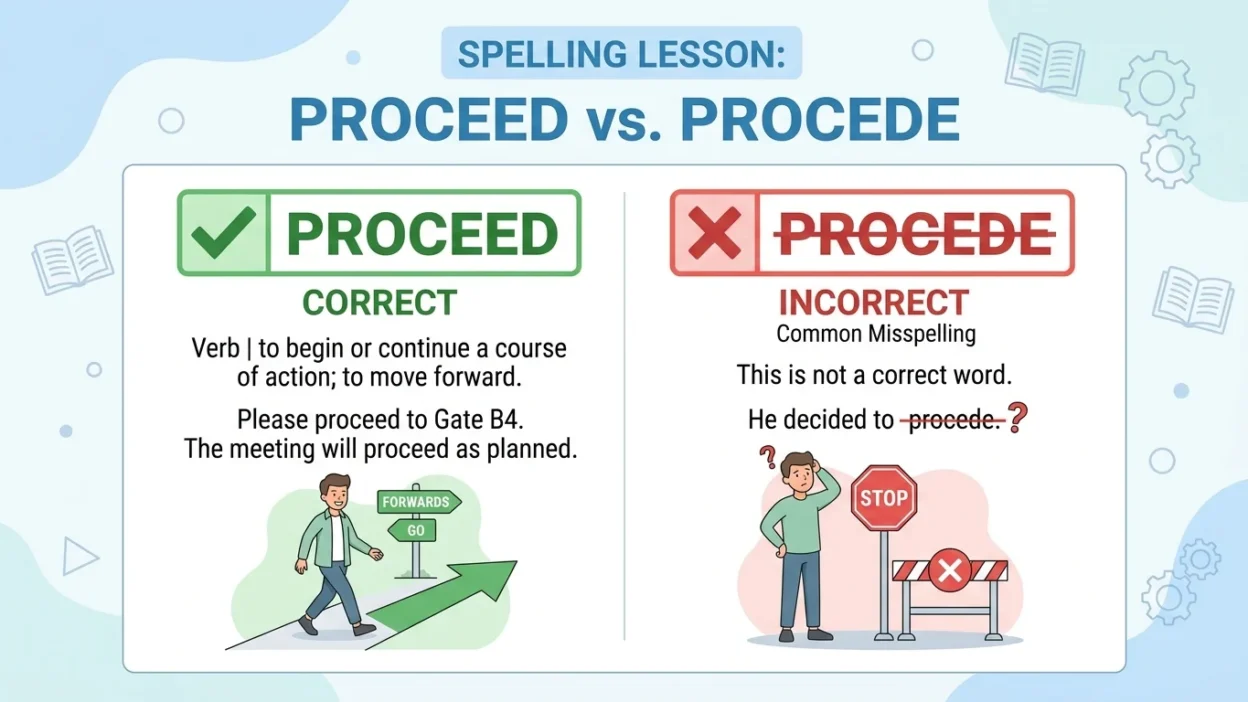
Many students and English learners feel unsure when writing the word “proceed.” They sometimes spell it as “procede” because both versions sound almost the same when spoken.
This confusion usually happens because English spelling does not always match pronunciation. When people hear the word pro-seed, they may guess the spelling and remove one letter “e.” As a result, they write procede instead of proceed.
Because of this, learners often ask simple questions such as:
- Is proceed correct?
- Is procede also a real word?
- Which spelling should I use?
In this article, everything will be explained in very simple English so students, beginners, and general readers can clearly understand the difference.
Quick Answer
Here is the simple and clear answer:
- Proceed is the correct spelling.
- Procede is not correct in standard English.
- Dictionaries and professional writing always use proceed.
- Procede is usually just a spelling mistake.
So whenever you want to use this word, the correct choice is always proceed.
Simple Background of the Word
The word proceed has been used in English for many centuries. It originally came from older French and Latin words that meant to move forward or continue.
Over time, the word entered English and kept the spelling proceed, which includes two “e” letters together.
The word proceed is usually used as a verb, and it means:
- to continue
- to move forward
- to start the next step
Examples:
- proceed with the meeting
- proceed carefully
- proceed to the next step
Because this spelling has been used for a long time in books, dictionaries, and official writing, proceed became the standard form.
Clear Explanation of the Difference
Now let’s look clearly at the two spellings.
Proceed
Proceed is the correct and accepted word.
It is a verb that means:
- to continue doing something
- to move forward
- to go to the next step
Examples:
- The meeting will proceed as planned.
- Please proceed to the next page.
- After the introduction, the speaker will proceed with the presentation.
This spelling appears in dictionaries, books, business writing, and everyday communication.
Procede
Procede is not the correct spelling in English.
People usually write procede because they forget the second “e.” Since the word sounds like pro-seed, they may think only one “e” is needed.
However, the correct spelling includes double “e”:
proceed
So when writing this word, procede should not be used.
Comparison Table
| Feature | Proceed | Procede |
|---|---|---|
| Correct spelling | Yes | No |
| Found in dictionaries | Yes | No |
| Used in formal writing | Yes | No |
| Common spelling mistake | No | Yes |
| Recommended spelling | Yes | No |
This table clearly shows that proceed is the correct spelling.
Which One to Use and When
You should always use proceed when talking about continuing something or moving forward.
Here are common situations where the word is used.
Meetings
Example:
“The meeting will proceed after the break.”
Instructions
Example:
“Please proceed to the checkout counter.”
Presentations
Example:
“The speaker will now proceed with the final topic.”
Processes
Example:
“Once the form is complete, we can proceed with the application.”
In all these situations, the correct spelling is proceed.
Common Mistakes People Make
Many learners make small spelling mistakes with this word. Let’s look at the most common ones.
Dropping the Second “E”
Incorrect:
“Please procede to the next step.”
Correct:
“Please proceed to the next step.”
The correct spelling has two “e” letters together.
Guessing the Spelling From Sound
Because the word sounds like pro-seed, some writers guess the spelling and remove a letter.
However, the correct spelling remains proceed.
Typing Quickly
Sometimes people type fast and accidentally leave out a letter.
Incorrect:
“We will procede with the plan.”
Correct:
“We will proceed with the plan.”
Everyday Real-Life Examples
Here are examples of how the word proceed is used in daily communication.
Example in an Email
“Once we receive your approval, we will proceed with the project.”
Example in School
“After reading the instructions, students may proceed with the test.”
Example in Business
“The company decided to proceed with the new plan.”
Example on Social Media
“If everything goes well, we will proceed with the event next week.”
Example in Conversation
Person A:
“Are we ready to start?”
Person B:
“Yes, we can proceed.”
These examples show how commonly the word proceed appears in everyday English.
Learning Tips for Students and Beginners
Here are two easy tricks to remember the correct spelling.
Remember the Double “E”
The word proceed has two “e” letters together.
You can remember it like this:
pro + ceed
Thinking of the double ee sound can help you remember the spelling.
Think of the Word “Proceeding”
Related words keep the same spelling pattern.
Examples:
- proceed
- proceeding
- proceedings
Seeing these related forms can help you remember the correct spelling.
(FAQ)
Is procede a real English word?
No. Procede is not the correct spelling in English. It is usually a spelling mistake.
What is the correct spelling?
The correct spelling is proceed.
What does proceed mean?
Proceed means to continue, move forward, or go to the next step.
Why do people write procede?
Many people remove one “e” because they spell the word based on its sound.
Is proceed a verb or noun?
Proceed is a verb.
Example:
“Please proceed with the instructions.”
What is the noun form of proceed?
A related noun is proceeding or proceedings.
Example:
“The court proceedings lasted several hours.”
Is proceed used in formal writing?
Yes. Proceed is commonly used in business, education, and official communication.
Can proceed be used in instructions?
Yes.
Example:
“Click the button to proceed.”
Conclusion
The difference between proceed and procede is very simple.
Proceed is the correct spelling and is used when talking about continuing something, moving forward, or starting the next step.
Procede, on the other hand, is a spelling mistake that happens when someone forgets the second “e.”
To avoid confusion, remember this simple rule:
Always write proceed with two “e” letters together.
Once you remember this pattern, spelling the word correctly becomes much easier.
English spelling can sometimes feel confusing, but learning small differences like this can greatly improve writing accuracy and confidence.