Many English learners feel confused when they see the words “reinforce” and “reenforce.” Both spellings look very similar, and when spoken, they sound almost the same. Because of this, some people are unsure which spelling is correct.
This confusion often happens because the word contains the prefix “re.” In English, the prefix re- usually means again or back. When people see or hear the word, they sometimes think it should be written as reenforce.
However, English spelling does not follow that pattern in this case. Only one spelling is correct in modern English.
In this article, everything will be explained in very simple English so students, beginners, and general readers can clearly understand the difference.
Quick Answer
Here is the simple answer:
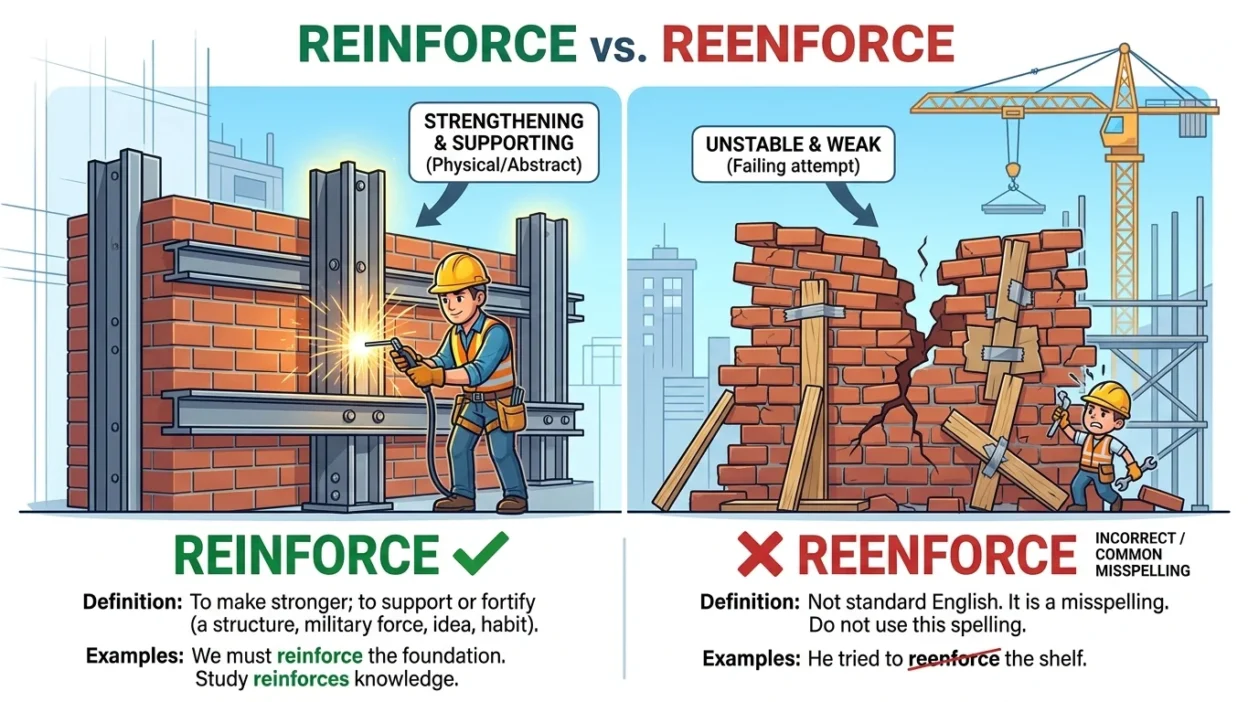
- Reinforce is the correct spelling.
- Reenforce is not the standard spelling today.
- Dictionaries and modern writing use reinforce.
- Reenforce is usually considered a spelling mistake or outdated form.
So whenever you write this word, you should always choose reinforce.
Simple Background of the Word
The word reinforce comes from older French words that meant to make something stronger.
The word is made from two parts:
- re- (again or back)
- enforce (to make stronger or apply force)
Over time, English combined these parts into the word reinforce, which means to strengthen something or make it stronger.
Examples:
- reinforce a building
- reinforce a wall
- reinforce an idea
Because this spelling became widely used in books, education, and communication, reinforce became the standard form.
Clear Explanation of the Difference
Now let’s look clearly at both spellings.
Reinforce
Reinforce is the correct and commonly used word.
It is a verb, and it means:
- to make something stronger
- to add extra support
- to strengthen an idea or message
Examples:
- Workers reinforced the bridge.
- The teacher reinforced the lesson with examples.
- Steel bars reinforce the concrete.
This spelling appears in dictionaries, books, newspapers, and professional writing.
Reenforce
Reenforce is not the modern standard spelling.
Some older texts used reenforce many years ago, but today it is rarely used. In most modern writing, it is considered incorrect or outdated.
Most people who write reenforce simply believe the word should start with re + enforce, so they add another e.
However, the accepted spelling today is reinforce.
Comparison Table
| Feature | Reinforce | Reenforce |
|---|---|---|
| Correct modern spelling | Yes | No |
| Found in dictionaries | Yes | Rarely |
| Used in modern writing | Yes | Very uncommon |
| Considered standard | Yes | No |
| Recommended to use | Yes | No |
This table clearly shows that reinforce is the correct spelling.
Which One to Use and When
You should always use reinforce when you want to talk about making something stronger.
Here are common situations where the word is used.
Construction
Example:
“Engineers reinforced the bridge with steel.”
Learning and Education
Example:
“The teacher used examples to reinforce the lesson.”
Ideas and Messages
Example:
“The campaign helped reinforce the importance of safety.”
Structures and Materials
Example:
“Steel rods reinforce the concrete walls.”
In all these situations, the correct spelling is reinforce.
Common Mistakes People Make
Many learners make similar mistakes with this word.
Adding an Extra “E”
Incorrect:
“We need to reenforce the building.”
Correct:
“We need to reinforce the building.”
Thinking the Word Is “Re + Enforce”
Some people think the word should follow this pattern:
re + enforce = reenforce
However, English uses the spelling reinforce instead.
Copying Rare or Outdated Spellings
Sometimes older texts may contain the spelling reenforce, but modern English uses reinforce.
Always use the modern spelling in school, work, and writing.
Everyday Real-Life Examples
Let’s look at how reinforce appears in daily communication.
Example in an Email
“We need to reinforce the safety rules in the workplace.”
Example in School
“Teachers often repeat ideas to reinforce learning.”
Example in News
“Workers reinforced the damaged bridge after the storm.”
Example on Social Media
“This video helps reinforce the importance of kindness.”
Example in Conversation
Person A:
“The wall looks weak.”
Person B:
“Yes, we should reinforce it.”
These examples show how commonly the word reinforce is used.
Learning Tips for Students and Beginners
Here are two simple tricks to remember the correct spelling.
Remember the “Rein” Pattern
The word begins with rein, not reen.
reinforce ✔
reenforce ❌
Think of the Meaning
The word reinforce means to make something stronger.
Remembering the meaning can help you remember the spelling.
(FAQ)
Is reenforce a real word?
Reenforce appeared in some older English texts, but today it is not the standard spelling.
What is the correct spelling?
The correct modern spelling is reinforce.
What does reinforce mean?
Reinforce means to make something stronger or give additional support.
Why do people write reenforce?
Many people think the word is formed from re + enforce, so they add another e.
Is reinforce used in construction?
Yes.
Example:
“Builders reinforced the wall with steel.”
Can reinforce describe ideas?
Yes.
Example:
“Examples help reinforce learning.”
Is reinforce used in formal writing?
Yes. It is common in academic, professional, and everyday writing.
What is the past tense of reinforce?
The past tense is reinforced.
Example:
“The team reinforced the structure yesterday.”
Conclusion
The difference between reinforce and reenforce is simple.
Reinforce is the correct and standard spelling used in modern English. It means to make something stronger or add support.
Reenforce, on the other hand, is an outdated or incorrect spelling that is rarely used today.
To avoid confusion, remember this simple rule:
Always spell the word reinforce, not reenforce.
Once you remember this pattern, you will be able to write the word correctly and confidently in everyday English.

Weston Maddox is both an author and administrator at SpellCorrect. He oversees site operations while creating accurate, easy-to-understand content focused on correct spelling and proper word usage, helping readers improve writing clarity, precision, and confidence across academic, professional, and everyday English communication.