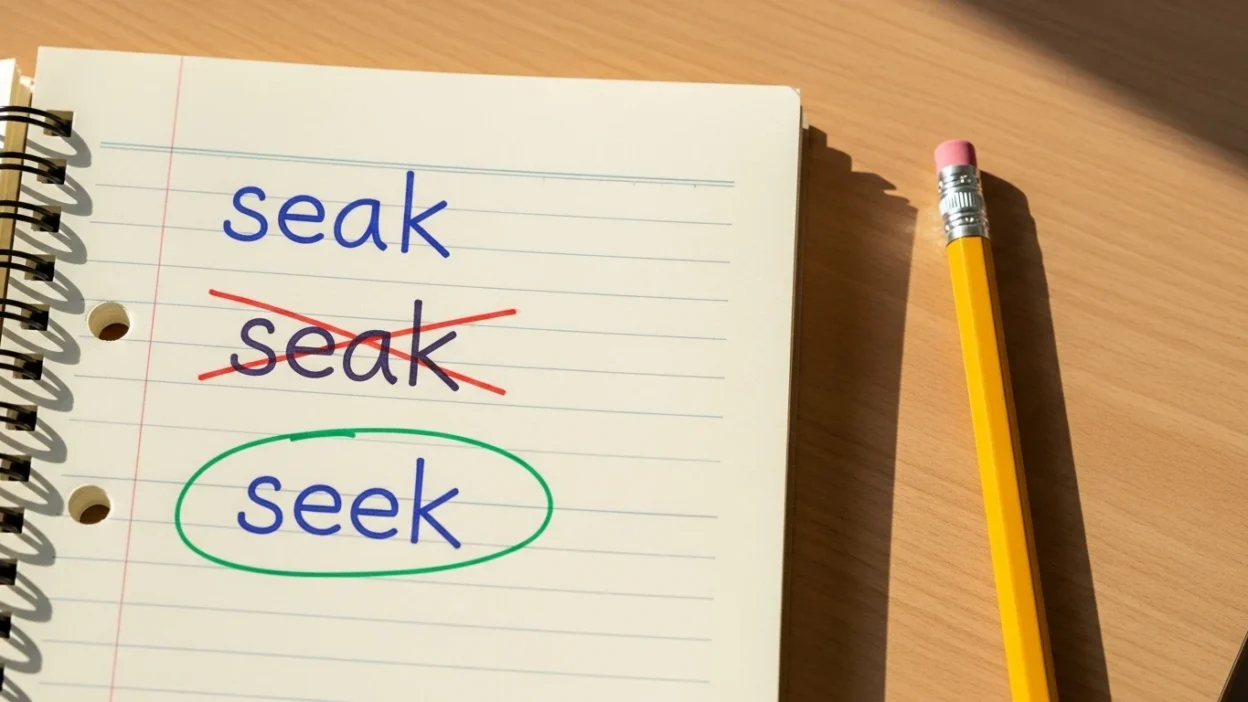
Many students and English learners feel confused about seak vs seek. The two words look very similar, and when people type quickly, they may accidentally write the wrong one. Because of this small spelling change, readers may not understand the sentence clearly.
The truth is very simple: only one of these spellings is correct in standard English. Once you understand this clearly, you will not make this mistake again.
This guide explains the difference in very easy English so anyone can understand it quickly.
Quick Answer
- Seek ✅ is the correct English word.
- Seak ❌ is a spelling mistake.
- “Seek” means to try to find something or ask for something.
- “Seak” has no meaning in English.
- Always use seek in writing, school work, emails, and daily communication.
Simple Origin and Background
The word seek is an old English word that has existed for many hundreds of years. It originally came from an old form of English that meant to search for something or to try to find something.
Over time, the word stayed almost the same. People still use seek today when they want to talk about searching, asking, or trying to get something.
Examples of how the word developed:
- seek help
- seek advice
- seek information
- seek answers
There has never been a correct English word spelled seak. It appears only when someone accidentally types the wrong letters.
Clear Explanation of the Difference
Understanding the difference between these two words is actually very easy.
What is “seek”?
Seek is a verb.
A verb is an action word.
The word seek means:
- to search for something
- to try to find something
- to ask for something
Examples:
- I seek knowledge.
- They seek better opportunities.
- She seeks advice from her teacher.
It often appears in formal or serious sentences, but it is still common in everyday English.
What is “seak”?
Seak is not a real English word.
It does not appear in dictionaries and has no meaning. When people write seak, they usually mean seek, but they accidentally type the wrong letter.
So the difference is simple:
- seek = correct word
- seak = spelling mistake
Comparison Table
| Word | Correct? | Meaning | Should You Use It? |
|---|---|---|---|
| Seek | ✅ Yes | To search for or try to find something | Yes |
| Seak | ❌ No | No meaning | No |
This table shows clearly that only seek should be used.
Which One to Use and When
Always use seek when you talk about searching or asking for something.
You can use it in many situations.
Seeking Information
- I seek more information about the course.
- The students seek answers to their questions.
Seeking Help
- Please seek help if you feel confused.
- Many people seek advice from doctors.
Seeking Opportunities
- She seeks a new job.
- They seek better education.
In all these examples, the correct spelling is seek.
Never use seak, because it is not a real word.
Common Mistakes People Make
Many learners make mistakes with this word. Let’s look at the most common ones.
1. Typing Too Fast
Sometimes people type quickly and press the wrong letter.
Wrong:
- I seak information.
Correct:
- I seek information.
2. Confusing the Vowel Sound
The sound in seek can make some learners think the spelling should be ea instead of ee.
But the correct spelling always uses ee.
3. Not Checking Spelling
Some people do not notice the mistake before sending a message or submitting school work.
A quick spelling check can fix this easily.
4. Copying Incorrect Writing
Sometimes learners see the wrong spelling online and copy it without realizing it is incorrect.
Always remember:
Seek = correct
Seak = incorrect
Everyday Real Life Examples
The word seek appears in many everyday situations. Here are some examples.
In Emails
Correct:
- I am writing to seek your advice.
- We seek more details about the project.
Incorrect:
- I am writing to seak your advice.
In School Writing
Correct:
- Students seek knowledge through education.
- Researchers seek answers to difficult questions.
Incorrect:
- Students seak knowledge.
On Social Media
Correct:
- Always seek the truth.
- Seek happiness in small things.
Incorrect:
- Always seak the truth.
In News or Public Messages
Correct:
- The company seeks skilled workers.
- Leaders seek solutions to problems.
Incorrect:
- The company seaks skilled workers.
Using the correct spelling helps your writing look more clear and professional.
Learning Section for Students and Beginners
Here are some simple tricks to help you remember the correct spelling.
Memory Trick
Think of this simple sentence:
We seek what we need.
Notice that seek and need both contain ee.
This can help you remember the spelling.
Another Helpful Idea
Many English words use ee to show a long “ee” sound.
Examples:
- see
- need
- keep
- meet
The word seek follows the same pattern.
Practice Exercise
Fill in the blank with the correct word.
- I ______ advice from my teacher.
- They ______ new opportunities.
- We ______ the truth.
Answers:
- seek
- seek
- seek
Practice like this helps you remember the correct spelling easily.
FAQ
1. Is “seak” ever correct?
No. “Seak” is always a spelling mistake.
2. What does “seek” mean?
It means to search for something or try to find something.
3. Is “seek” a verb or a noun?
“Seek” is a verb because it describes an action.
4. How do you spell the past form of “seek”?
The past form is sought.
Example:
- She sought help from her teacher.
5. Why do people write “seak”?
Usually because of typing mistakes or confusion with vowel sounds.
6. Can “seek” be used in everyday conversation?
Yes. It can be used in both formal and everyday situations.
7. What are some common phrases with “seek”?
Common examples include:
- seek help
- seek advice
- seek information
- seek justice
8. How can I remember the correct spelling?
Remember that seek uses ee, just like the words see and need.
Conclusion
The confusion between seak vs seek is very common, especially for students and English learners. However, the answer is very simple.
Only seek is the correct word. It means to search for something, try to find something, or ask for something.
The spelling seak is only a mistake and should never be used in correct English writing.
If you remember that the word seek follows the same spelling pattern as words like see and need, it becomes easy to remember.
From now on, whenever you want to talk about searching or asking for something, always write seek.
Your writing will look clearer, more accurate, and more confident.

Weston Maddox is both an author and administrator at SpellCorrect. He oversees site operations while creating accurate, easy-to-understand content focused on correct spelling and proper word usage, helping readers improve writing clarity, precision, and confidence across academic, professional, and everyday English communication.