
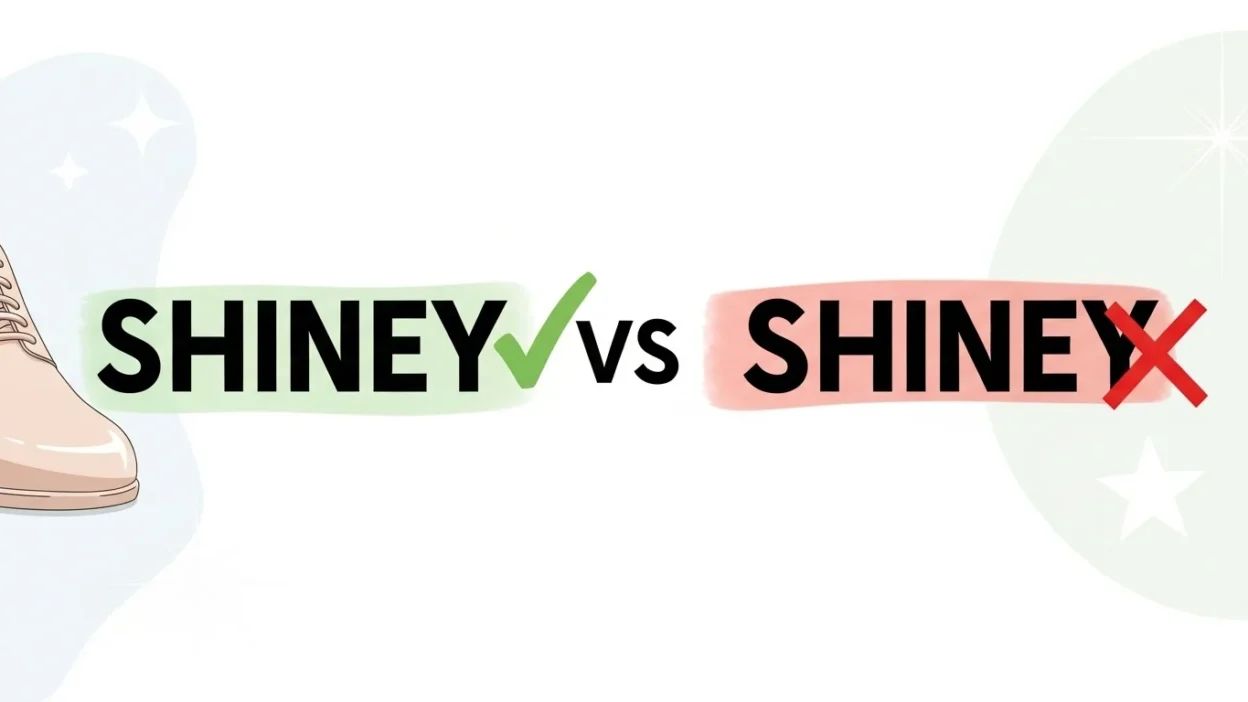
Many students and English learners feel confused about shiney vs shiny. The two words look very similar. The only difference is one extra letter “e.”
Because of this small difference, people often wonder:
- Is it spelled shiney or shiny?
- Why does it lose the “e”?
- Which one is correct in school writing?
This confusion is very common. English spelling rules can sometimes feel tricky. But don’t worry this topic is actually very simple. By the end of this article, you will clearly understand the difference and never feel unsure again.
Quick Answer
Here is the short and clear answer:
- ✅ Shiny = Correct spelling
- ❌ Shiney = Incorrect spelling
- “Shiny” describes something that reflects light
- “Shiney” is a spelling mistake
If you remember one thing, remember this:
The correct spelling is S-H-I-N-Y.
Simple Background: Where Does “Shiny” Come From?
The word shiny comes from the verb:
shine
The verb shine means:
- To give off light
- To reflect light
- To be bright
Examples:
- The sun shines.
- Her shoes shine.
- The stars shine at night.
When we turn “shine” into an adjective (a describing word), we add -y.
But before adding -y, we remove the silent “e.”
So:
shine shiny
noise noisy
taste tasty
This is a common spelling rule in English.
That is why we write shiny, not “shiney.”
Clear Explanation of the Difference
Let’s look at each word carefully.
What Is “Shiny”?
“Shiny” is a real English word.
It is an adjective.
It describes something that looks bright or reflects light.
Examples:
- She wore shiny shoes.
- The car looks shiny after washing.
- I found a shiny coin.
- The table has a shiny surface.
In all these sentences, “shiny” is correct.
What Is “Shiney”?
“Shiney” is not a correct English word.
It:
- Is not found in standard dictionaries
- Has no official meaning
- Is considered a spelling mistake
If you write “shiney” in:
- Exams
- Homework
- Professional emails
- Reports
It will be marked wrong.
There is no situation in standard English where “shiney” is correct.
Comparison Table
Here is a simple table to make everything clear:
| Feature | Shiny | Shiney |
|---|---|---|
| Correct spelling? | ✅ Yes | ❌ No |
| Real English word? | Yes | No |
| Meaning | Bright, reflecting light | No meaning |
| Used in formal writing? | Yes | No |
| Found in dictionary? | Yes | No |
Simple rule:
👉 Always use shiny.
👉 Never use shiney.
Why Do We Remove the “E”?
This is where many learners feel confused.
The base word is:
shine
When adding -y, English often removes the silent “e.”
For example:
- shine → shiny
- noise → noisy
- ice → icy
- spice → spicy
We do NOT keep the “e.”
So:
shine + y → shiny
Not:
shine + y → shiney ❌
This is a common spelling pattern in English.
Which One to Use and When
You should use shiny whenever you describe something that reflects light or looks bright.
Here are common situations:
1. Talking About Objects
- The floor is shiny.
- She has shiny hair.
- The necklace looks shiny.
2. Talking About Nature
- The river looked shiny in the sun.
- The stars were shiny at night.
3. Talking About New Items
- He bought shiny new shoes.
- The car looks shiny and clean.
In all these cases, the correct word is shiny.
Never write:
- ❌ The car is shiney.
- ❌ She has shiney hair.
Common Mistakes People Make
Let’s look at common mistakes.
Mistake 1: Keeping the Silent “E”
Wrong:
- The coin is shiney.
Correct:
- The coin is shiny.
Remember: remove the silent “e.”
Mistake 2: Spelling It the Way It Sounds
When we say “shiny,” it may sound like there is an “e” inside. But English spelling does not always match sound exactly.
Mistake 3: Typing Quickly
Sometimes “shiney” happens because of fast typing. Always check your spelling.
Mistake 4: Thinking All Words Keep Their Base Form
Some words do keep the base word:
- hope hopeful
- care careful
But many words remove the silent “e” before adding certain endings like “-y.”
Everyday Real Life Examples
Let’s see how “shiny” appears in daily life.
In Text Messages
- Your shoes look shiny!
- I love your shiny bag.
On Social Media
- Check out my shiny new phone.
- Look at this shiny sunset!
In School Writing
- The knight wore shiny armor.
- The lake had a shiny surface.
In News Articles
- The company launched a shiny new product.
- The building has shiny glass windows.
In professional writing, you will always see shiny, never “shiney.”
Short Learning Section for Students and Beginners
Here is a simple step-by-step guide.
Step 1: Remember the Base Word
The base word is:
shine
Step 2: Remove the Silent “E”
Before adding “-y,” remove the “e.”
shine → shiny
Step 3: Spell It Slowly
S – H – I – N – Y
No “e” after the “n.”
Easy Memory Trick
Think:
“Shine drops the ‘e’ to become shiny.”
Or remember these pairs:
- ice → icy
- spice → spicy
- noise → noisy
- shine → shiny
Same pattern.
Quick Practice
Fill in the blank:
- The star is very .
- She bought a dress.
- The shoes look after polishing.
Answers:
- shiny
- shiny
- shiny
Always remove the “e.”
(FAQ)
1. Is “shiney” ever correct?
No. “Shiney” is always incorrect in standard English.
2. Why does “shiny” not have an “e”?
Because when we add “-y” to “shine,” we remove the silent “e.”
3. Is “shiny” an adjective?
Yes. It describes something that reflects light or looks bright.
4. What is the verb form?
The verb is “shine.”
Example:
- The sun shines brightly.
5. What is the comparative form?
- shiny shinier
- shiny shiniest
Still no “e.”
6. Is this mistake common?
Yes. Many learners write “shiney” by mistake.
7. How can I remember the correct spelling?
Remember:
Shine loses the “e” before adding “y.”
Final Conclusion
The difference between shiney vs shiny is very simple:
- ✅ Shiny is correct.
- ❌ Shiney is incorrect.
“Shiny” comes from the word “shine.”
We remove the silent “e” and add “y.”
If you remember one clear rule, remember this:
Shine drops the “e” to become shiny.
Now you can write confidently and avoid this common spelling mistake in the future.