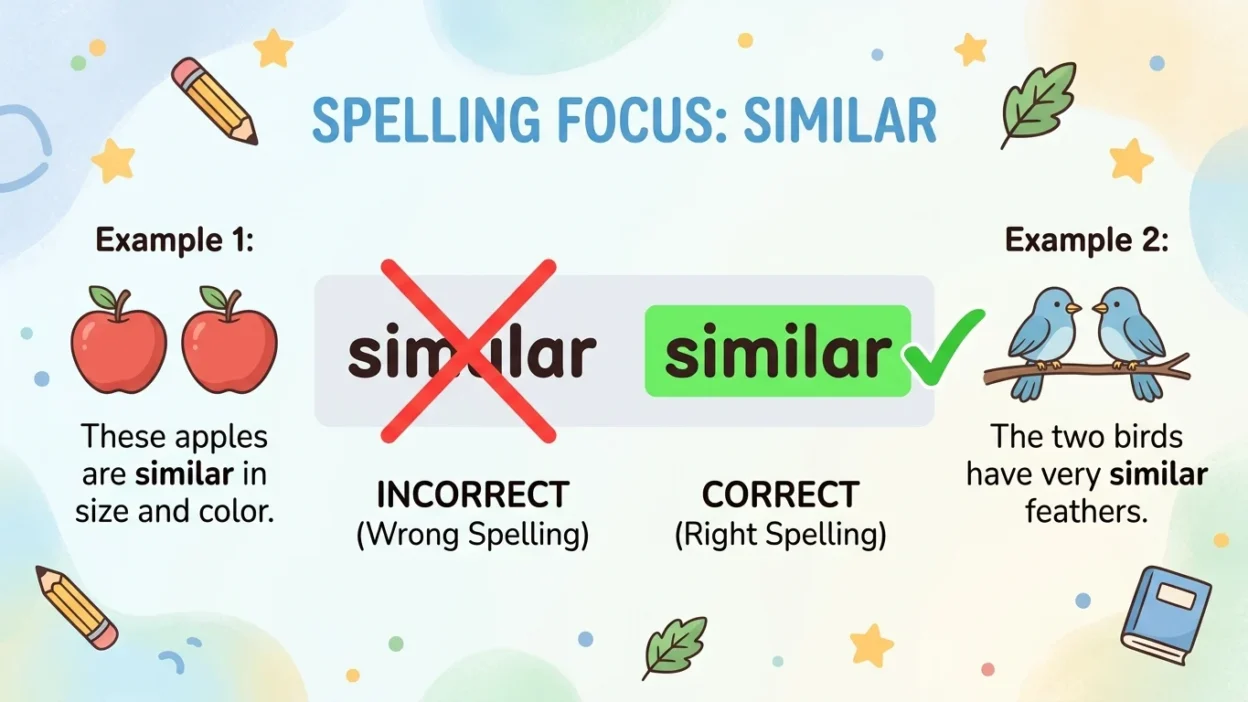
Many learners feel confused when they see the words “simular” and “similar.” They look almost the same. They sound close too. So it is easy to think both are correct.
But here is the truth: one is correct, and the other is not.
This confusion happens because English spelling is not always simple. Small letter changes can completely change whether a word is correct or wrong.
In this guide, you will learn the difference in a very clear and easy way. By the end, you will never mix them up again.
Quick Answer
- ✅ Similar = Correct word
- ❌ Simular = Incorrect spelling
- Use similar when you want to say “almost the same”
- Never use simular in writing
Simple Background Explanation
The word similar comes from an old Latin word “similis.” This word means “like” or “almost the same.”
Over time, this word came into English as similar.
The spelling has always included an “i” in the middle:
sim + i + lar = similar
The spelling “simular” is just a mistake. It likely happens because:
- People hear the word and guess the spelling
- The “i” sound is soft and not clear when spoken
- Some other English words use “u” in similar positions
But in standard English, “simular” is not a real word.
Clear Explanation of the Difference
Let’s make this very simple.
What is “Similar”?
Similar means:
- Almost the same
- Not exactly the same, but very close
Examples:
- These two shirts are similar in color.
- Your idea is similar to mine.
- The two cities are similar in size.
What is “Simular”?
Simular:
- ❌ Not a correct English word
- ❌ A spelling mistake of “similar”
If you use it in writing, it will be marked wrong.
Comparison Table
| Feature | Similar ✅ | Simular ❌ |
|---|---|---|
| Correct spelling | Yes | No |
| Meaning | Almost the same | No meaning |
| Used in English | Yes | No |
| Example sentence | “They look similar.” | Incorrect usage |
| Should you use it? | Yes | Never |
Which One to Use and When
Always use similar when you want to compare things.
Use “similar” when:
- Talking about things that look alike
- “The twins look very similar.”
- Talking about ideas or opinions
- “We have similar thoughts.”
- Talking about situations
- “I had a similar experience.”
Never use “simular”
Even in informal writing like:
- Text messages
- Social media
- Notes
You should still avoid simular.
Using the correct spelling helps you:
- Write clearly
- Avoid mistakes
- Sound more confident in English
Common Mistakes People Make
Here are some common errors learners make:
1. Writing what they hear
People often spell words based on sound:
- “simular” sounds close to “similar”
But English spelling is not always based on sound.
2. Mixing vowels (i and u)
Some learners confuse:
- i → u
So “similar” becomes “simular”
3. Typing too fast
Sometimes it is just a typing mistake:
- Pressing “u” instead of “i”
4. Not checking spelling
If you don’t check your writing, small mistakes stay.
Everyday Real Life Examples
Let’s see how similar is used in daily life.
In Emails
- “Your proposal is very similar to our previous plan.”
- “We noticed similar issues in the last report.”
In Social Media
- “This movie feels similar to the last one.”
- “Our styles are so similar!”
In School or Study
- “These questions are similar to the exam.”
- “This topic is similar to what we learned yesterday.”
In Daily Conversation
- “We have similar tastes in music.”
- “This place looks similar to my hometown.”
Incorrect Example (Avoid This)
- ❌ “This is simular to my idea.”
✔ Correct: “This is similar to my idea.”
Short Learning Section for Students and Beginners
Here is a simple way to remember:
Memory Trick
Think of this:
👉 Similar has “i” for “identical-like” (almost same)
Even if not exactly identical, it is close.
Practice Exercise
Choose the correct word:
- These two phones are very _______.
- My bag looks _______ to yours.
- This problem is _______ to the last one.
Answers:
- similar
- similar
- similar
Quick Tip
If you are unsure:
- Think: “Is this a real word?”
- If it is “simular,” change it to similar
FAQ
1. Is “simular” ever correct?
No. It is always a spelling mistake.
2. Why do people write “simular”?
Because it sounds similar to the correct word, and people guess the spelling.
3. What does “similar” mean in simple words?
It means “almost the same.”
4. Can I use “similar” in formal writing?
Yes. It is a common and correct word in all types of writing.
5. How can I remember the correct spelling?
Remember:
Similar = sim + i + lar (not u)
6. Is “similar” used in speaking and writing?
Yes. It is used in both daily speaking and formal writing.
7. What is a synonym of “similar”?
Some simple synonyms:
- alike
- close
- almost the same
8. Is this sentence correct: “They are very simular”?
No. Correct sentence:
“They are very similar.”
Conclusion
The difference between simular and similar is very simple:
- Similar is the correct word
- Simular is a mistake
Even though both may sound alike, only one belongs in proper English.
Always choose similar when you want to describe things that are almost the same.
With this clear understanding, you can now:
- Write correctly
- Avoid common mistakes
- Feel more confident in English