At first glance, “teams” and “teams” look exactly the same and that’s because they are the same word. This can confuse learners who expect a difference, especially when comparing similar looking words.
Sometimes, confusion happens not because of spelling, but because of how a word is used in a sentence. In this guide, we will clearly explain what “teams” means, how it is used, and why there is actually no difference at all.
Quick Answer
- “Teams” and “teams” are exactly the same word.
- There is no spelling difference.
- Any confusion is about usage, not spelling.
👉 Simple rule: “Teams” is always correct when used properly in a sentence.
Simple Origin or Background
The word “team” comes from Old English and originally meant a group working together. Over time, it became a very common word in English.
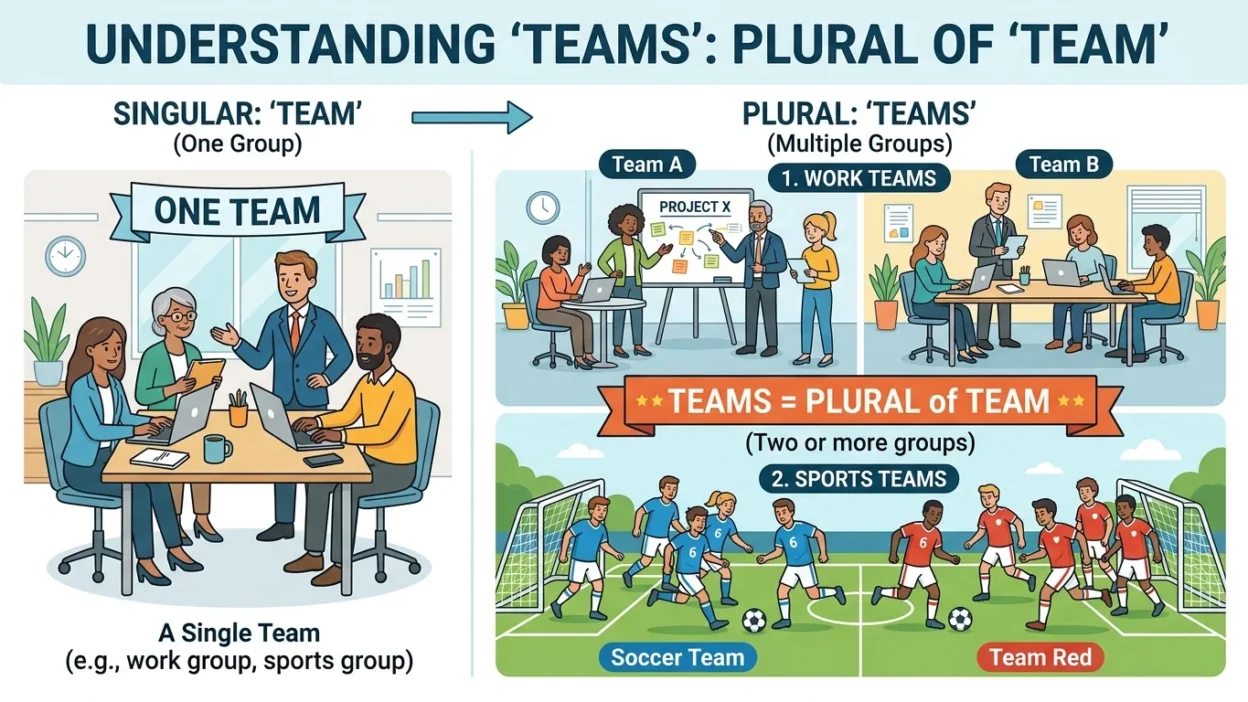
To make it plural, we simply add “-s”:
- team → teams
This follows a basic English rule for most nouns.
Clear Explanation of the Difference
Here is the key idea:
👉 There is no difference between “teams” and “teams.”
However, the word can be used in different ways depending on the sentence.
Meaning of “teams”
“Teams” means:
- More than one team
- Groups of people working together
Examples:
- Two teams are playing.
- The company has many teams.
Different uses in sentences
Even though the spelling is the same, the role can change:
- As a noun:
- The teams are ready.
- As part of a verb (rare informal use):
- They team up (not “teams” alone, but related idea)
Comparison Table
| Feature | Teams | Teams |
|---|---|---|
| Spelling | Same | Same |
| Meaning | Plural of team | Plural of team |
| Correct usage | ✅ Yes | ✅ Yes |
| Difference | None | None |
Which One to Use and When
👉 Always use “teams” when talking about more than one team.
Use “teams” when:
- Talking about sports
- Talking about work groups
- Talking about school or projects
Examples:
- The teams are playing football.
- Our office has three teams.
- The students formed different teams.
👉 There is no alternative spelling in this case.
Common Mistakes People Make
Thinking there are two versions
Some learners think there are two correct spellings but there is only one.
Looking for a difference that does not exist
This can happen when learning similar words.
Confusing with other words
People may mix it up with words like:
- team’s (possessive)
- teams’ (plural possessive)
👉 These are different forms, but “teams” itself stays the same.
Everyday Real Life Examples
In sports
- Two teams are competing.
- The best teams reached the final.
In work
- The company has many teams.
- Different teams handle different tasks.
In school
- Students worked in teams.
- The teacher divided the class into teams.
In daily life
- We formed two teams for the game.
- The project needs strong teams.
On social media
- “Our teams did a great job!”
- “Both teams played well!”
Short Learning Section for Students and Beginners
Step 1: Learn the base word
Team
Step 2: Make it plural
Team → Teams
Step 3: Use it correctly
👉 Teams = more than one team
Easy memory tip
👉 “Add ‘s’ to make team plural → teams.”
Practice
Fill in the blanks:
- The two ______ are ready.
- Our school has many ______.
✔ Answers:
- teams
- teams
FAQ
Is there any difference between “teams” and “teams”?
No, they are exactly the same.
Is “teams” correct?
Yes, it is correct.
What does “teams” mean?
It means more than one team.
Can “teams” be spelled differently?
No, this is the only correct spelling.
What is the singular form?
The singular form is “team.”
What is “team’s”?
It shows possession (something belongs to one team).
What is “teams’”?
It shows possession for more than one team.
Is this word commonly used?
Yes, it is very common in daily English.
Conclusion
There is no difference between “teams” and “teams.” They are exactly the same word with the same spelling and meaning.
👉 If you remember one rule, remember this: “Teams” is simply the plural of “team,” and there is no alternative spelling.

Weston Maddox is both an author and administrator at SpellCorrect. He oversees site operations while creating accurate, easy-to-understand content focused on correct spelling and proper word usage, helping readers improve writing clarity, precision, and confidence across academic, professional, and everyday English communication.