Many students and English learners feel confused about thier, their, and there.
Why?
Because they sound almost the same when we speak. But when we write, they are very different. One of them is even wrong!
If you mix them up, don’t worry. You are not alone. This is one of the most common spelling problems in English.
The good news?
After reading this simple guide, you will clearly understand the difference — and you won’t confuse them again.
Quick Answer
Here is the short and simple explanation:
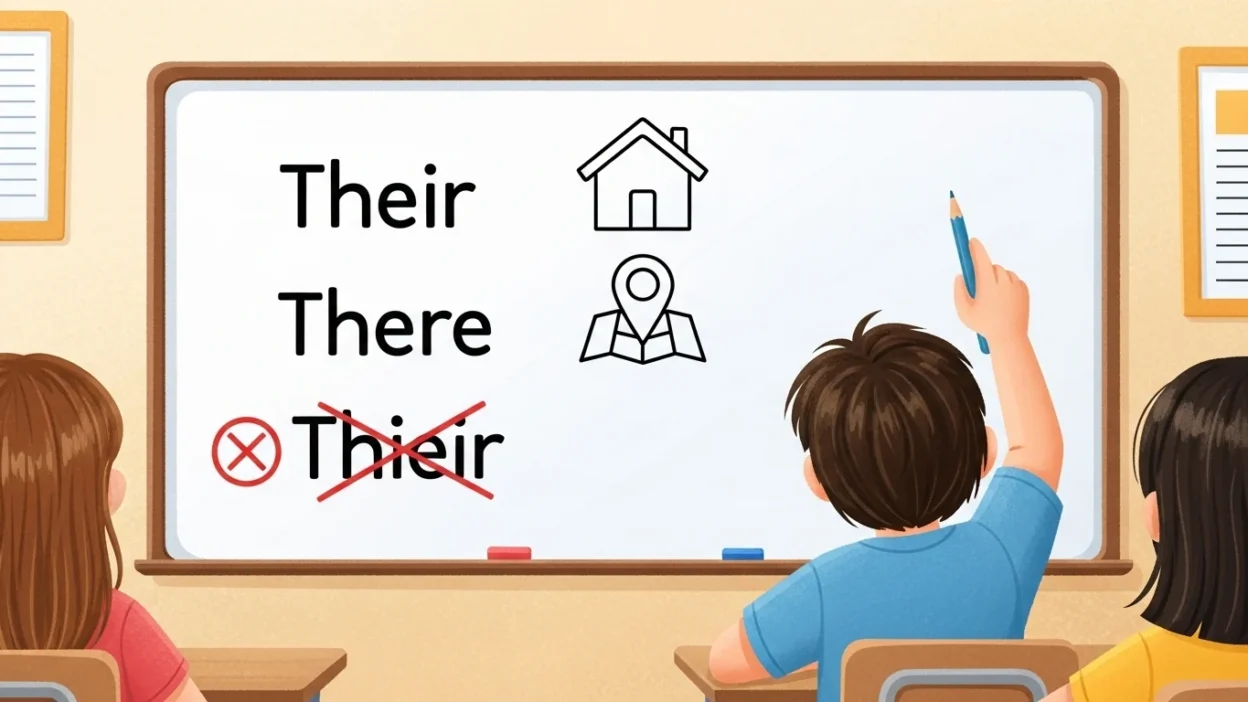
- Thier → ❌ Wrong spelling
- Their → Shows ownership (something belongs to them)
- There → Refers to a place or is used in a sentence like “There is…”
That’s it in short. Now let’s understand it fully and clearly.
Simple Background Explanation
English has many words that sound the same but have different meanings and spellings. These are called homophones.
Their and there are homophones. They sound the same, but they mean different things.
Thier is just a spelling mistake. It is not a real English word.
The confusion usually happens because:
- The words sound the same.
- People type quickly.
- English spelling rules are not always simple.
But once you understand the meaning of each word, it becomes very easy.
Clear Explanation of the Difference
Let’s explain each word one by one in very simple language.
1. Thier
This is not a real word.
It is a spelling mistake of their.
❌ Example (wrong):
- Thier house is big.
✅ Correct version:
- Their house is big.
If you see “thier,” always correct it to “their.”
2. Their
Their shows ownership.
It means something belongs to “them.”
If you can replace it with “our” or “my,” it usually means you need their.
Examples:
- Their car is new.
- The students forgot their books.
- The children love their parents.
- The workers finished their job.
In all these examples, something belongs to someone.
Simple trick:
If it shows ownership → use their.
3. There
There usually talks about a place.
It can also be used at the beginning of a sentence like:
- There is…
- There are…
Examples (place):
- The keys are over there.
- We went there yesterday.
- She is standing there.
Examples (existence):
- There is a problem.
- There are many people here.
- There was a loud noise.
Simple trick:
If you are talking about a place or starting with “There is/are” → use there.
Comparison Table
Here is an easy table to help you remember:
| Word | Meaning | Is It Correct? | Example Sentence |
|---|---|---|---|
| Thier | No meaning | ❌ No | Thier house (wrong) |
| Their | Shows ownership | ✅ Yes | Their house is big. |
| There | Refers to place or existence | ✅ Yes | The book is there. |
Keep this table in mind, and you will not make mistakes.
Which One to Use and When
Let’s make it even simpler.
Use their when:
- Something belongs to them.
- You can replace it with “our” or “my.”
- You are talking about people owning something.
Example:
- Their teacher is kind.
- Their idea was smart.
Use there when:
- You are talking about a place.
- You point to something.
- The sentence starts with “There is” or “There are.”
Example:
- There is a cat outside.
- Put the bag over there.
Never use thier. It is always wrong.
Common Mistakes People Make
Here are mistakes many students make:
1. Typing too fast
People type quickly and mix the letters.
Wrong:
- Thier dog is cute.
Correct:
- Their dog is cute.
2. Forgetting the meaning
Some people choose the word because it sounds right, not because it means right.
Wrong:
- Their is a problem.
Correct:
- There is a problem.
Remember:
- “There is” is correct.
- “Their is” is wrong.
3. Confusing place and ownership
Wrong:
- The students put there bags down.
Correct:
- The students put their bags down.
Ask yourself:
Are the bags owned by the students?
Yes → Use their.
Everyday Real-Life Examples
Let’s see how these words are used in daily life.
In Emails
Correct:
- Please bring your documents to the meeting. Their copies are on the table.
- There is an update about your order.
Wrong:
- Thier copies are attached.
In News
Correct:
- The players celebrated their victory.
- There was heavy rain in the city.
On Social Media
Correct:
- They shared their vacation photos.
- Look over there!
Wrong:
- Thier vacation was amazing.
In School
Correct:
- The children cleaned their classroom.
- There are 30 students in the class.
Short Learning Section for Students and Beginners
Here is a simple learning method.
Step 1: Ask yourself — Is it about ownership?
If yes → use their.
Step 2: Is it about a place or “There is/are”?
If yes → use there.
Step 3: Did you write “thier”?
If yes → fix it immediately.
Practice Exercise:
Fill in the blanks:
- _______ is a dog outside.
- The kids forgot _______ lunch.
- Put the chair over _______.
- _______ house is beautiful.
- _______ are many stars tonight.
Answers:
- There
- Their
- There
- Their
- There
Practice makes you confident.
(FAQ)
1. Is “thier” ever correct?
No. It is always a spelling mistake.
2. How do I remember “their”?
Think of the word “heir” inside “their.”
An heir receives something. So it connects to ownership.
3. How do I remember “there”?
The word “here” is inside “there.”
Both talk about place.
4. Can “there” show ownership?
No. “There” never shows ownership.
5. Why do these words sound the same?
English has many words that sound alike but have different meanings. These are called homophones.
6. Is this mistake common among native speakers?
Yes. Even native speakers sometimes confuse them when typing fast.
7. What is the easiest rule?
Ownership → their
Place or “There is” → there
Thier → never
8. Can spell check fix this mistake?
Sometimes yes, but not always. It is better to understand the rule yourself.
Conclusion
Now you clearly understand the difference between thier, their, and there.
Let’s repeat one last time:
- Thier → Wrong spelling
- Their → Shows ownership
- There → Talks about place or starts “There is/are”
The confusion happens because the words sound the same. But their meanings are very different.
When writing, slow down for a moment. Ask yourself:
Is this ownership?
Is this about a place?
That simple question will help you choose the correct word every time.
Keep practicing, and soon this mistake will completely disappear from your writing.