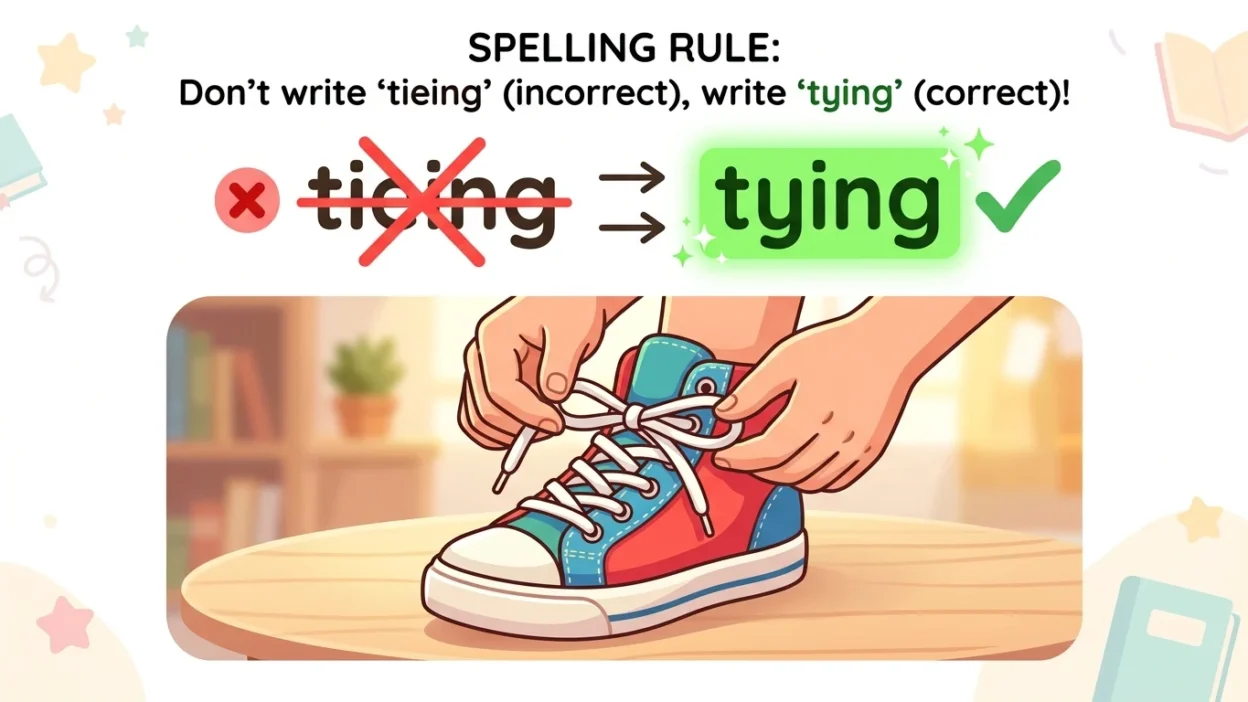
Many learners feel confused when they see tieing and tying. Both look similar, and both seem to come from the verb “tie.” So which one is correct?
This confusion happens because English spelling rules are not always simple. When we add ing to verbs, sometimes the spelling changes. Sometimes it does not. Because of this, people often guess and that leads to mistakes.
In this article, you will learn the correct form, understand why it is correct, and see many simple examples. By the end, you will feel fully confident and never confuse these two words again.
Quick Answer
- ✅ Tying = correct spelling
- ❌ Tieing = incorrect spelling (not used in standard English)
- Use tying when you talk about making a knot or fastening something
Simple Background Explanation
The verb “tie” means to fasten something using a string, rope, or similar item.
Examples:
- Tie your shoes
- Tie a rope
- Tie a bag
Now, when we want to show an action happening right now, we add -ing:
- tie → tying
But here is the important part:
English often changes spelling when adding -ing to words that end in -ie.
Basic Rule:
When a verb ends in -ie, we usually:
- change ie → y
- then add -ing
So:
- tie → tying
- die → dying
- lie → lying
This is why tieing is wrong. It does not follow the spelling rule.
Clear Explanation of the Difference
Let’s make it very simple:
What is “tying”?
- It is the present participle (or -ing form) of “tie”
- It shows an action happening now or in progress
Example:
- She is tying her hair.
What is “tieing”?
- It is a misspelling
- It is not used in correct English writing
So, there is no real “difference” in meaning—because one word is correct, and the other is not.
Comparison Table
| Feature | Tying ✅ | Tieing ❌ |
|---|---|---|
| Correct spelling | Yes | No |
| Used in English | Yes | No |
| Meaning | Fastening something | Not a real word |
| Grammar | Present participle | Incorrect form |
| Example | He is tying a knot | Not correct |
Which One to Use and When
Always use tying.
Use “tying” when:
- You talk about something happening now
- You describe an ongoing action
- You write sentences in present continuous tense
Examples:
- I am tying my shoes.
- She is tying a ribbon.
- They are tying the rope tightly.
Never use:
- ❌ tieing
Even if it looks logical, it is still incorrect.
Common Mistakes People Make
Here are some mistakes learners often make:
1. Writing “tieing” because it looks natural
People think:
- tie + ing = tieing
But English changes the spelling:
- tie → tying
2. Forgetting the “ie → y” rule
This rule is very important. Many learners forget it.
Wrong:
- dieing
- lieing
- tieing
Correct:
- dying
- lying
- tying
3. Mixing spoken and written English
When we speak, we hear:
- “tying”
But when writing, some people spell it incorrectly as “tieing.”
4. Overthinking simple words
Sometimes learners think:
“This looks too simple. Maybe it is wrong.”
But in this case:
- tying is simple AND correct
Everyday Real Life Examples
Let’s look at how “tying” is used in daily life.
In Emails
- I am tying up the final details of the project.
- She is tying the documents together for submission.
In Social Media
- Just finished tying my shoelaces and ready to run!
- He is tying balloons for the party.
In News or Reports
- Workers are tying safety ropes before climbing.
- The team is tying cables for the new system.
In Daily Conversations
- Wait, I am tying my shoes.
- She is tying her hair before going out.
- He is tying the bag tightly.
Short Learning Section for Students and Beginners
Here is an easy way to remember:
Step by Step Rule
- Look at the verb: tie
- Check the ending: -ie
- Change ie → y
- Add -ing
Result:
- tying ✅
Memory Trick
Think:
“Drop IE, add Y + ING”
Examples:
- tie → tying
- die → dying
- lie → lying
Quick Practice
Fill in the blanks:
- She is ______ her shoes.
- He is ______ the rope.
- They are ______ balloons.
Answers:
- tying
- tying
- tying
FAQ Section
1. Is “tieing” ever correct?
No. “Tieing” is always incorrect in standard English.
2. Why do we write “tying” instead of “tieing”?
Because English spelling rules say:
- change ie → y before adding -ing
3. Is “tying” used in formal writing?
Yes. It is correct in both formal and informal writing.
4. What is the base form of “tying”?
The base form is tie.
5. Are there other words like this?
Yes:
- die → dying
- lie → lying
6. Can “tying” be used in past tense?
No. “Tying” is not past tense.
Past tense:
- tied
Example:
- He tied the rope yesterday.
7. Is this rule always true?
Yes, for most verbs ending in -ie, this rule works.
8. How can I avoid this mistake?
- Remember the rule
- Practice writing
- Check your spelling
Conclusion
The confusion between tieing and tying is very common, but the answer is simple.
- Tying is the correct spelling
- Tieing is incorrect and should not be used
The key rule is easy:
- Change ie → y before adding -ing
Once you remember this rule, you will not only use tying correctly but also improve your spelling for similar words like dying and lying.
Keep practicing, and soon this will feel natural to you.