Many students and English learners feel confused when writing the word transferring. Some people write transfering, while others write transferring. At first glance, both spellings look similar, so it is easy to wonder which one is correct.
This confusion usually happens because English spelling rules are not always obvious. Sometimes letters change when we add -ing to a word, and sometimes they do not. Because of this, many learners are unsure whether the letter “r” should be doubled or not.
The good news is that the answer is simple once you understand the rule. In this guide, you will learn the clear difference between transferring and transfering, when to use the correct form, and how to avoid common mistakes.
By the end of this article, you will feel confident using the correct spelling in writing, emails, school work, and everyday communication.
Quick Answer
Here is the short and simple answer:
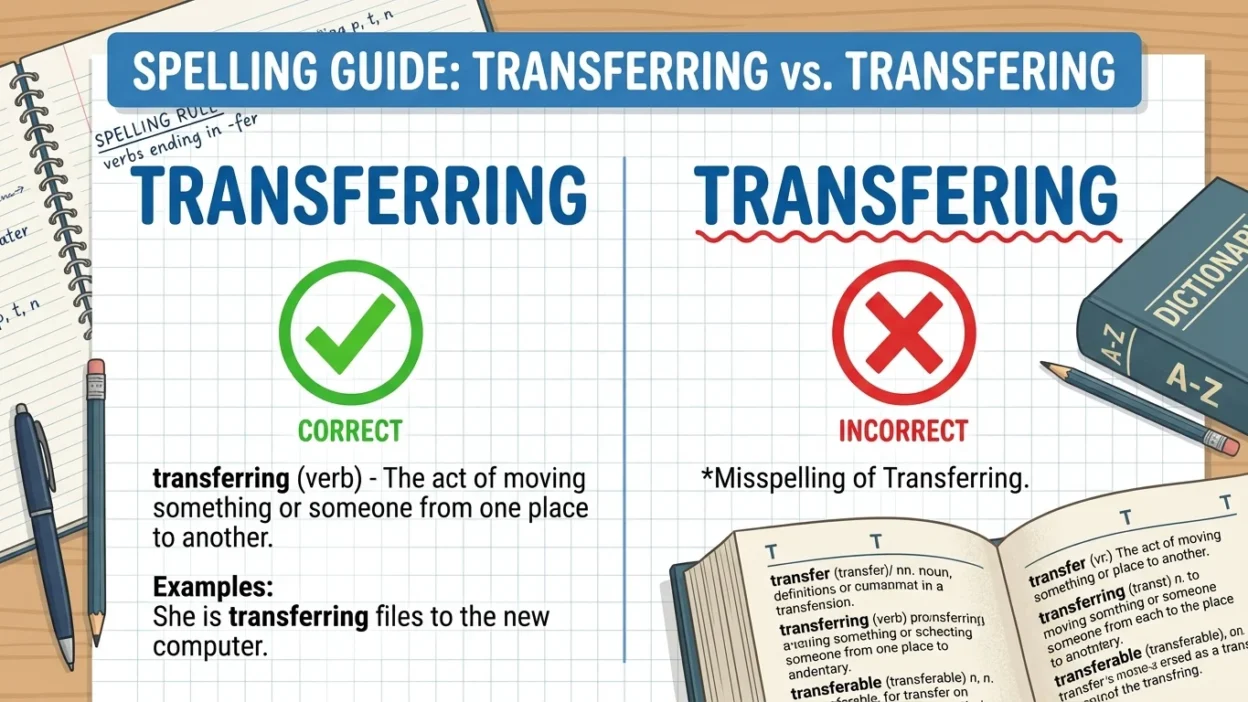
- Transferring is the correct spelling.
- Transfering is incorrect and should not be used.
- The word transfer doubles the final r before adding -ing.
- This happens because of a common English spelling rule.
Example:
- Correct: She is transferring the money today.
- Incorrect: She is transfering the money today.
If you remember one thing, remember this: always write “transferring” with two r’s.
Simple Background of the Word
The word transfer means to move something from one place to another.
For example:
- moving money from one bank account to another
- sending a file from one computer to another
- changing from one school to another
- moving a player from one team to another
The word came into English many years ago from older languages used in Europe. Over time, the spelling became transfer.
When we add -ing to show an action happening now, the spelling changes slightly.
That is why we get the word transferring.
Understanding this small spelling change helps remove the confusion.
The Real Difference Between Transferring and Transfering
The truth is very simple.
There is no real difference in meaning, because only one spelling is correct.
Transferring
This is the correct form.
It follows a common English rule:
When a word ends with a vowel + consonant, the final consonant is often doubled before adding -ing.
Example pattern:
- prefer → preferring
- refer → referring
- transfer → transferring
The double r keeps the correct sound of the word.
Transfering
This spelling breaks the rule, so it is incorrect.
It may appear in:
- typing mistakes
- quick messages
- informal online writing
However, it should not be used in proper writing.
Comparison Table
| Feature | Transferring | Transfering |
|---|---|---|
| Correct spelling | Yes | No |
| Standard English | Yes | No |
| Used in formal writing | Yes | No |
| Used in school or exams | Yes | No |
| Follows spelling rules | Yes | No |
The table shows clearly that transferring is the only correct choice.
Which One Should You Use?
You should always use “transferring.”
Use it whenever you want to describe moving something from one place to another.
Examples include:
Banking
- The bank is transferring the money to your account.
Schools
- She is transferring to another university.
Technology
- The phone is transferring photos to the computer.
Work or Office
- The company is transferring employees to a new branch.
In all of these cases, the correct spelling is transferring.
Common Mistakes People Make
Many learners make the same spelling mistakes with this word. Understanding them helps you avoid them.
1. Forgetting to Double the “R”
Some people simply add -ing without doubling the last letter.
Incorrect example:
- The bank is transfering funds.
Correct version:
- The bank is transferring funds.
2. Writing Too Fast
When typing quickly, people often forget the second r.
This happens often in:
- social media posts
- chat messages
- emails
Even though the mistake is common, it is still incorrect.
3. Not Knowing the Double-Consonant Rule
Many learners are not familiar with this rule.
When a word ends with vowel + consonant, we usually double the consonant before adding -ing.
Examples:
- run → running
- sit → sitting
- refer → referring
- transfer → transferring
Learning this rule helps with many other words too.
4. Trusting Spellings Seen Online
Sometimes people copy spellings they see online without checking them. Since anyone can write on the internet, mistakes spread easily.
Always remember: transferring is the correct spelling.
Everyday Examples in Real Life
To understand the word better, let’s look at examples from daily life.
Email Example
Hello Sarah,
I am transferring the documents to your email now. Please check them later.
Social Media Example
I’m transferring all my photos to a new phone today.
School Example
Ali is transferring to another college next semester.
Banking Example
The bank is transferring the payment this afternoon.
Technology Example
The laptop is transferring files to the external drive.
News Example
The football club is transferring a player to another team.
These examples show how common the word transferring is in everyday communication.
A Simple Learning Tip for Students
Here is a small trick to remember the correct spelling.
Think of this pattern:
Refer → Referring
Prefer → Preferring
Transfer → Transferring
All of them double the letter “r.”
So if you remember referring, you will easily remember transferring.
Another tip:
Break the word into parts:
transfer + ing → transferring
When you see the word clearly, the spelling becomes easier to remember.
Practicing with sentences also helps students learn faster.
(FAQ)
1. Is transfering ever correct?
No. Transfering is always incorrect.
The correct spelling is transferring.
2. Why does transferring have two r’s?
Because of an English spelling rule that doubles the final consonant before adding -ing.
3. Is transferring used in American and British English?
Yes. Both forms of English use transferring.
4. What does transferring mean?
It means moving something from one place, person, or system to another.
5. Can transferring be used for money?
Yes. It is often used in banking.
Example:
She is transferring money to her friend.
6. Can transferring be used for schools?
Yes.
Example:
He is transferring to another university.
7. Is transferring a verb?
Yes. It is the -ing form of the verb transfer.
8. How can I remember the correct spelling?
Remember similar words:
- referring
- preferring
- transferring
They all double the r.
Conclusion
The confusion between transferring and transfering is very common, especially for students and English learners. Since both spellings look similar, many people are unsure which one to use.
However, the rule is simple.
Transferring is the correct spelling.
Transfering is incorrect and should be avoided.
The reason is the English spelling rule that doubles the final consonant before adding -ing. Because the word transfer ends with a vowel followed by r, the r becomes double.
Once you understand this rule, the confusion disappears.
So whenever you write about moving money, files, students, or information from one place to another, remember the correct form:
transferring — with two r’s.
Learning small spelling rules like this helps you write clearer English and feel more confident in your everyday communication.