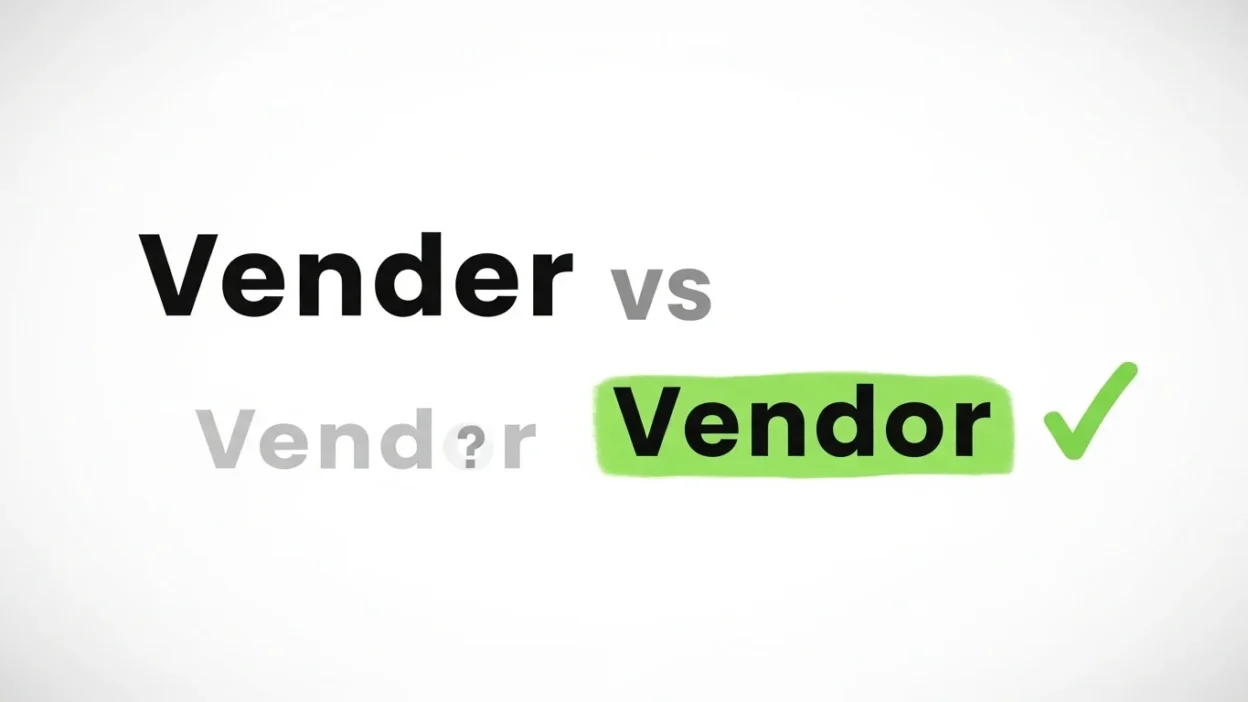
Many people feel confused about vender and vendor. They look almost the same. They sound almost the same. The only difference is one letter: e or o.
So which one is correct?
If you are a student, an ESL learner, or someone who wants clear English, this guide will help you understand everything in very simple words.
Let’s make it easy.
Quick Answer
Here is the short and simple explanation:
- Vendor ✅ = the correct and common spelling
- Vender ⚠️ = rare spelling, mostly old or uncommon
- In modern English, you should almost always use vendor
- If you see vender, it is usually a mistake or an old form
In everyday English, business English, school writing, and news writing, vendor is the word people use.
Where Do These Words Come From?
Both words come from the same old Latin word “vendere.”
“Vendere” means to sell.
Over time:
- In French and Latin-based languages, forms like vendre (to sell) stayed common.
- In English, the spelling changed and became vendor.
In older English writing, you could sometimes see vender. But over time, English chose vendor as the standard spelling.
Today:
- Vendor = normal and correct
- Vender = outdated or very rare
Language changes slowly, and spelling becomes more fixed over time. That is what happened here.
Clear Explanation of the Difference
Now let’s explain it in the simplest way possible.
What Does “Vendor” Mean?
A vendor is:
A person or company that sells something.
That’s it. Very simple.
Examples:
- A street food seller
- A company that sells computers
- A business that provides software
- A person selling fruit at a market
All of these are vendors.
The word is used in:
- Business
- Law
- Technology
- Everyday life
- News
- Contracts
- School textbooks
What About “Vender”?
“Vender” is:
- An old spelling
- A very rare spelling
- Sometimes a spelling mistake
In modern English, people do not normally use vender.
If you use it in school or at work, it may be marked as incorrect.
Comparison Table
Here is an easy table to understand the difference quickly:
| Feature | Vendor | Vender |
|---|---|---|
| Correct modern spelling | ✅ Yes | ❌ No (rare) |
| Used in business English | ✅ Yes | ❌ No |
| Common in news and media | ✅ Yes | ❌ No |
| Found in contracts and legal papers | ✅ Yes | ❌ No |
| Old or outdated form | ❌ No | ✅ Yes |
| Recommended for students | ✅ Yes | ❌ No |
If you want to be safe, always choose vendor.
Which One Should You Use?
Always Use: Vendor
Use vendor when you talk about:
- A company selling products
- A person selling goods
- A business partner that supplies items
- A service provider
For example:
- “We contacted the software vendor.”
- “The food vendor closed early.”
- “The company changed its main vendor.”
- “Street vendors sell snacks and drinks.”
These are all correct.
When Should You Use “Vender”?
Almost never.
You might see it:
- In very old books
- In historical documents
- In spelling mistakes online
But in normal modern writing, do not use it.
Common Mistakes People Make
Here are some common mistakes students and learners make:
1. Thinking Both Are Equally Correct
Some people think:
“Maybe both are fine.”
But that is not true today.
In modern English:
- Vendor = correct
- Vender = uncommon and usually wrong
2. Spelling Based on Sound
Both words sound very similar.
So learners sometimes write:
- vender instead of vendor
This is normal, especially for ESL learners. English spelling is not always logical.
3. Mixing It with “Vending”
You may know the word:
- Vending machine
Notice it uses “vending,” not “vending machine.”
This can confuse people.
Even though we say:
- vending machine
The person or company is still called:
- vendor
Example:
- “The snack vendor owns three vending machines.”
4. Autocorrect Errors
Sometimes phones or old spell check tools do not correct “vender.”
So people think it is correct.
But modern dictionaries list vendor as the standard spelling.
Real Life Examples
Let’s look at how “vendor” is used in daily life.
In an Email
“Dear Vendor,
We would like to confirm the delivery date.”
Correct.
Not:
“Dear Vender”
In the News
- “Local vendors protested new market rules.”
- “The city supports small vendors.”
You will see vendor, not vender.
In Business
- “We selected a new IT vendor.”
- “The vendor signed the contract.”
Very common in business English.
On Social Media
- “Support small vendors!”
- “Looking for a reliable wedding vendor.”
Again, vendor is the normal word.
In Daily Conversation
- “The hot dog vendor is on the corner.”
- “The flower vendor comes every morning.”
Simple and clear.
Learning Section for Students and Beginners
If you are learning English, here is an easy memory trick.
Easy Trick to Remember
Think of:
Vendor = Very common
Both words start with “V.”
Vendor Very common
Vender Very rare
So remember:
If it is common, use vendor.
Practice Sentences
Choose the correct word:
- The street ___ sells fruit.
- We emailed the software ___.
- The company changed its main ___.
Answers:
- vendor
- vendor
- vendor
Every time, the answer is vendor.
Small Writing Exercise
Write three sentences using “vendor.”
Example:
- The vendor sells coffee.
- Our vendor delivers every Friday.
- I spoke to the event vendor.
This will help you remember the correct spelling.
FAQ
Here are common questions people ask.
1. Is “vender” ever correct?
It is not wrong in history, but in modern English it is very rare. Today, you should use vendor.
2. Why do both spellings exist?
Both come from the same old word meaning “to sell.” Over time, English chose vendor as the standard spelling.
3. Is “vender” used in American English?
No. American English uses vendor.
4. Is “vender” used in British English?
Modern British English also uses vendor.
5. What is a vendor in simple words?
A vendor is a person or company that sells something.
6. Is a street seller a vendor?
Yes. A person selling food or items on the street is a vendor.
7. What is a software vendor?
A software vendor is a company that sells computer programs or digital tools.
8. Is “vending machine” connected to vendor?
Yes. A vending machine sells products. The person or company that owns it is called a vendor.
Final Summary:
Let’s make everything clear one more time.
- Vendor is the correct and modern spelling.
- It means a person or company that sells something.
- It is used in business, daily life, news, and school writing.
- Vender is an old or rare spelling.
- In modern English, you should not use “vender.”
If you remember only one thing from this article, remember this:
When in doubt, choose vendor.
Now you can write with confidence, without confusion.
English can sometimes be tricky, but this one is simple. 😊

Weston Maddox is both an author and administrator at SpellCorrect. He oversees site operations while creating accurate, easy-to-understand content focused on correct spelling and proper word usage, helping readers improve writing clarity, precision, and confidence across academic, professional, and everyday English communication.