Many English learners feel confused when they see the words “weeped” and “wept.” Both seem like they could be the past tense of the verb “weep.” Since many English verbs form the past tense by adding -ed, it is natural to think weeped might be correct.
However, English has many irregular verbs, and they do not always follow the simple -ed rule. Because of this, people sometimes write or say the wrong form without realizing it.
The good news is that this confusion is easy to solve. Once you understand the correct form and why it exists, you will remember it easily.
In this guide, you will learn:
- Which word is correct
- Why the confusion happens
- How to use the correct form in daily life
- Common mistakes to avoid
Everything is explained in very simple English, so even beginners can understand it easily.
Quick Answer
Here is the short and clear answer:
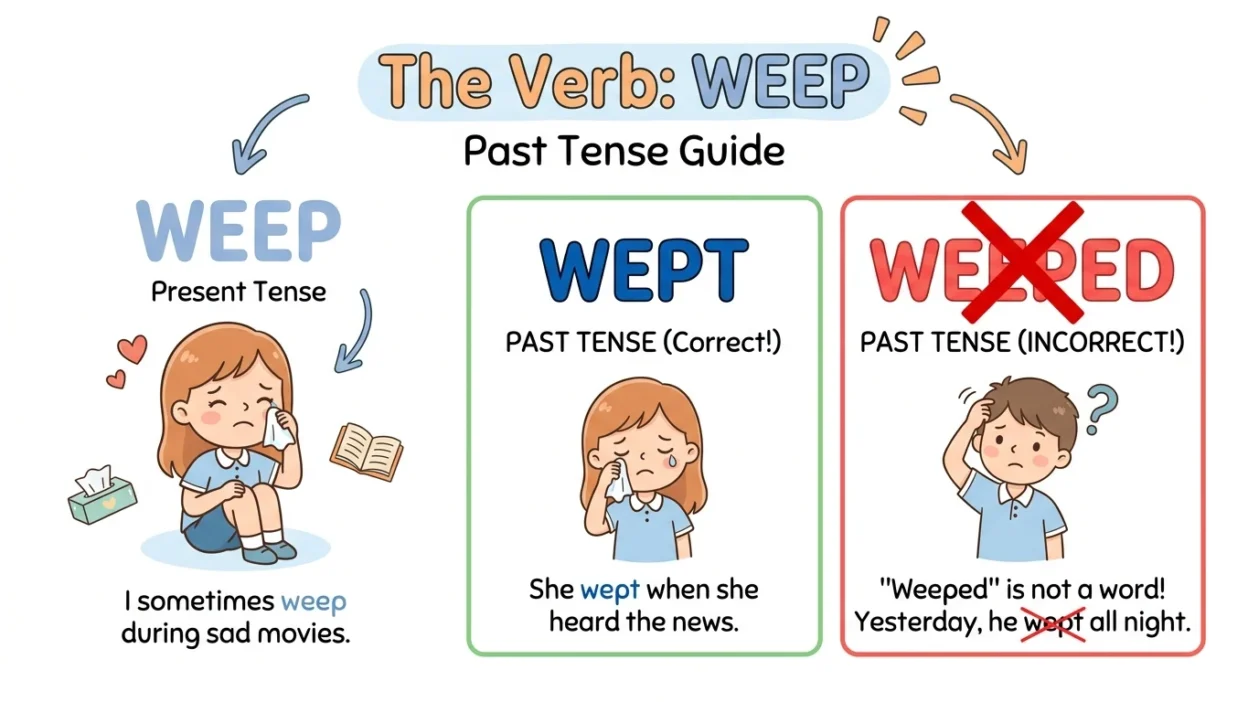
- Wept is the correct past tense and past participle of weep.
- Weeped is not correct in standard English.
- Always use wept when talking about crying in the past.
Examples:
- She wept quietly after hearing the sad news.
- The child wept when he lost his toy.
Incorrect example:
- She weeped all night. ❌
If you remember one thing from this article, remember this:
The past tense of “weep” is “wept,” not “weeped.”
Simple Origin or Background
To understand why wept is correct, it helps to know a little about the history of the word.
The verb weep is an old English word. It has been used for hundreds of years to describe crying with sadness or deep emotion.
In early English, many verbs changed their form in special ways when talking about the past. They did not simply add -ed.
For example:
- keep → kept
- sleep → slept
- weep → wept
These verbs follow a pattern where the “ee” sound changes to “e” and “pt” is added.
Because of this old pattern, the correct past tense became wept, not weeped.
Even today, modern English still keeps this form.
Clear Explanation of the Difference
The difference between weeped and wept is simple.
Wept
Wept is the correct past tense and past participle of weep.
It means cried deeply or sadly in the past.
Examples:
- She wept during the emotional movie.
- He wept after hearing the news.
- The mother wept with happiness when her child returned home.
Weeped
Weeped is not a correct word in standard English.
People sometimes create it by mistake because many verbs use -ed for the past tense.
Examples of this pattern:
- walk → walked
- jump → jumped
- laugh → laughed
Because of this pattern, learners may think weep → weeped, but this is incorrect.
Correct sentence:
- She wept after the sad story.
Incorrect sentence:
- She weeped after the sad story.
Comparison Table
| Word | Is it correct? | Meaning | Example |
|---|---|---|---|
| Weep | Yes | Present tense verb | She may weep if she hears the news. |
| Wept | Yes | Past tense of weep | She wept after the loss. |
| Weeped | No | Incorrect form | She weeped all night. ❌ |
This table makes the rule simple:
Use wept for the past. Never use weeped.
Which One to Use and When
You should use wept whenever you talk about crying in the past.
Use “weep”
When talking about the present or future.
Examples:
- She may weep if she hears the news.
- Some people weep when they feel strong emotions.
Use “wept”
When talking about something that already happened.
Examples:
- He wept during the funeral.
- The boy wept after losing his pet.
- She wept with joy at the surprise.
Never use “weeped”
Even though it looks logical, it is not correct English.
Common Mistakes People Make
Many learners make similar mistakes with irregular verbs. Here are some common problems related to weep.
1. Adding “-ed” automatically
Many students learn the rule:
verb + ed = past tense
So they write:
- weeped ❌
But irregular verbs do not follow this rule.
Correct form:
- wept ✔
2. Thinking both forms are correct
Some people believe weeped and wept are both acceptable. This is not true.
Only wept is correct.
3. Confusing with similar verbs
Because of other verbs like:
- jump → jumped
- cry → cried
learners expect the same pattern.
But verbs like weep, sleep, and keep are different.
Examples:
- sleep → slept
- keep → kept
- weep → wept
4. Using “weeped” in writing
Sometimes people write:
- “She weeped quietly.”
This should be corrected to:
- “She wept quietly.”
Everyday Real-Life Examples
Let’s see how wept is used in normal daily situations.
In Emails
Example:
I was very moved by the story you shared. I actually wept while reading it.
Another example:
Many people wept during the ceremony yesterday.
In News
Example:
Families wept as they remembered the victims.
Another example:
The crowd wept during the emotional speech.
On Social Media
Example:
I just watched that movie and wept the whole time.
Another example:
I wept when I saw the reunion video.
In Daily Conversation
Example:
- “Did she cry after hearing the news?”
- “Yes, she wept for a long time.”
Another example:
- “The child wept when the balloon flew away.”
These examples show how the word appears in real life.
Learning Tip for Students and Beginners
A simple trick can help you remember the correct form.
Think of this pattern:
- keep → kept
- sleep → slept
- weep → wept
All three verbs follow the same change.
Another easy memory tip:
“Weep becomes wept when the crying already happened.”
Practice writing a few sentences:
- The baby wept loudly.
- She wept with happiness.
- He wept after the sad movie.
Practicing like this helps the word stay in your memory.
(FAQ)
1. Is “weeped” a real word?
No. Weeped is not correct in standard English.
The correct past tense is wept.
2. What does “wept” mean?
Wept means cried deeply or sadly in the past.
Example:
- She wept after hearing the sad news.
3. What is the present tense of wept?
The present tense is weep.
Example:
- Some people weep during emotional movies.
4. Why isn’t the past tense “weeped”?
Because weep is an irregular verb, and irregular verbs do not follow the -ed rule.
So the past form became wept.
5. Is “wept” formal or old-fashioned?
It is a normal English word used in writing, stories, news, and everyday language.
6. Can “wept” show happiness?
Yes. People can weep with joy, not only sadness.
Example:
- She wept with joy when she saw her family again.
7. Is “cry” the same as “weep”?
They are similar, but weep often shows deeper emotion.
Example:
- The child cried loudly.
- The mother wept quietly.
8. How can I remember the correct form?
Remember this simple pattern:
- sleep → slept
- keep → kept
- weep → wept
Conclusion
The confusion between weeped and wept happens because many English verbs use -ed for the past tense. This makes learners think weeped might be correct.
However, weep is an irregular verb, so it follows a different pattern.
The correct forms are:
- Weep – present tense
- Wept – past tense and past participle
The form weeped is not correct in standard English.
If you remember the pattern keep → kept, sleep → slept, weep → wept, you will never forget the correct word.
With a little practice and a few example sentences, this small grammar problem becomes very easy to understand.
Soon, using wept correctly will feel completely natural.

Weston Maddox is both an author and administrator at SpellCorrect. He oversees site operations while creating accurate, easy-to-understand content focused on correct spelling and proper word usage, helping readers improve writing clarity, precision, and confidence across academic, professional, and everyday English communication.