Many people feel confused about whos and whose. They look almost the same. They sound exactly the same when we say them. Because of this, students, ESL learners, and even native speakers sometimes mix them up.
The good news is this: the difference is actually very simple. Once you understand one small rule, you will never be confused again.
Let’s make it easy.
Quick Answer
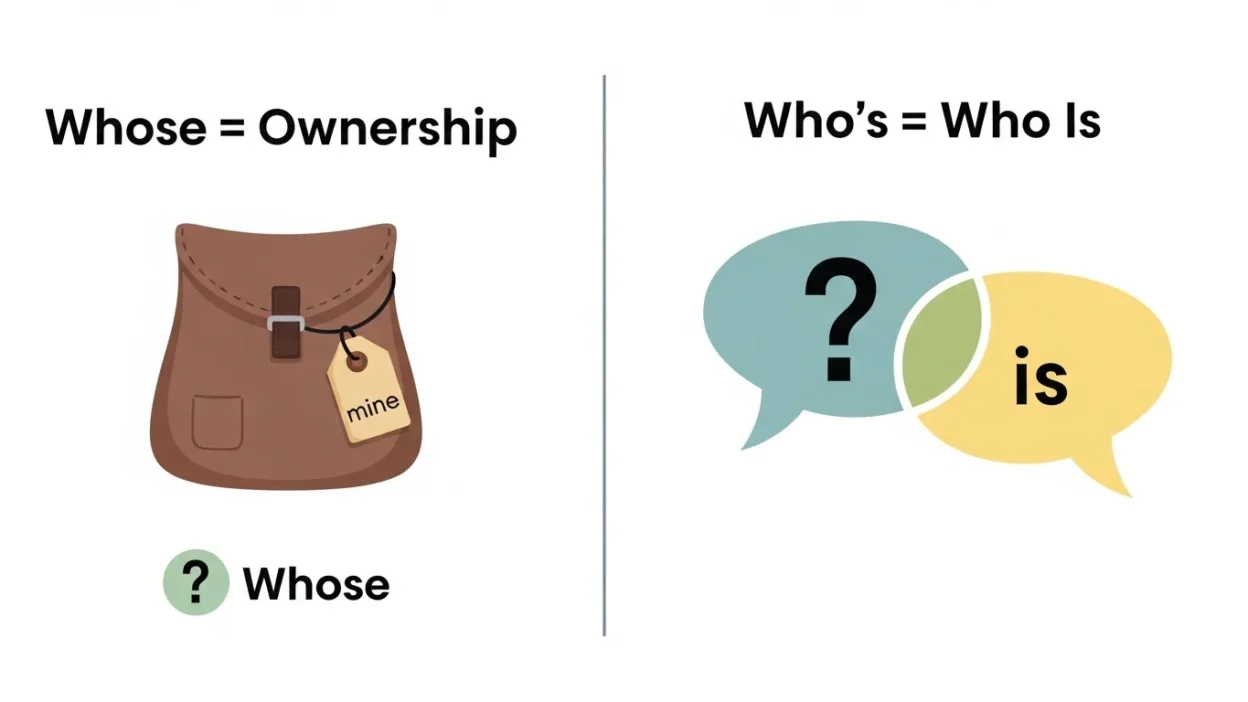
- Whose = shows ownership (something belongs to someone)
- Whos = not a correct word in standard English
- If you mean “who is”, you should write who’s (with an apostrophe)
That’s it.
If you remember that whose = ownership, you will be correct almost every time.
Simple Background Explanation
To understand this better, let’s look at the word who.
The word who is a question word. We use it to talk about a person.
Example:
- Who is at the door?
- Who called you?
Now, English sometimes changes words to show possession (ownership).
For example:
- he → his
- she → her
- they → their
- who → whose
So whose is simply the possessive form of who.
It means: belonging to which person?
On the other hand, whos (without an apostrophe) is not a real word in correct English spelling.
Many people mean to write:
- who’s (short for who is or who has)
But they forget the apostrophe and write whos, which is incorrect.
Clear Explanation of the Difference
Let’s explain this in the simplest way possible.
1. Whose = Ownership
We use whose when we talk about something that belongs to someone.
Think of it like this:
Whose = “belonging to who”
Examples:
- Whose bag is this?
- Do you know whose phone is ringing?
- She is the teacher whose class I enjoy.
In all these examples, something belongs to someone.
2. Whos = Incorrect Spelling
Whos without an apostrophe is not correct in English.
If you see it, it is usually a spelling mistake.
People often mean to write:
- who’s = who is
- who’s = who has
Example:
- Who’s coming to the party? (Who is coming?)
- Who’s finished the work? (Who has finished?)
But if someone writes:
- Whos coming to the party?
That is incorrect.
Comparison Table
Here is a simple table to help you see the difference clearly:
| Word | Is It Correct? | Meaning | Example |
|---|---|---|---|
| whose | Yes | Shows ownership | Whose shoes are these? |
| who’s | Yes | Short for “who is/has” | Who’s at the door? |
| whos | No | Not a correct spelling | ❌ Whos calling? |
This table shows everything in one quick view.
Which One to Use and When
Here is a very easy rule you can follow.
Step 1: Ask yourself a question
Do I mean:
- “Who is” or “Who has”?
→ Use who’s - “Belonging to who”?
→ Use whose - If you wrote “whos” without an apostrophe
→ It is almost always wrong.
Easy Test Trick
Replace the word with “who is.”
If the sentence still makes sense, use who’s.
Example:
- Who’s your teacher?
→ Who is your teacher? ✔ (correct)
Now try with “whose”:
- Whose car is outside?
→ Who is car is outside? ❌ (does not make sense)
So we know it must be whose.
Common Mistakes People Make
Let’s look at common mistakes so you can avoid them.
Mistake 1: Using “whos” instead of “who’s”
❌ Whos going with us?
✔ Who’s going with us?
Mistake 2: Confusing “whose” with “who’s”
❌ Who’s bag is this?
✔ Whose bag is this?
Remember:
- Bag belongs to someone ownership whose
Mistake 3: Thinking “whose” is only for questions
Many learners think we use whose only in questions. That is not true.
We can also use it in sentences.
Example:
- I met a girl whose brother is a doctor.
- This is the man whose car was stolen.
Here, we are not asking a question. We are giving extra information.
Everyday Real Life Examples
Let’s see how these words appear in daily life.
In Emails
- Who’s responsible for this report?
- Whose name should I write on the form?
In School
- Whose notebook is on my desk?
- Who’s absent today?
On Social Media
- Who’s watching this show tonight?
- Whose idea was this challenge?
In News Headlines
- Whose fault is the accident?
- Who’s leading the election?
These examples show how common these words are in real life.
Short Learning Section for Students and Beginners
If you are a beginner, here is a simple learning plan.
Step 1: Memorize This Rule
Whose = ownership
Who’s = who is / who has
Whos = wrong
Step 2: Practice With Simple Sentences
Fill in the blank:
- _____ coming to dinner?
- _____ shoes are these?
- _____ finished the homework?
- _____ phone keeps ringing?
Answers:
- Who’s
- Whose
- Who’s
- Whose
Step 3: Speak It Out Loud
Say:
- Who is
- Who’s
Notice how they sound the same.
Now say:
- Whose
It also sounds the same.
That is why people get confused. The sound is the same, but the meaning is different.
FAQ
1. Is “whos” ever correct?
No. “Whos” without an apostrophe is not correct in standard English.
2. What is the difference between “whose” and “who’s”?
- Whose = shows ownership
- Who’s = short for “who is” or “who has”
3. Can “whose” be used in statements, not questions?
Yes.
Example:
- She is the student whose project won the prize.
4. How can I quickly check which one to use?
Replace it with “who is.”
If it works, use who’s.
If not, use whose (for ownership).
5. Why do they sound the same?
Because English has many words that sound the same but have different meanings. These are called homophones.
6. Is “whose” only for people?
Mostly, yes. But sometimes we use it for animals and even things in modern English.
Example:
- A company whose products are popular.
7. Is this mistake common?
Yes. Even native speakers sometimes mix them up in fast typing.
8. Should I worry too much about this?
No. Just remember the ownership rule, and you will be fine.
Conclusion
The difference between whos and whose is much easier than it looks.
Here is the simple truth:
- Whose shows ownership.
- Who’s means “who is” or “who has.”
- Whos is not correct.
If you remember just one thing, remember this:
If something belongs to someone, use whose.
With this rule, you can write emails, school assignments, and social media posts with confidence.
Small spelling mistakes can cause big confusion, but now you understand this one clearly. Keep practicing, and soon you will never mix them up again.

Weston Maddox is both an author and administrator at SpellCorrect. He oversees site operations while creating accurate, easy-to-understand content focused on correct spelling and proper word usage, helping readers improve writing clarity, precision, and confidence across academic, professional, and everyday English communication.