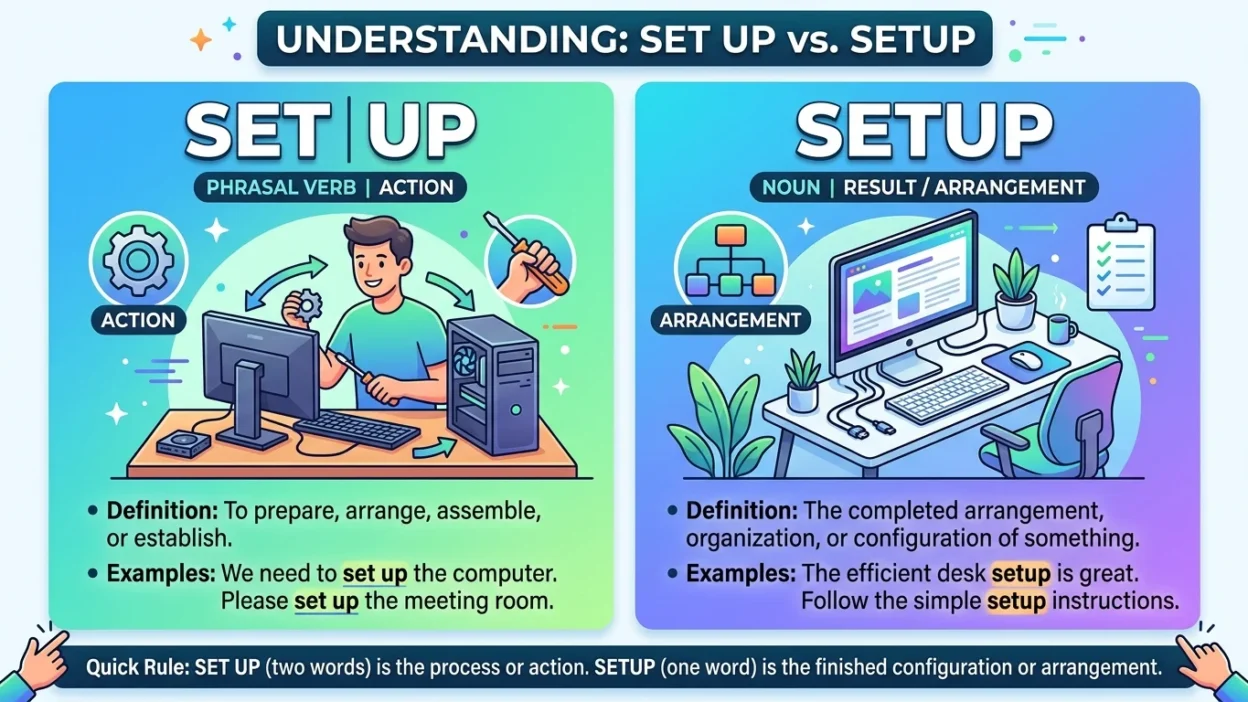
Many learners feel confused about “setup” and “set up” because they look almost the same. The only difference is a space, but that small detail changes how the words work in a sentence.
This is a very common mistake, especially for students and ESL learners. The good news is that once you learn one easy rule, you can use both forms correctly without thinking too hard.
Quick Answer
- Setup = a noun (a thing or arrangement)
- Set up = a verb (an action)
Examples:
- I like your computer setup.
- I will set up the computer.
Simple Background Explanation
In English, some words change meaning depending on whether they are written as one word or two words.
- Two words (set up) → usually a verb (action)
- One word (setup) → usually a noun (thing or result)
This pattern appears in other word pairs too, but here we will focus only on setup vs set up.
Clear Explanation of the Difference
What does “set up” mean?
Set up is a verb phrase. It means to arrange, prepare, or organize something.
Use it when you are talking about an action.
Examples:
- I will set up the meeting.
- She helped me set up my new phone.
- They are setting up the stage.
It can change form depending on tense:
- set up (present)
- setting up (present continuous)
- set up (past)
What does “setup” mean?
Setup is a noun. It refers to the arrangement, system, or way something is organized.
Examples:
- This room has a nice setup.
- His gaming setup is expensive.
- The setup of the event was perfect.
Think of it as the result of the action “set up.”
Comparison Table
| Word | Type | Meaning | Example Sentence |
|---|---|---|---|
| Set up | Verb | To arrange or prepare something | I will set up the equipment. |
| Setup | Noun | Arrangement or system | The setup looks great. |
Which One to Use and When
Use set up when:
- You are talking about an action
- You are doing something
Examples:
- Let’s set up the chairs.
- He will set up the website.
Use setup when:
- You are talking about a thing or result
- You are describing an arrangement
Examples:
- I like your desk setup.
- The camera setup is simple.
Quick Tip
- Set up = action (verb)
- Setup = thing (noun)
Common Mistakes People Make
1. Using setup as a verb
❌ I will setup the room.
✔ I will set up the room.
2. Using set up as a noun
❌ Your set up is nice.
✔ Your setup is nice.
3. Forgetting the space
Many learners forget that spacing changes meaning.
4. Mixing both forms in one sentence
❌ I like how you set up your setup.
✔ I like your setup and how you set it up.
Everyday Real Life Examples
In Technology
- I need to set up my laptop.
- My desk setup is clean and simple.
In Work or Office
- Let’s set up a meeting.
- The office setup is modern.
In Events
- They will set up the stage.
- The wedding setup looked beautiful.
In Daily Life
- Can you set up the table?
- The dining setup is ready.
On Social Media
- Time to set up my new phone 📱
- Check out my gaming setup 🎮
Short Learning Section for Students and Beginners
Step 1: Ask yourself
- Is it an action? → set up
- Is it a thing? → setup
Step 2: Practice
Fill in the blanks:
- I will ______ the equipment.
- The ______ looks amazing.
- They are ______ the room now.
- This is a simple ______.
Answers:
- set up
- setup
- setting up
- setup
Practice these sentences to build confidence.
FAQ
What is the difference between setup and set up?
Set up is a verb (action), while setup is a noun (thing or arrangement).
Can setup be used as a verb?
No. Setup is only a noun.
Is set up always two words?
Yes, when used as a verb, it is always written as two words.
How can I remember the difference?
Think:
- Set up = do something
- Setup = result of that action
Can I say “setup the system”?
No. Correct form is set up the system.
Is setup common in daily use?
Yes, especially in technology, events, and general conversation.
Can both forms be used in one sentence?
Yes. Example:
- I will set up the new setup today.
Conclusion
The difference between setup and set up is simple once you focus on their roles:
- Set up is an action (verb)
- Setup is a thing (noun)
By remembering this one rule, you can avoid common mistakes and use both forms correctly in everyday writing and speaking.