Many learners get confused between “any time” and “anytime” because they look almost the same. The only difference is a space, but this small change affects how each form is used in a sentence.
The good news is that the rule is simple. Once you understand when to use one word or two words, you will not mix them up again.
Quick Answer
- Anytime = an adverb (means “whenever”)
- Any time = a noun phrase (means “at any moment”)
Examples:
- You can call me anytime.
- You can call me at any time.
Simple Background Explanation
In English, some expressions can be written as one word or two words depending on grammar:
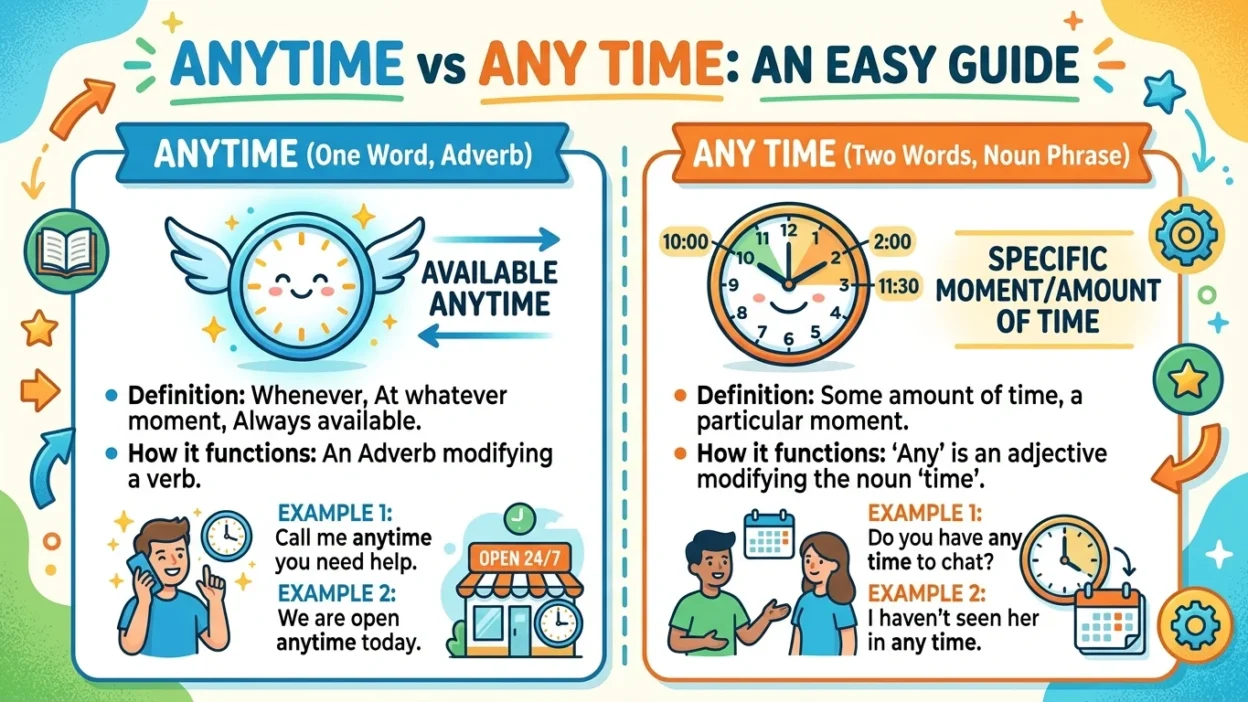
- Anytime (one word) → acts like an adverb
- Any time (two words) → acts like a noun phrase
Both forms are correct, but they are used in different sentence structures.
Clear Explanation of the Difference
What does “anytime” mean?
Anytime is an adverb. It means whenever or at any moment, and it does not need a preposition like “at.”
Examples:
- You can visit anytime.
- Call me anytime you need help.
- I’m available anytime.
It is common in informal and everyday English.
What does “any time” mean?
Any time is a noun phrase. It usually comes after a preposition like “at.”
Examples:
- You can call me at any time.
- I am free at any time today.
- Come here at any time.
Without a preposition, it may sound incomplete in formal grammar.
Comparison Table
| Form | Type | Meaning | Example Sentence |
|---|---|---|---|
| Anytime | Adverb | Whenever | Call me anytime. |
| Any time | Noun phrase | At any moment | Call me at any time. |
Which One to Use and When
Use anytime when:
- You do not use “at”
- You want a simple, informal expression
- It directly modifies a verb
Examples:
- Visit anytime.
- I’m here anytime.
Use any time when:
- You use a preposition like “at”
- You need a noun phrase
- Writing more formally
Examples:
- Visit at any time.
- You can reach me at any time.
Quick Tip
- Anytime = no “at” needed
- Any time = usually with “at”
Common Mistakes People Make
1. Using anytime after “at”
❌ Call me at anytime.
✔ Call me at any time.
2. Using any time without a preposition
❌ Call me any time. (can sound less natural in strict grammar)
✔ Call me anytime.
(Note: In modern English, “call me any time” is often accepted, but “anytime” is cleaner.)
3. Ignoring sentence structure
Always check if a preposition is present.
4. Overthinking the rule
Keep it simple:
- With “at” → any time
- Without “at” → anytime
Everyday Real Life Examples
In Conversations
- Call me anytime.
- Call me at any time.
In Daily Life
- You can come anytime.
- You can come at any time.
In School
- Ask questions anytime.
- You may ask questions at any time.
In Work or Office
- Contact me anytime.
- Contact me at any time.
On Social Media
- DM me anytime 📩
- Available at any time ⏰
Short Learning Section for Students and Beginners
Step 1: Look for “at”
- If “at” is there → any time
- If not → anytime
Step 2: Practice
Fill in the blanks:
- You can call me ______.
- You can call me at ______.
- Visit us ______ you want.
- I am free at ______ today.
Answers:
- anytime
- any time
- anytime
- any time
FAQ
What is the difference between anytime and any time?
Anytime is an adverb, while any time is a noun phrase.
Can I say “at anytime”?
No, it is better to say at any time.
Is anytime correct?
Yes, it is correct and commonly used.
Which one is more formal?
Any time is slightly more formal.
Can I use anytime in writing?
Yes, especially in informal writing.
How can I remember the rule?
Think:
- Anytime = no “at”
- Any time = with “at”
Are both forms common?
Yes, both are widely used in English.
Can both be used in one sentence?
Yes. Example:
- You can visit anytime or at any time that suits you.
Conclusion
The difference between anytime and any time is simple when you focus on structure:
- Anytime is used without “at”
- Any time is used with “at” or as a noun phrase
By remembering this easy rule, you can confidently use both forms in everyday English.