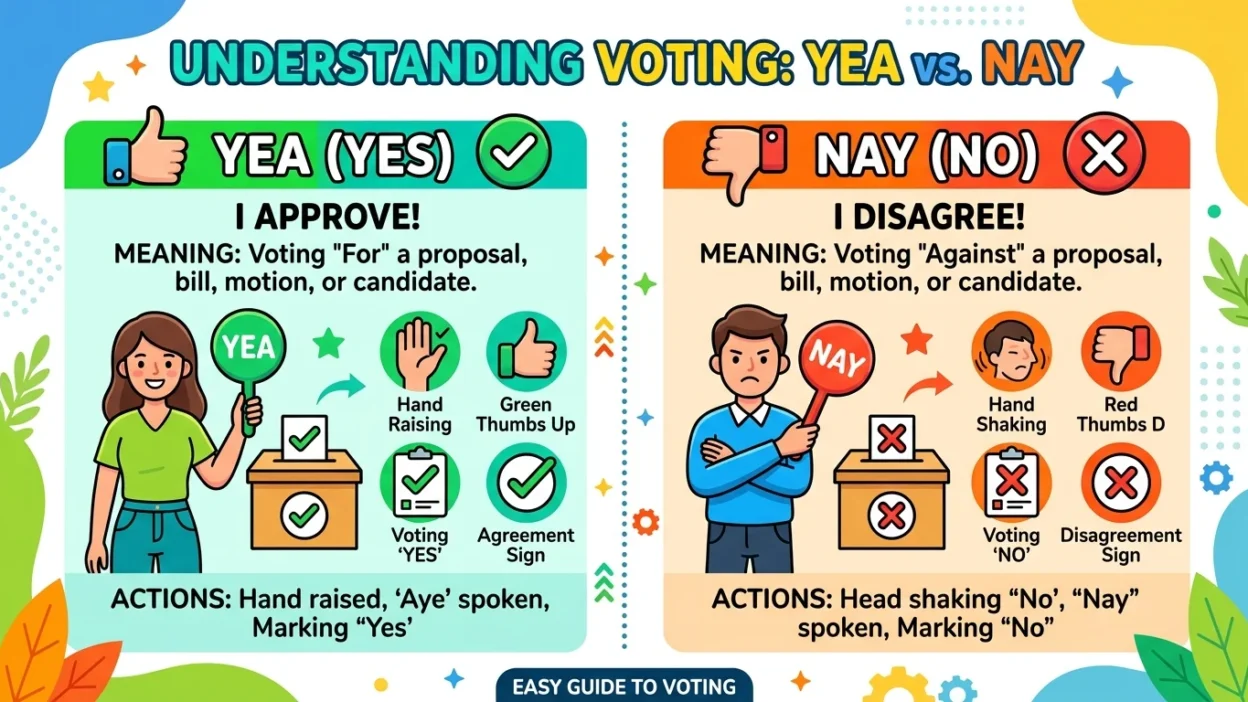
Many learners get confused between “yea” and “nay” because these words are not common in everyday conversation. You might see them in old texts, formal voting situations, or historical contexts.
They are simple once you understand their meaning: one means yes, and the other means no. This guide explains everything clearly so you can recognize and use them correctly.
Quick Answer
- Yea = yes (formal or old fashioned)
- Nay = no (formal or old fashioned)
Examples:
- The members voted yea.
- The proposal was rejected with many nays.
Simple Background Explanation
“Yea” and “nay” come from older forms of English. They were commonly used in formal decisions, especially in government or assemblies.
Even today, these words are still used in:
- Voting systems (like “yea” or “nay”)
- Historical writing
- Formal or ceremonial language
However, in everyday conversation, people usually say yes and no instead.
Clear Explanation of the Difference
What does “yea” mean?
Yea means yes. It shows agreement or approval, especially in formal situations.
Examples:
- The committee voted yea.
- All in favor say yea.
It is often used in voting or official decisions.
What does “nay” mean?
Nay means no. It shows disagreement or rejection.
Examples:
- Several members voted nay.
- All opposed say nay.
It is the opposite of “yea.”
Comparison Table
| Word | Meaning | Usage Style | Example Sentence |
|---|---|---|---|
| Yea | Yes | Formal/old fashioned | The members voted yea. |
| Nay | No | Formal/old fashioned | The proposal received many nays. |
Which One to Use and When
Use yea when:
- You mean “yes” in formal settings
- Talking about voting or approval
Examples:
- The decision passed with many yeas.
- Everyone said yea.
Use nay when:
- You mean “no” in formal settings
- Showing rejection
Examples:
- The motion failed due to many nays.
- Some members voted nay.
Quick Tip
- Yea = yes
- Nay = no
Common Mistakes People Make
1. Confusing “yea” with “yeah”
- Yea = formal “yes”
- Yeah = informal spoken “yes”
❌ Yea, I agree. (informal context)
✔ Yeah, I agree.
2. Using these words in daily conversation
These words sound unnatural in casual speech.
❌ Do you want tea? Yea.
✔ Do you want tea? Yes.
3. Mixing meanings
❌ He said nay to agree.
✔ He said yea to agree.
4. Forgetting the context
Use them mainly in formal or historical situations.
Everyday Real Life Examples
In Formal Voting
- All those in favor say yea.
- All those against say nay.
In News or Reports
- The bill passed with more yeas than nays.
- The decision failed after several nays.
In Historical Context
- The council responded with a loud yea.
- The king’s proposal was met with nay.
In Writing
- The vote was counted as yea.
- There were more nays than expected.
On Social Media (formal tone or humor)
- I vote yea for pizza 🍕
- Definitely a nay from me 😄
Short Learning Section for Students and Beginners
Step 1: Learn meanings
- Yea = yes
- Nay = no
Step 2: Know the context
- Formal or historical use
Step 3: Practice
Fill in the blanks:
- All in favor say ______.
- All opposed say ______.
- The vote had more ______ than ______.
- He voted ______ against the idea.
Answers:
- yea
- nay
- yeas, nays
- nay
FAQ
What is the difference between yea and nay?
Yea means yes, while nay means no.
Are these words used in daily conversation?
No, they are mostly used in formal or historical contexts.
Is yea the same as yeah?
No. Yea is formal, while yeah is informal.
Where are yea and nay commonly used?
They are used in voting, formal decisions, and historical writing.
Can I use yea in exams?
Yes, if the context is formal or historical.
What does nay mean?
It means no or refusal.
How can I remember the difference?
Think:
- Yea = yes
- Nay = no
Can both be used together?
Yes. Example:
- The vote included both yeas and nays.
Conclusion
The difference between yea and nay is very simple:
- Yea means yes
- Nay means no
They are mostly used in formal or historical contexts, especially in voting. For everyday conversation, it is better to use yes and no.
By remembering this simple rule, you can understand and use these words correctly whenever you see them.

Weston Maddox is both an author and administrator at SpellCorrect. He oversees site operations while creating accurate, easy-to-understand content focused on correct spelling and proper word usage, helping readers improve writing clarity, precision, and confidence across academic, professional, and everyday English communication.