Many learners confuse “costumer” and “customer.” The words look almost the same, and when spoken quickly, they sound very similar. Because of this, people often use the wrong one without realizing it.
But here’s the important part: both words are real but they have completely different meanings. This is why it’s important to understand the difference clearly.
This guide will explain everything in very simple English so you can use the right word every time.
Quick Answer
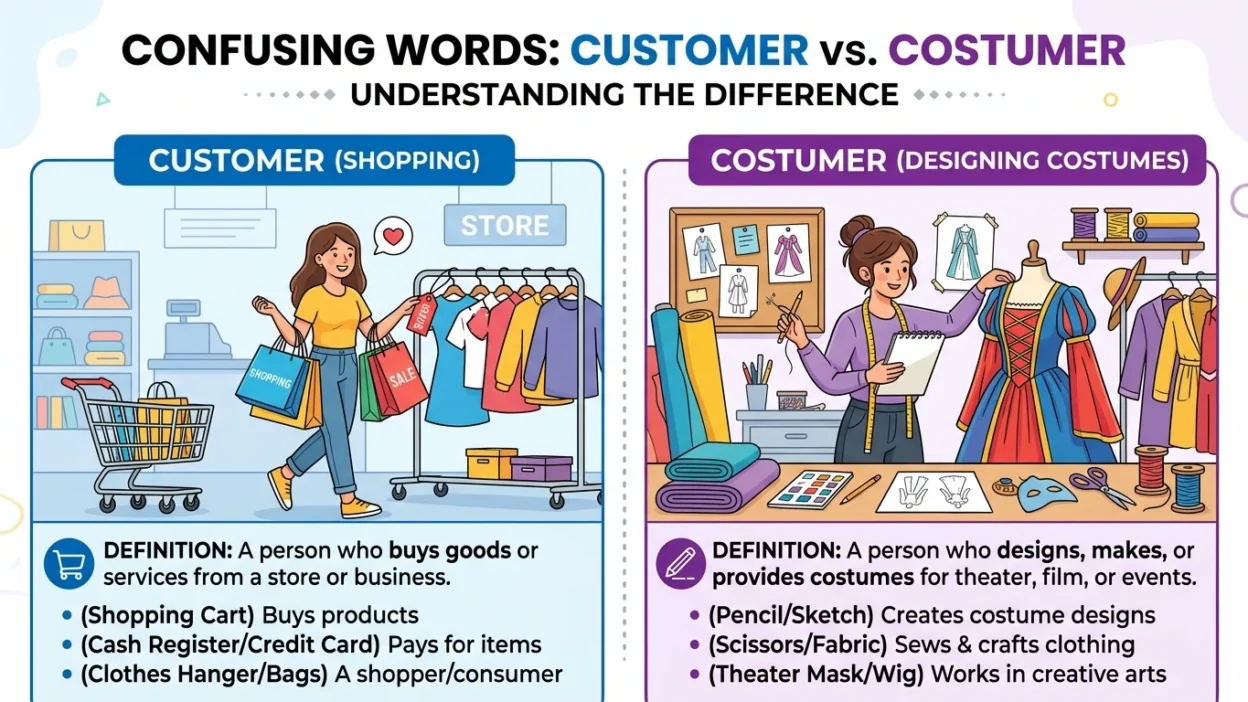
- “Customer” = a person who buys something
- “Costumer” = a person who makes or sells costumes
- Both words are correct, but they are not the same
👉 Simple rule: Use “customer” for buying, “costumer” for costumes.
Simple Origin or Background
Both words come from the root word “custom,” but they developed in different ways.
- Customer comes from the idea of someone who regularly buys goods or services
- Costumer comes from “costume,” which means special clothing (like for movies, theater, or parties)
Because of this, their meanings became very different over time.
Clear Explanation of the Difference
Here is the key idea:
👉 Customer and costumer are both correct but used in different situations.
What does “customer” mean?
A customer is:
- A person who buys something
- Someone who uses a service
Examples:
- A shop customer
- A restaurant customer
What does “costumer” mean?
A costumer is:
- A person who makes costumes
- A person who sells or designs costumes
Examples:
- A movie costumer
- A theater costumer
👉 Important: “Costumer” is much less common than “customer.”
Comparison Table
| Feature | Costumer | Customer |
|---|---|---|
| Meaning | Makes/sells costumes | Buys goods or services |
| Usage | Less common | Very common |
| Field | Fashion, theater, movies | Shops, business, daily life |
| Correct spelling | ✅ Yes | ✅ Yes |
| Recommended use | Specific situations | Everyday use |
Which One to Use and When
👉 Use “customer” in most daily situations.
Use customer when talking about:
- Shopping
- Business
- Services
- Daily life
Examples:
- The customer paid the bill.
- We value every customer.
👉 Use “costumer” in special situations.
Use costumer when talking about:
- Theater
- Movies
- Costume design
- Fashion for events
Examples:
- The costumer designed outfits for the film.
- She works as a theater costumer.
Common Mistakes People Make
1. Mixing the two words
❌ The costumer bought a product
✔ The customer bought a product
2. Using “costumer” too often
“Costumer” is not used in everyday situations.
3. Spelling confusion
Both words look similar, so people choose the wrong one.
4. Not knowing the meaning
Many learners do not know that “costumer” relates to costumes.
👉 Tip: Think of costume → costumer
Everyday Real Life Examples
In shops
- The customer is always right.
- We help every customer quickly.
In restaurants
- The customer ordered food.
- Happy customers return again.
In movies or theater
- The costumer created beautiful outfits.
- The film hired a professional costumer.
In daily life
- I am a regular customer at that store.
- She works as a costumer for events.
On social media
- “Great service for every customer!”
- “Amazing designs by the costumer!”
Short Learning Section for Students and Beginners
Step 1: Learn both words
- Customer = buys things
- Costumer = works with costumes
Step 2: Connect meanings
👉 Costume → Costumer
👉 Buy → Customer
Step 3: Choose correctly
Use customer most of the time
Easy memory tip
👉 “Customer buys, costumer designs costumes.”
Practice
Fill in the blanks:
- The ______ paid for the item.
- The movie hired a ______.
✔ Answers:
- customer
- costumer
FAQ
Are both words correct?
Yes, both are correct but have different meanings.
What does “customer” mean?
It means a person who buys something.
What does “costumer” mean?
It means a person who makes or sells costumes.
Which word is more common?
“Customer” is much more common.
Can I use “costumer” in daily life?
Only if you are talking about costumes or costume design.
Why do people confuse them?
Because they look and sound similar.
How can I remember the difference?
Remember: “Costume → costumer.”
Is this important for exams?
Yes, using the correct word is important in writing.
Conclusion
The difference between “costumer” and “customer” is very important. Both are correct words, but they have completely different meanings.
- Customer = someone who buys
- Costumer = someone who works with costumes
👉 If you remember one rule, remember this: Customer is for daily use, costumer is for costumes.

Weston Maddox is both an author and administrator at SpellCorrect. He oversees site operations while creating accurate, easy-to-understand content focused on correct spelling and proper word usage, helping readers improve writing clarity, precision, and confidence across academic, professional, and everyday English communication.