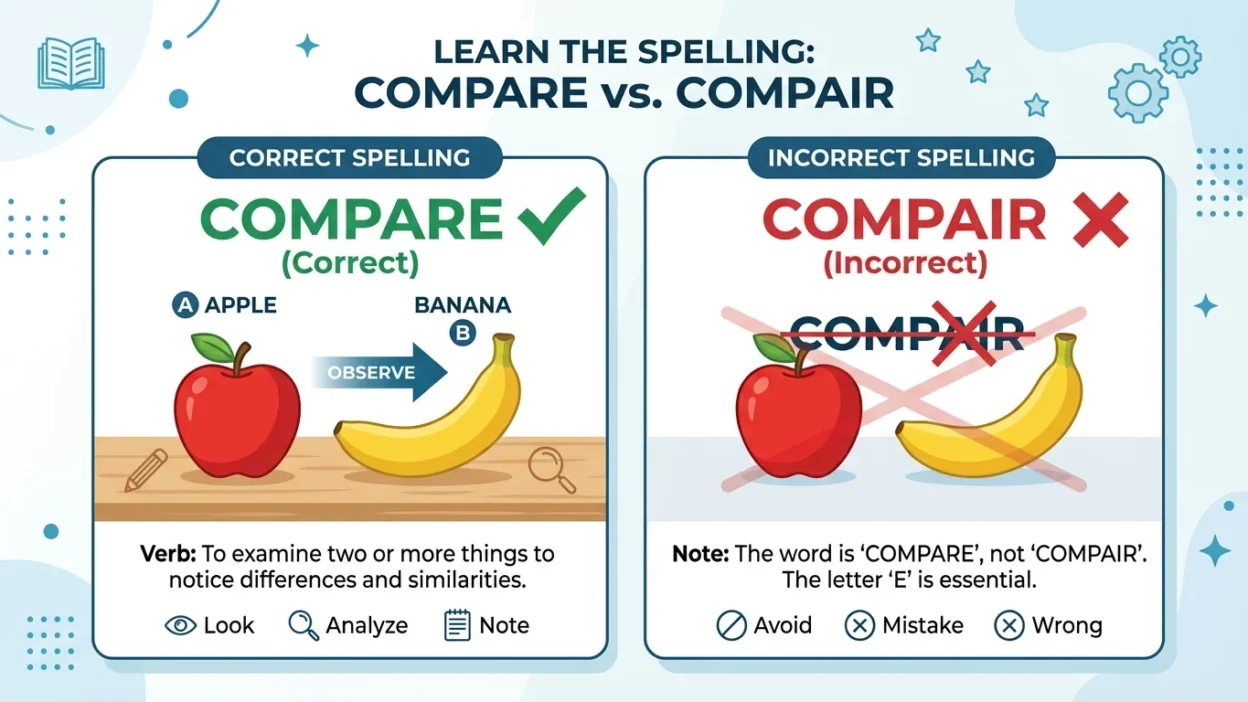
Many learners get confused between “compair” and “compare.” The words look very similar, and when spoken quickly, they sound almost the same. Because of this, people often wonder: Are both correct? Or is one a mistake?
This confusion is very common for students, ESL learners, and beginners. But the truth is simple. Once you learn one clear rule, you will never mix them up again.
Quick Answer
- “Compare” is correct.
- “Compair” is incorrect.
- “Compair” is just a spelling mistake.
- Always use “compare” in writing.
👉 Simple rule: Use “compare,” never “compair.”
Simple Origin or Background
The word “compare” comes from Latin roots meaning “to match” or “to examine together.” Over time, it became part of English with the spelling “compare.”
English often uses “-are” endings in verbs like:
- prepare
- repair
- declare
That is why the correct form is compare, not “compair.”
The spelling “compair” does not follow any standard English pattern.
Clear Explanation of the Difference
Here is the key idea:
👉 There is no real difference—because “compair” is not a correct word.
What does “compare” mean?
“Compare” means:
- To look at two or more things
- To find similarities or differences
Examples of meaning:
- Compare two books
- Compare prices
- Compare results
What about “compair”?
- It is a wrong spelling
- It has no meaning in correct English
- It should never be used
Comparison Table
| Feature | Compair | Compare |
|---|---|---|
| Correct spelling | ❌ No | ✅ Yes |
| Meaning | None | Examine differences |
| Usage | Incorrect | Correct and common |
| Found in dictionary | ❌ No | ✅ Yes |
| Recommended use | Never use | Always use |
Which One to Use and When
👉 Always use “compare.”
Use “compare” when you:
- Look at similarities
- Find differences
- Study two or more things
Examples:
- Please compare the two answers.
- We need to compare prices.
- She compared both options.
👉 Never use “compair.”
Common Mistakes People Make
Writing based on sound
People spell the word as they hear it, and “compare” may sound like “compair.”
Confusing vowel sounds
The “a” and “ai” sound similar, which causes mistakes.
Typing quickly
Sometimes it is just a typing error.
Not knowing the correct pattern
Learners may not recognize the common “-are” ending in verbs.
👉 Tip: Remember words like “prepare” and “compare.”
Everyday Real Life Examples
In school
- Compare your answers with your partner.
- Students compare results in class.
In shopping
- Always compare prices before buying.
- I compared different brands.
In work
- We need to compare these reports.
- She compared the data carefully.
In daily life
- Let’s compare our ideas.
- He likes to compare options before deciding.
On social media
- “Can you compare these two phones?”
- “I compared both and chose this one.”
👉 In all these examples, “compair” would be incorrect.
Short Learning Section for Students and Beginners
Step 1: Learn the correct word
👉 Compare
Step 2: Understand the meaning
Compare = look at similarities and differences
Step 3: Remember the ending
👉 Use “-are,” not “-air”
Easy memory tip
👉 “Compare ends like prepare.”
Practice
Fill in the blanks:
- Please ______ the two pictures.
- I will ______ the prices.
✔ Answers:
- compare
- compare
FAQ
Is “compair” a real word?
No, it is not correct.
Is “compare” correct?
Yes, it is the correct spelling.
Why do people write “compair”?
Because it sounds similar to “compare.”
What does “compare” mean?
It means to examine similarities and differences.
Is “compare” used in daily English?
Yes, it is very common.
How can I remember the spelling?
Remember: “Compare ends with -are.”
Are there similar words?
Yes, like prepare, repair, and declare.
Can I use “compair” in informal writing?
No, it should always be avoided.
Conclusion
The difference between “compair” and “compare” is very simple. “Compare” is correct, and “compair” is a spelling mistake.
Even though they sound similar, only “compare” is accepted in proper English.
👉 If you remember one rule, remember this: Always use “compare” with “-are.”