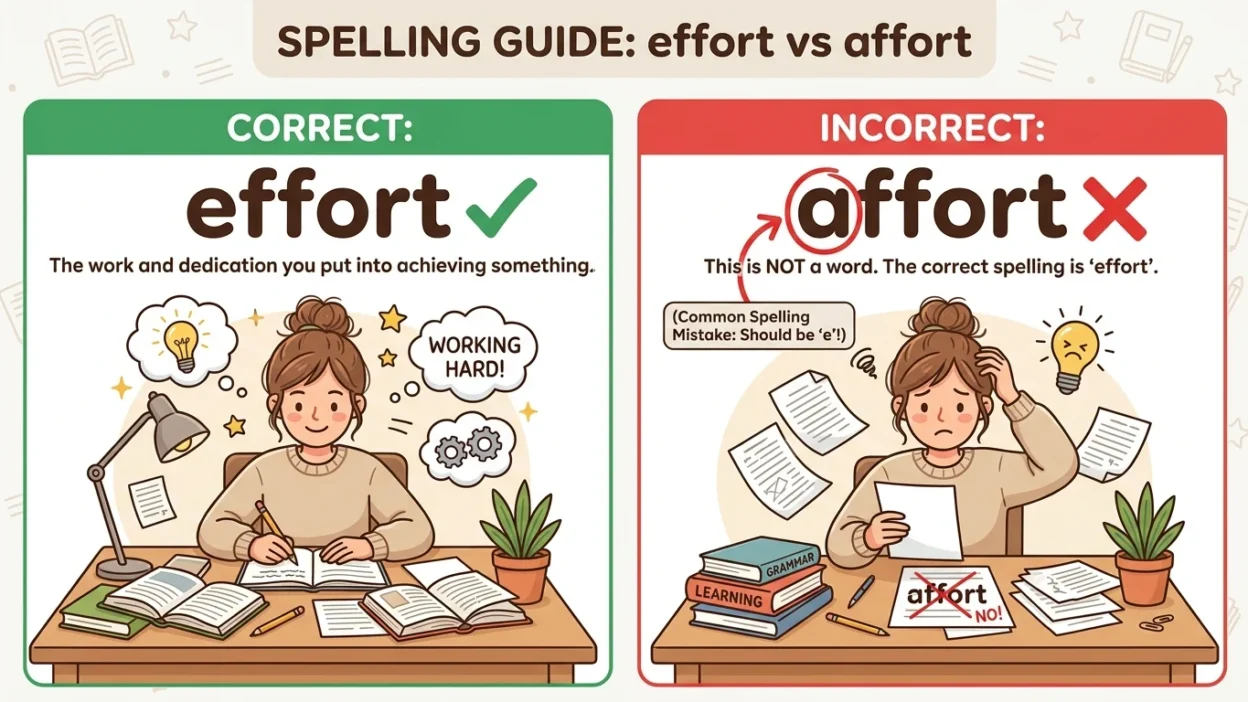
Many learners get confused between “effort” and “affort.” The words look similar, and when speaking quickly, they can sound almost the same. Because of this, it is easy to think both might be correct.
But here’s the truth: only one of these words is correct in standard English. This guide will explain everything clearly in very simple language so you never make this mistake again.
Quick Answer
- “Effort” is correct.
- “Affort” is incorrect (not a real English word).
- Always use “effort” when talking about trying hard.
👉 Simple rule: Use “effort,” never “affort.”
Simple Origin or Background
The word “effort” comes from older French and Latin roots. It means to try hard or use energy to do something.
Over time, the spelling stayed as “effort,” and it became a common English word.
“Affort” does not come from any standard English root. It is usually just a spelling mistake, often caused by confusion with words like “afford.”
Clear Explanation of the Difference
Here is the key idea:
👉 There is no real comparison—because “affort” is not correct.
What does “effort” mean?
“Effort” means:
- Trying hard
- Using energy to do something
- Doing your best
Examples of meaning:
- Make an effort = try hard
- Put in effort = give energy and time
- Best effort = your strongest try
What about “affort”?
- It is not a real English word
- It has no meaning in standard English
- It should never be used in writing
Comparison Table
| Feature | Affort | Effort |
|---|---|---|
| Correct spelling | ❌ No | ✅ Yes |
| Meaning | None | Trying hard |
| Usage | Incorrect | Correct and common |
| Found in dictionary | ❌ No | ✅ Yes |
| Recommended use | Never use | Always use |
Which One to Use and When
👉 Always use “effort.”
Use “effort” when talking about:
- Studying or learning
- Work and tasks
- Goals and achievements
- Daily activities
Examples:
- You need to make more effort.
- She put a lot of effort into her work.
- Success requires effort.
👉 Never use “affort.”
Common Mistakes People Make
1. Mixing with “afford”
Some learners confuse “effort” with “afford.”
- effort = try hard
- afford = have enough money
2. Wrong spelling
❌ affort
✔ effort
3. Typing quickly
People sometimes write “affort” by mistake.
4. Guessing the spelling
👉 Tip: Remember the correct starting sound: “ef-”
Everyday Real Life Examples
In school
- He made a lot of effort to pass the exam.
- She put great effort into her homework.
In work
- This project needs more effort.
- The team showed strong effort.
In daily life
- Success comes from hard effort.
- I appreciate your effort.
In conversations
- “Please make an effort.”
- “Thank you for your effort.”
👉 In all these examples, “affort” would be incorrect.
Short Learning Section for Students and Beginners
Step 1: Learn the correct word
👉 Effort
Step 2: Understand the meaning
Effort = trying hard
Step 3: Avoid the mistake
❌ affort
✔ effort
Easy memory tip
👉 “Effort starts with ‘ef’ like ‘energy’ both need effort.”
Practice
Fill in the blanks:
- You must make more ______.
- She put a lot of ______ into her work.
✔ Answers:
- effort
- effort
FAQ
Is “affort” a real word?
No, it is not correct.
Is “effort” correct?
Yes, it is the correct spelling.
What does “effort” mean?
It means trying hard or using energy to do something.
Why do people write “affort”?
Because of confusion with similar sounds or words like “afford.”
Can I use “affort” in informal writing?
No, it should always be avoided.
What is the difference between “effort” and “afford”?
- effort = try hard
- afford = have enough money
Is “effort” commonly used?
Yes, it is very common in daily English.
How can I remember it?
Remember: “Effort is the only correct spelling.”
Conclusion
The difference between “effort” and “affort” is very simple. “Effort” is the correct word, and “affort” is a spelling mistake.
If you remember one rule always use “effort” you will never go wrong.