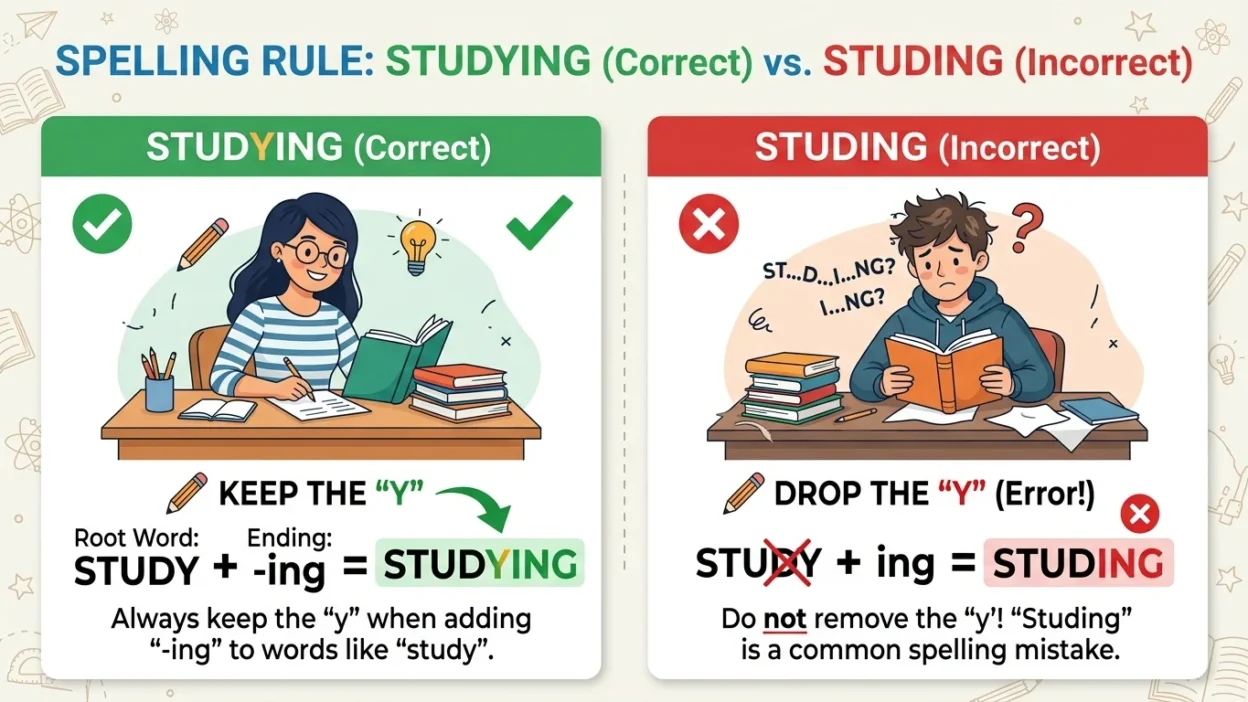
Many learners get confused between “studying” and “studing.” The words look very similar, and when typing fast, it’s easy to miss one letter. Because of this, many students are unsure which one is correct.
The good news is that this is a very simple spelling rule in English. Once you understand it, you will never make this mistake again.
Quick Answer
- “Studying” is correct.
- “Studing” is incorrect.
- We drop “y” and add “-ying” when forming the present continuous.
👉 Simple rule: Always write “studying,” never “studing.”
Simple Origin or Background
The base word is “study.”
When we add “-ing” to verbs, we usually just add it:
- play → playing
- read → reading
But when a verb ends in “y,” something special happens.
👉 We change the spelling slightly:
- study → studying
This follows a common English spelling pattern.
Clear Explanation of the Difference
Here is the key idea:
👉 “Studing” is not a correct word.
What is “studying”?
“Studying” is the present continuous form of “study.” It means:
- Learning something
- Reading or practicing to gain knowledge
Examples:
- I am studying English.
- She is studying for her exam.
What is “studing”?
- It is a spelling mistake
- It is not used in correct English
- It often happens when people forget to follow the spelling rule
Comparison Table
| Feature | Studing | Studying |
|---|---|---|
| Correct spelling | ❌ No | ✅ Yes |
| Meaning | None | Learning/reading |
| Usage | Incorrect | Correct and common |
| Found in dictionary | ❌ No | ✅ Yes |
| Recommended use | Never use | Always use |
Which One to Use and When
👉 Always use “studying.”
Use “studying” when:
- Talking about learning now
- Describing ongoing action
- Writing about school, exams, or practice
Examples:
- I am studying right now.
- They are studying together.
- He is studying math.
👉 Never use “studing.”
Common Mistakes People Make
1. Dropping the “y” incorrectly
❌ studing
✔ studying
2. Typing too fast
Many people accidentally skip the “y.”
3. Not knowing the rule
Learners may not know how verbs ending in “y” change.
4. Guessing the spelling
👉 Tip: Always check the base word “study.”
Everyday Real Life Examples
In conversations
- “I am studying for my test.”
- “She is studying at home.”
In school
- He is studying science.
- We are studying English grammar.
In messages
- “Sorry, I’m studying right now.”
- “They are studying together.”
In daily life
- She spends hours studying every day.
- I am studying for tomorrow’s exam.
👉 In all these examples, “studing” would be wrong.
Short Learning Section for Students and Beginners
Step 1: Start with the base word
Study
Step 2: Add “-ing”
Study → Studying
Step 3: Remember the rule
👉 Keep the “y” and add “-ing” → studying
Easy memory tip
👉 “Don’t drop the ‘y’—study becomes studying.”
Practice
Fill in the blanks:
- I am ______ for my exam.
- She is ______ English.
✔ Answers:
- studying
- studying
FAQ
Is “studing” a real word?
No, it is not correct.
Is “studying” correct?
Yes, it is the correct form.
Why do we keep the “y”?
Because when adding “-ing,” we usually do not remove “y.”
Is this rule common?
Yes, many verbs follow this pattern.
Can I use “studing” in informal writing?
No, it should be avoided completely.
What does “studying” mean?
It means learning or preparing for something.
Is “studying” used in daily English?
Yes, it is very common.
How can I remember it easily?
Remember: “Study keeps the ‘y’ → studying.”
Conclusion
The difference between “studying” and “studing” is very simple. “Studying” is correct, and “studing” is a spelling mistake.
If you follow one easy rule always keep the “y” and add “-ing” you will never make this mistake again.

Weston Maddox is both an author and administrator at SpellCorrect. He oversees site operations while creating accurate, easy-to-understand content focused on correct spelling and proper word usage, helping readers improve writing clarity, precision, and confidence across academic, professional, and everyday English communication.