Many learners get confused between “Thursdays” and “Thursday’s” because they look almost the same. The only visible difference is a small apostrophe, but that tiny mark changes the meaning completely.
If you are a student, ESL learner, or beginner, this can feel tricky at first. The good news is that once you understand one simple rule, the confusion disappears.
This guide will explain everything in very clear and simple English so you can use both forms correctly every time.
Quick Answer
Here is the simple difference:
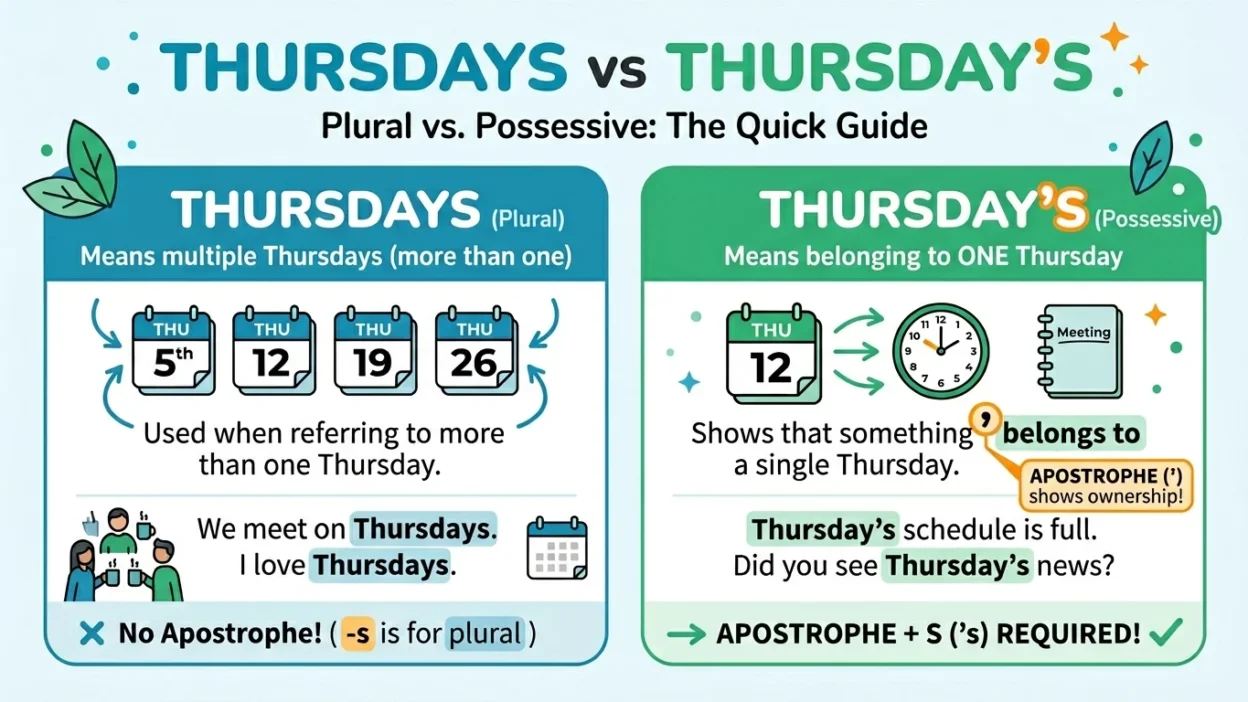
- Thursdays = plural form (more than one Thursday)
- Thursday’s = possessive form (something belongs to Thursday)
Examples:
- I go to class on Thursdays.
- Thursday’s meeting was canceled.
That’s the core idea. Now let’s break it down step by step.
Simple Background Explanation
In English, we change words in two common ways:
- Plural form → to show more than one
- Possessive form → to show ownership or belonging
Days of the week follow these same rules.
- Adding -s makes a word plural
- Adding ’s shows possession
So:
- Thursday + s = Thursdays
- Thursday + ’s = Thursday’s
This is why they look similar but mean different things.
Clear Explanation of the Difference
What does “Thursdays” mean?
Thursdays is the plural form of Thursday. It means more than one Thursday or something that happens regularly on that day.
Use it when talking about habits, routines, or repeated events.
Examples:
- I have football practice on Thursdays.
- Shops close early on Thursdays.
- We meet every Thursdays evening.
What does “Thursday’s” mean?
Thursday’s is the possessive form. It shows that something belongs to Thursday or happens on a specific Thursday.
Examples:
- Thursday’s class was very interesting.
- I missed Thursday’s lecture.
- Do you remember Thursday’s weather?
Think of it like this:
If you can say “the class of Thursday,” then “Thursday’s class” is correct.
Comparison Table
| Word | Type | Meaning | Example Sentence |
|---|---|---|---|
| Thursdays | Plural | More than one Thursday | I work late on Thursdays. |
| Thursday’s | Possessive | Something belongs to Thursday | Thursday’s meeting is important. |
This table gives you a quick way to remember the difference.
Which One to Use and When
Use Thursdays when:
- You mean repeated days
- You talk about routines
- You describe habits
Examples:
- I visit my grandparents on Thursdays.
- We have quizzes on Thursdays.
Use Thursday’s when:
- You refer to one specific Thursday
- Something belongs to that day
- You talk about an event from that day
Examples:
- Thursday’s test was difficult.
- I forgot about Thursday’s appointment.
Quick Tip
Ask yourself:
- Am I talking about many Thursdays? → Use Thursdays
- Am I talking about one Thursday’s thing? → Use Thursday’s
Common Mistakes People Make
1. Using an apostrophe for plural
❌ I go to school on Thursday’s.
✔ I go to school on Thursdays.
Many learners add an apostrophe by mistake. Remember: plural does not need an apostrophe.
2. Forgetting the apostrophe in possessive form
❌ Thursdays meeting was canceled.
✔ Thursday’s meeting was canceled.
Without the apostrophe, the meaning becomes unclear.
3. Mixing both meanings
❌ I enjoyed Thursdays lecture.
✔ I enjoyed Thursday’s lecture.
Here, you are talking about one lecture, so you need the possessive form.
4. Overthinking the rule
Some learners try to memorize too many rules. Keep it simple:
- s = many
- ’s = belongs to
Everyday Real Life Examples
In Emails
- I am available on Thursdays for meetings.
- Let’s discuss Thursday’s report tomorrow.
In School or College
- We have exams on Thursdays.
- Thursday’s exam was easier than Monday’s.
In News
- Traffic is usually heavy on Thursdays.
- Thursday’s match ended in a draw.
On Social Media
- Gym days: Mondays and Thursdays 💪
- Loved Thursday’s sunset! 🌅
In Daily Conversations
- We eat out on Thursdays.
- Did you enjoy Thursday’s party?
These examples show how naturally both forms are used in real life.
Short Learning Section for Students and Beginners
Here is an easy way to practice:
Step 1: Identify the meaning
Read the sentence and ask:
- Is it about many days?
- Or one specific day?
Step 2: Choose the correct form
- Many → Thursdays
- One + ownership → Thursday’s
Step 3: Practice sentences
Fill in the blanks:
- I have music class on ______.
- ______ lesson was very helpful.
- We play cricket every ______.
- I missed ______ meeting.
Answers:
- Thursdays
- Thursday’s
- Thursdays
- Thursday’s
Practice like this daily, and the difference will become natural.
FAQ Section
What is the difference between Thursdays and Thursday’s?
Thursdays is plural (many days), while Thursday’s shows possession (something belongs to Thursday).
Can Thursdays have an apostrophe?
No. Thursdays is a simple plural and does not need an apostrophe.
When should I use Thursday’s?
Use it when talking about something related to one specific Thursday, like Thursday’s meeting.
Is “Thursdays meeting” correct?
No. It should be Thursday’s meeting because the meeting belongs to Thursday.
How can I remember the rule easily?
Think:
- s = many
- ’s = belongs to
Can I use Thursdays for routines?
Yes. Use Thursdays for repeated actions, like weekly plans.
Is Thursday’s always singular?
Yes. It refers to one specific Thursday.
Do other days follow the same rule?
Yes. For example:
- Mondays / Monday’s
- Fridays / Friday’s
The rule is the same for all days.
Conclusion
The difference between Thursdays and Thursday’s is simple once you understand the role of the apostrophe.
- Thursdays talks about more than one day or repeated events
- Thursday’s shows that something belongs to a specific Thursday
If you remember this one idea, you will avoid most mistakes. With a little practice, using the correct form will feel natural and easy in both writing and speaking.