Many learners feel confused between “take effect” and “take affect.” The reason is simple: “effect” and “affect” sound very similar, but they have different meanings and grammar roles. Because of this, people often choose the wrong spelling, especially in writing.
The truth is clear: only one of these phrases is correct. This guide will explain the difference in very simple English so you can understand it quickly and use it confidently.
Quick Answer
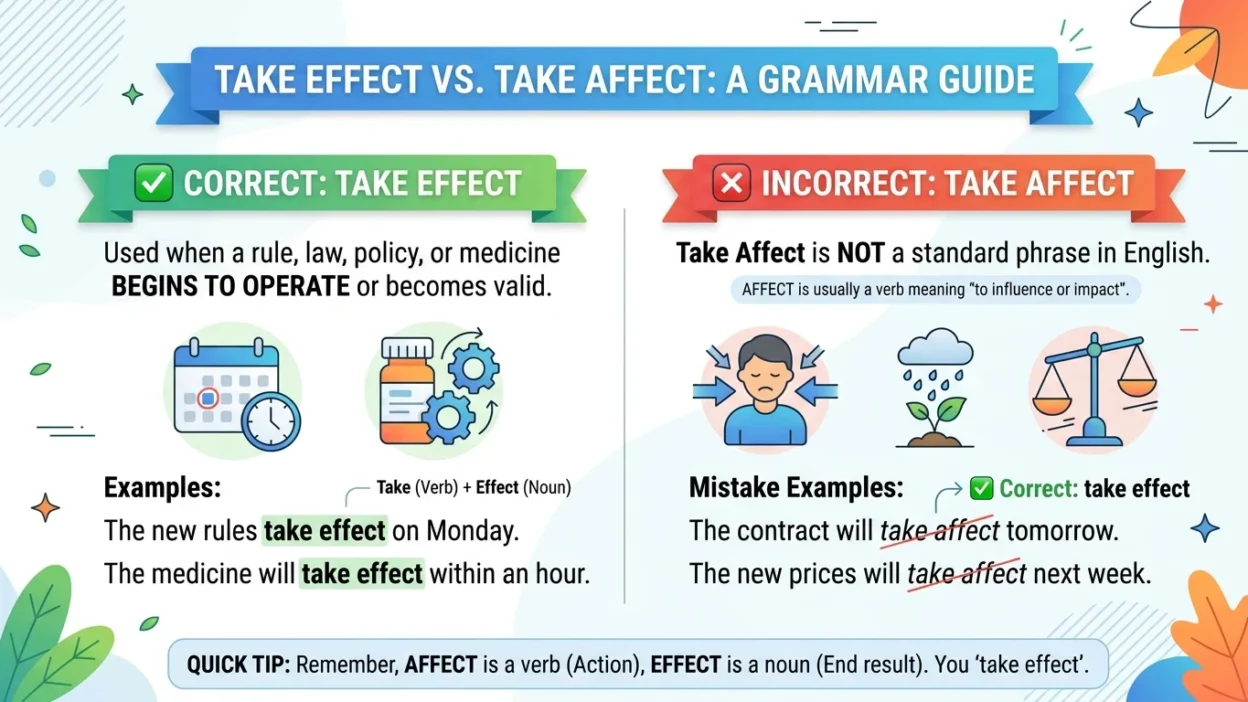
- Take effect = ✅ correct phrase
- Take affect = ❌ incorrect
- “Effect” = result or change
- “Affect” = usually a verb (to influence)
- 👉 Always use “take effect”
Simple Origin or Background
The confusion comes from the words “affect” and “effect.”
- Affect is usually a verb
- Example: “This will affect your decision.”
- Effect is usually a noun
- Example: “This had a strong effect.”
In the phrase “take effect,” the word “effect” means a result or change that begins to happen.
“Take affect” is incorrect because “affect” does not fit grammatically in this phrase.
Clear Explanation of the Difference
Let’s understand it step by step.
What does “take effect” mean?
“Take effect” means:
👉 to start working or to become active
It is used when something begins to have an impact or starts being applied.
Examples:
- “The new law will take effect next month.”
- “The medicine will take effect soon.”
- “The changes take effect immediately.”
👉 It shows the beginning of a result or action.
Why is “take affect” incorrect?
“Affect” is usually a verb, so it cannot be used after “take” in this phrase.
❌ “The rule will take affect tomorrow.”
✔ This is incorrect because “affect” does not work as a noun here.
👉 The phrase needs a noun, and only “effect” is correct.
Comparison Table
| Feature | Take Effect | Take Affect |
|---|---|---|
| Correctness | ✅ Correct | ❌ Incorrect |
| Meaning | Start working / begin | No proper meaning |
| Grammar | Uses noun (effect) | Wrong form (verb) |
| Usage | Common and standard | Not used |
| Example | “The law takes effect.” | ❌ Incorrect sentence |
Which One to Use and When
Always use “take effect.”
Use it when:
- A rule, law, or change begins
- Something starts working
- You talk about timing of actions
Examples:
- “The policy will take effect in July.”
- “The medicine takes effect in 30 minutes.”
- “The new system takes effect today.”
👉 Never use “take affect” in correct English.
Common Mistakes People Make
One common mistake is confusing “affect” and “effect” because they sound the same.
Another mistake is not understanding grammar roles. “Affect” is usually a verb, but this phrase needs a noun.
Some learners also write quickly and choose the wrong spelling without checking.
A simple rule helps:
👉 After “take,” use effect, not affect.
Everyday Real-Life Examples
In daily conversation:
- “The medicine will take effect soon.”
In emails:
- “The new rules take effect from Monday.”
In news:
- “The law will take effect next year.”
In school or work:
- “The changes take effect immediately.”
Incorrect example:
- ❌ “The plan will take affect tomorrow.”
Short Learning Section for Students and Beginners
Easy Trick to Remember
- Effect = result → correct here
- Affect = action → not correct here
Quick Practice
Fill in the blank:
- The rule will ______ effect soon.
- The medicine will ______ effect quickly.
- The changes ______ effect today.
✔ Correct answers:
- Take
- Take
- Take
(Complete phrase: take effect)
Simple Rule
👉 “Take effect” is always correct
👉 “Take affect” is always wrong
FAQ Section
Is “take affect” ever correct?
No, it is not correct in standard English.
What does “take effect” mean?
It means something starts working or becomes active.
Why do people confuse affect and effect?
Because they sound similar but have different meanings and grammar uses.
Is “affect” always a verb?
Most of the time, yes. That is why it does not fit in this phrase.
Can “effect” be a verb?
Yes, but rarely. In this phrase, it is a noun.
Is “take effect” formal or informal?
It can be used in both formal and informal situations.
How can I remember the correct phrase?
Remember: “Effect = result,” so it fits after “take.”
Conclusion
The difference between “take effect” and “take affect” is very simple.
- “Take effect” is correct and widely used.
- “Take affect” is incorrect and should be avoided.
If you remember that “effect” means result and fits the phrase, you will always use the correct form. Keep practicing, and this mistake will become easy to avoid.