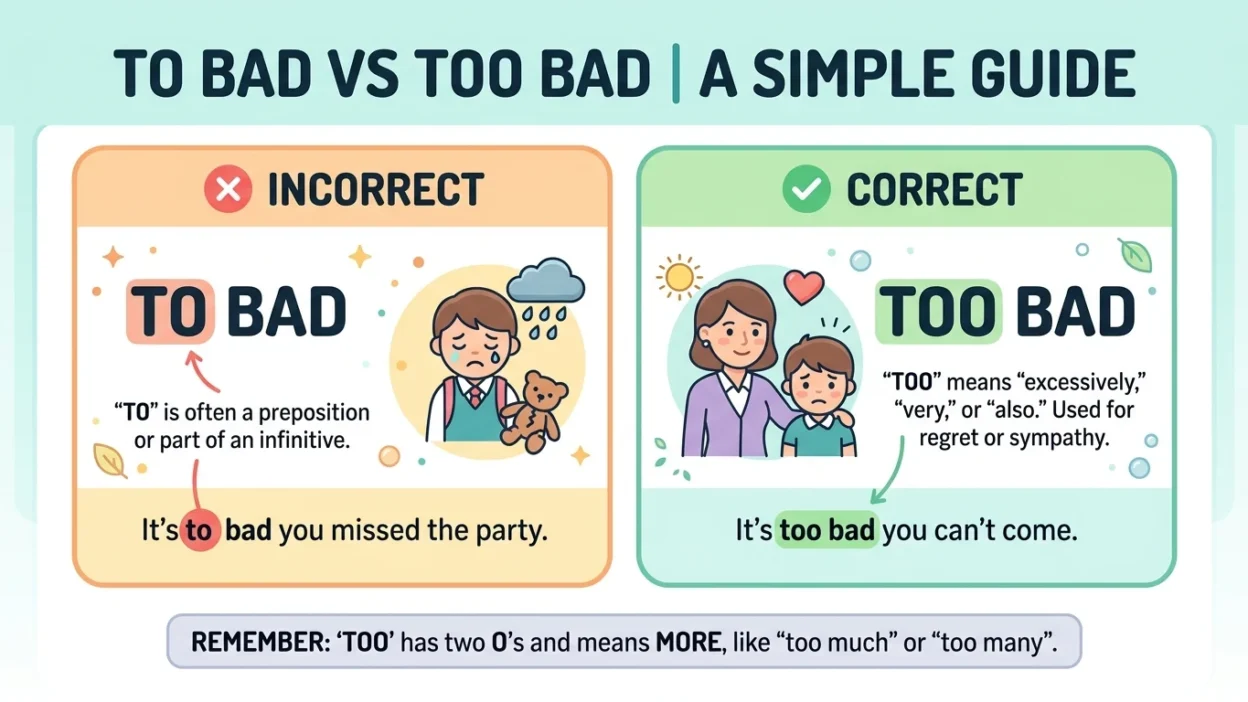
Many learners feel confused when choosing between “to bad” and “too bad.” The reason is simple: “to” and “too” sound exactly the same, but they have different meanings and uses. Because of this, people often write the wrong one without noticing.
The good news is that this difference is very easy to understand. Once you learn one simple rule, you will never mix them up again.
Quick Answer
Too bad = ✅ correct phrase
To bad = ❌ incorrect in almost all cases
“Too” = means very or more than enough
“To” = used for direction or purpose
👉 Always use “too bad” when expressing regret or disappointment
Simple Origin or Background
The confusion comes from the words “to” and “too.”
To is a very common word used for:
direction → “go to school”
purpose → “want to learn”
Too means:
“very” → “too hot”
“more than needed” → “too much”
In the phrase “too bad,” the word “too” means “very” or “extremely.”
“To bad” does not follow any correct grammar rule, so it is considered incorrect.
Clear Explanation of the Difference
Let’s make it very simple.
What does “too bad” mean?
“Too bad” is a common expression used to show:
disappointment
sympathy
mild regret
It can mean:
“That is unfortunate”
“That is sad”
Examples:
“You missed the game? Too bad!”
“It’s too bad you couldn’t come.”
👉 It shows a feeling about something negative.
Why is “to bad” incorrect?
“To” cannot be used before “bad” in this way.
❌ “That’s to bad.”
✔ This is wrong because “to” does not mean “very.”
👉 The sentence needs “too,” not “to.”
Comparison Table
Feature Too Bad To Bad
Correctness ✅ Correct ❌ Incorrect
Meaning Very unfortunate / sad No proper meaning
Grammar Uses “too” (very) Wrong use of “to”
Usage Very common Not used
Example “That’s too bad.” ❌ Incorrect sentence
Which One to Use and When
Always use “too bad.”
Use it when:
You feel sorry about something
You want to show disappointment
You are reacting to bad news
Examples:
“It’s too bad you are sick.”
“Too bad we missed the bus.”
“That’s too bad.”
👉 Never use “to bad” in standard English.
Common Mistakes People Make
A very common mistake is using “to” instead of “too” because they sound the same.
Another mistake is not understanding that “too” means “very” in this phrase.
Some learners also write quickly and do not check spelling, which leads to errors like “to bad.”
A simple rule helps:
👉 If you mean “very” or “unfortunately,” use too.
Everyday Real-Life Examples
In conversation:
“You failed the test? Too bad.”
In messages:
“It’s too bad you couldn’t join us.”
In social media:
“Too bad the event was canceled.”
In daily life:
“Too bad it’s raining today.”
Incorrect example:
❌ “That’s to bad.”
Short Learning Section for Students and Beginners
Easy Trick to Remember
Too = extra / very → correct
To = direction → not correct here
Quick Practice
Fill in the blank:
That’s _ bad. It’s bad you missed it.
_ bad we can’t go.
✔ Correct answers:
Too
Too
Too
Simple Rule
👉 “Too bad” is always correct
👉 “To bad” is always wrong
FAQ Section
Is “to bad” ever correct?
No, it is not correct in standard English.
What does “too bad” mean?
It means something is unfortunate or disappointing.
Why do people confuse “to” and “too”?
Because they sound exactly the same.
Can “too” mean “very”?
Yes, “too” can mean “very” or “more than enough.”
Is “too bad” formal or informal?
It is mostly informal but widely used in everyday English.
Can I use “too bad” in writing?
Yes, especially in casual writing or dialogue.
How can I remember the difference?
Remember: “Too” has an extra “o,” meaning extra or more.
Conclusion
The difference between “to bad” and “too bad” is very simple.
“Too bad” is correct and commonly used.
“To bad” is incorrect and should be avoided.
If you remember that “too” means “very” or “extra,” you will always choose the right word. Keep practicing, and this mistake will disappear from your writing.