
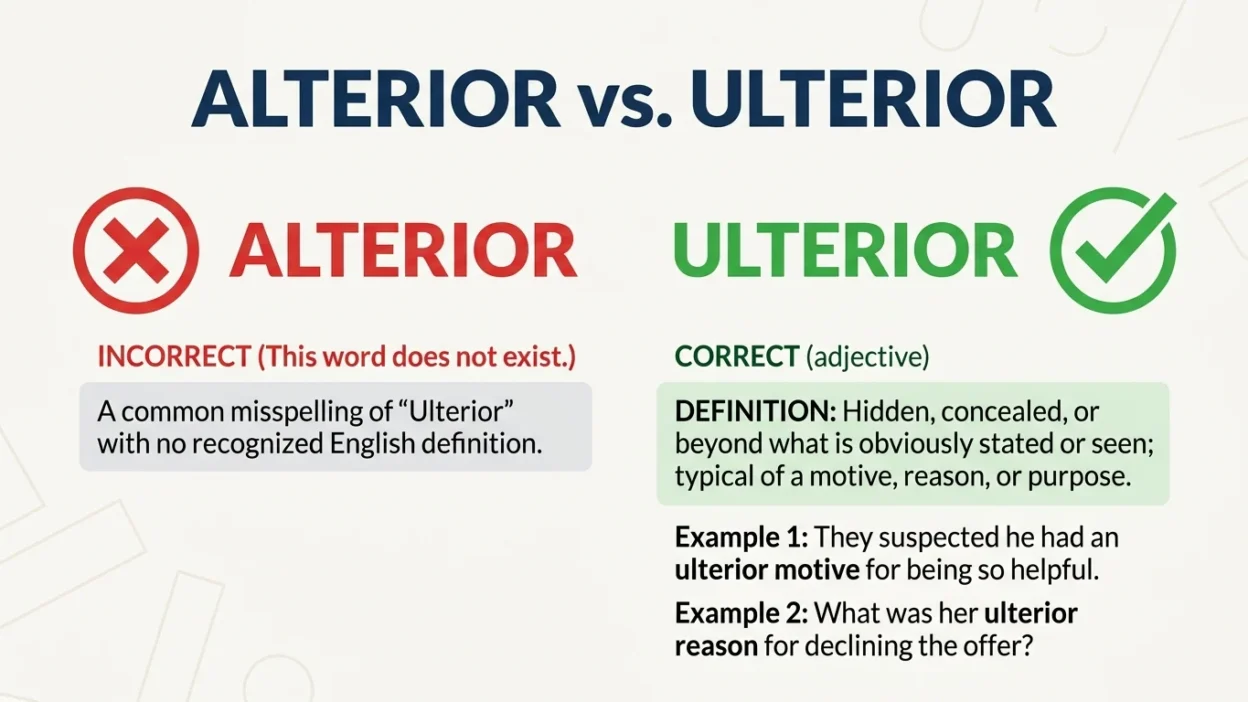
Many learners get confused between “alterior” and “ulterior.” The words look very similar, and the spelling difference is small. Because of this, people often think both are correct or interchangeable.
But the truth is simple: only one of these words is correct in English. This guide will help you understand the difference clearly and avoid mistakes.
Quick Answer
- Ulterior = ✅ correct word
- Alterior = ❌ incorrect spelling
- Meaning of “ulterior” = hidden or secret (often used with “motive”)
- 👉 Always use “ulterior”
Simple Origin or Background
The word “ulterior” comes from Latin, meaning “beyond” or “hidden.” Over time, it became part of English and is now commonly used in phrases like “ulterior motive.”
The spelling “alterior” likely appears because of confusion with similar-looking words like “alter” or “alternative.” However, it is not a real English word.
Clear Explanation of the Difference
The difference is very straightforward:
- Ulterior is the correct word. It describes something hidden, not obvious, or secret usually a reason behind someone’s actions.
- Alterior is a spelling mistake and has no meaning in standard English.
👉 So, whenever you want to talk about a hidden reason, use “ulterior.”
Comparison Table
| Feature | Ulterior | Alterior |
|---|---|---|
| Spelling | Correct | Incorrect |
| Usage | Common in English | Not used |
| Meaning | Hidden or secret | No meaning |
| Example | “ulterior motive” | ❌ Not correct |
| Recommended | ✅ Yes | ❌ No |
Which One to Use and When
Always use “ulterior” when you want to describe a hidden reason or intention.
Common usage:
- Ulterior motive = a secret reason behind an action
Examples:
- “He helped me, but I think he has an ulterior motive.”
- “She seems kind, but her intentions may be ulterior.”
Never use “alterior,” because it is always incorrect.
Common Mistakes People Make
One common mistake is spelling the word based on how it sounds. Since “ulterior” is not a very common word, learners often guess the spelling and write “alterior.”
Another mistake is mixing it with words like “alter” or “alternative,” which leads to the wrong spelling.
Some people also believe both versions are correct. This is not true—only “ulterior” is correct.
Everyday Real Life Examples
In conversation:
- “Are you sure he doesn’t have an ulterior motive?”
In news or discussions:
- “The decision may have ulterior reasons.”
In writing:
- “She agreed, but her intentions were ulterior.”
❌ Incorrect examples:
- “He has an alterior motive.”
- “Her alterior intentions are unclear.”
Short Learning Section for Students and Beginners
Easy Rule
👉 Ulterior = correct
👉 Alterior = wrong
Memory Trick
Think:
“Ulterior starts with ‘U’ = ‘Under’ (hidden meaning)”
Practice
Fill in the blank:
- He has an ______ motive.
- Her intentions seem ______.
- I suspect an ______ reason behind this.
✔ Answers:
- ulterior
- ulterior
- ulterior
FAQ Section
Is “alterior” a real English word?
No, “alterior” is not a correct word in English.
Which is correct: alterior or ulterior?
“Ulterior” is the correct spelling.
What does “ulterior motive” mean?
It means a hidden or secret reason for doing something.
Why do people write “alterior”?
Because they confuse it with similar words like “alter.”
Can I use “alterior” in formal writing?
No, it will be considered incorrect.
Is “ulterior” a formal word?
Yes, it is often used in formal and semi-formal contexts.
How can I remember the correct spelling?
Remember: “Ulterior” starts with “U” for “under” or hidden.
Conclusion
The difference between “alterior” and “ulterior” is very clear.
- Ulterior is the correct and meaningful word used to describe hidden motives or intentions.
- Alterior is a spelling mistake and should never be used.
To write correct English, always choose “ulterior.” This will help you sound clear, accurate, and confident.