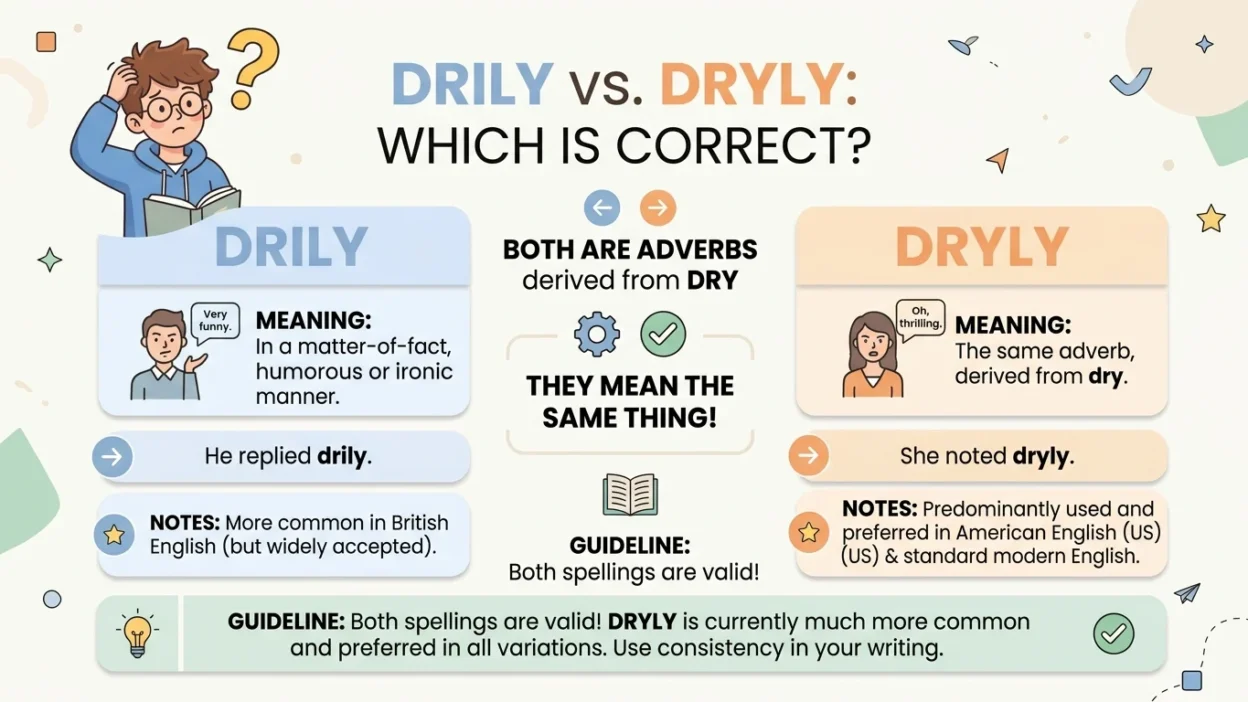
Many learners get confused between “drily” and “dryly.” At first look, both words seem almost the same. They sound the same, and they even mean the same thing in most situations. So, it’s normal to wonder: Is one correct and the other wrong? Or should I use both?
Don’t worry this guide will clear all your confusion in very simple English. By the end, you will fully understand when and how to use each word with confidence.
Quick Answer
- Both “drily” and “dryly” are correct.
- They have the same meaning.
- Both are adverbs of the word “dry.”
- “Dryly” is more common in modern English.
- “Drily” is less common, but still correct and used in some writing styles.
👉 In simple terms: You can use either one, but “dryly” is safer and more popular.
Simple Origin or Background
Both words come from the adjective “dry.” When we turn adjectives into adverbs (words that describe actions), we usually add “-ly.”
- dry → dry + ly = dryly
- dry → dri + ly = drily
This change happens because English sometimes adjusts spelling when adding endings. Over time, both forms stayed in use, which is why we now have two correct spellings.
Clear Explanation of the Difference
Here’s the most important point:
👉 There is NO difference in meaning between “drily” and “dryly.”
Both words mean:
- In a dry manner (not wet)
- In a serious or calm way without much emotion
- Sometimes with quiet or subtle humor
Example:
- He spoke dryly.
- He spoke drily.
Both sentences mean the same thing.
The only difference is in spelling and usage preference. “Dryly” is more modern and widely used, while “drily” is less common and may feel slightly formal.
Comparison Table
| Feature | Drily | Dryly |
|---|---|---|
| Meaning | Same as “dryly” | Same as “drily” |
| Correct spelling | Yes | Yes |
| Usage frequency | Less common | More common |
| Style | Slightly formal or old | Modern and standard |
| Easy for learners | Slightly confusing | Easier and clearer |
| Recommended use | Optional | Preferred choice |
Which One to Use and When
If you are unsure, follow this simple rule:
👉 Use “dryly” in most situations.
Use “dryly” when:
- Writing essays or school work
- Sending emails
- Posting on social media
- Writing stories or general content
Use “drily” when:
- You prefer a traditional or formal tone
- You see it in books and want to match that style
👉 Simple advice: If you want to be safe and clear, choose “dryly.”
Common Mistakes People Make
Thinking one word is wrong
❌ “Drily is incorrect.”
✔ Both are correct.
Thinking they have different meanings
❌ “Dryly and drily mean different things.”
✔ They mean the same thing.
Spelling confusion
❌ “Dryli”
❌ “Drilyy”
✔ Correct: dryly / drily
Overthinking the choice
Many learners waste time choosing between them.
👉 Tip: Just use dryly and continue writing.
Everyday Real Life Examples
In conversations
- She dryly said, “That was not your best idea.”
- He drily replied, “Well, that went well.”
In emails
- “Thanks for your reply,” she wrote dryly.
- “I will try again,” he added drily.
In news or reports
- The speaker dryly noted the issue.
- The official drily commented on the situation.
On social media
- “Great, another Monday,” she posted dryly.
- “Exactly what I needed,” he said drily.
👉 You can switch the words in all examples and the meaning will stay the same.
Short Learning Section for Students and Beginners
Step 1: Know the base word
“Dry” means:
- Not wet
- Or serious and calm
Step 2: Add “-ly”
Dry → Dryly (common form)
Step 3: Learn the variation
Dry → Drily (less common form)
Easy memory tip
👉 “Dryly is the normal one. Drily is the extra one.”
Practice
Fill in the blanks:
- He ______ said it was a mistake.
- She ______ smiled at the comment.
✔ Answer: Both dryly or drily are correct.
FAQ
Is “drily” a real word?
Yes, it is a correct English word.
Is “dryly” more correct?
No, but it is more common.
Do they have different meanings?
No, both have the same meaning.
Which one should I use in exams?
Use dryly to be safe and clear.
Why are there two spellings?
English keeps both old and new forms of some words.
Can I use both in one paragraph?
It is better to choose one and stay consistent.
Is “drily” old fashioned?
It may feel slightly old, but it is still correct.
Which one do native speakers use more?
Most people use dryly.
Conclusion
Understanding “drily” vs “dryly” is very simple once you know the truth. Both words are correct, both have the same meaning, and both can be used in the same situations.
The only real difference is how often they are used. Dryly is more common and easier, while drily is less common but still correct.
👉 If you remember one rule, remember this: Use “dryly” in everyday writing, and you will never go wrong.

Weston Maddox is both an author and administrator at SpellCorrect. He oversees site operations while creating accurate, easy-to-understand content focused on correct spelling and proper word usage, helping readers improve writing clarity, precision, and confidence across academic, professional, and everyday English communication.