Many learners get confused between “rehireable” and “rehirable.” Both look correct at first glance. Both come from the verb “rehire,” so it is easy to think either spelling works.
But in standard English, only one form is correct.
This guide will explain the difference in very simple English so you can use the right word with confidence.
Quick Answer
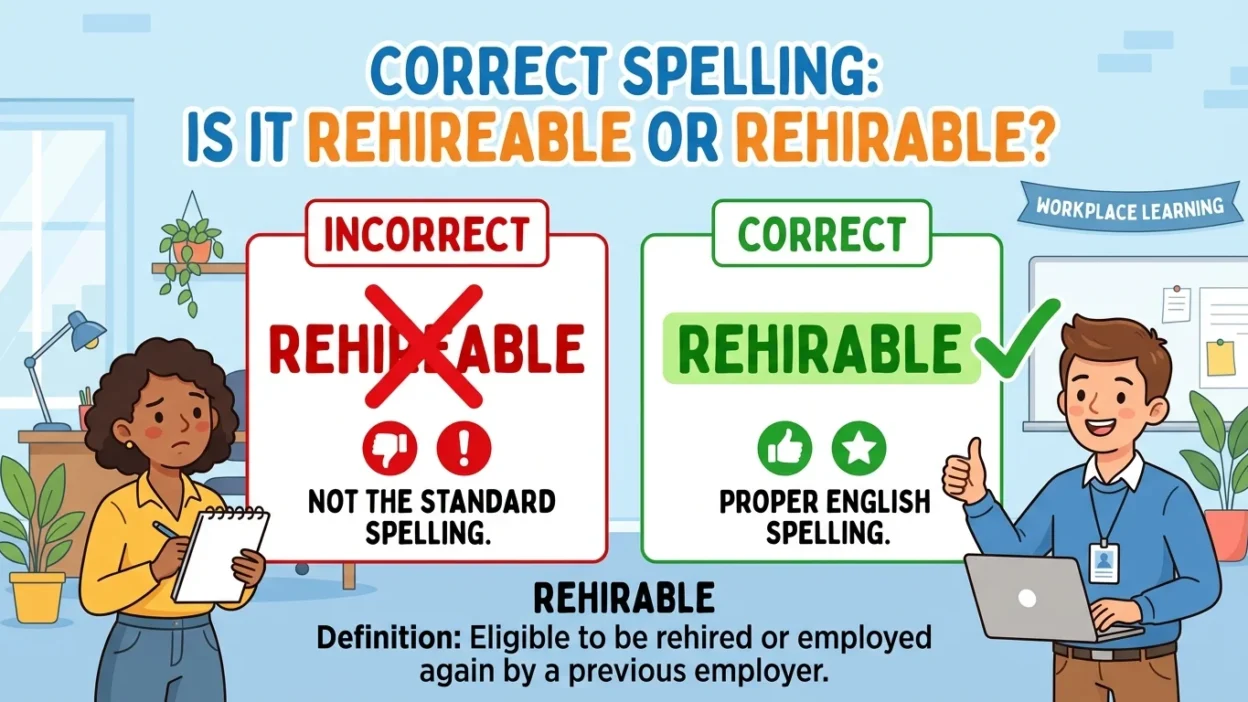
- ✅ Rehirable = Correct spelling
- ❌ Rehireable = Incorrect spelling (not standard)
- Use rehirable to describe someone who can be hired again
- Avoid rehireable in all writing
Simple Background Explanation
The word comes from two parts:
- re- = again
- hire = give someone a job
When we add “-able” (meaning “can be”), we get a word that means:
👉 “able to be hired again”
In English spelling, when we add “-able” to many words ending in “e,” we usually drop the “e.”
Example:
- hire → hirable
- rehire → rehirable
That is why rehirable is the correct form.
The version “rehireable” keeps the extra “e,” which is not standard.
Clear Explanation of the Difference
What is “Rehirable”?
Rehirable means:
- A person who can be hired again
- Someone suitable to return to a job
Examples:
- She is fully rehirable after leaving the company.
- The manager marked him as rehirable.
What is “Rehireable”?
Rehireable:
- ❌ Not standard English
- ❌ A spelling mistake or non-preferred form
Some people write it, but it is not correct in formal or proper writing.
Comparison Table
| Feature | Rehirable ✅ | Rehireable ❌ |
|---|---|---|
| Correct spelling | Yes | No (non-standard) |
| Meaning | Can be hired again | Same idea, wrong form |
| Used in English | Yes | Avoid using |
| Example sentence | “She is rehirable.” | Incorrect usage |
| Should you use it? | Yes | No |
Which One to Use and When
Always use rehirable.
Use “rehirable” when:
- Talking about employees
- “He is marked as rehirable.”
- Talking about job status
- “Former staff may be rehirable.”
- Writing formal documents
- “The employee is eligible and rehirable.”
Avoid “rehireable”
Even if you see it online or in casual writing, it is better to use the correct form rehirable.
Common Mistakes People Make
1. Keeping the extra “e”
People write:
- rehire → rehireable ❌
But the correct pattern is:
- rehire → rehirable ✅
2. Not knowing the “-able” rule
In many cases:
- remove final “e” before adding “-able”
3. Following wrong examples
Some words keep the “e,” but “rehire” does not follow that pattern.
4. Guessing the spelling
Learners often guess instead of checking standard usage.
Everyday Real Life Examples
In Work or HR
- “The employee is listed as rehirable.”
- “She left on good terms and is rehirable.”
In Emails
- “Please confirm if he is rehirable.”
- “All rehirable staff will be contacted.”
In Job Discussions
- “They only accept rehirable candidates.”
- “He is not marked as rehirable.”
Incorrect Example (Avoid This)
- ❌ “She is rehireable.”
✔ Correct: “She is rehirable.”
Short Learning Section for Students and Beginners
Memory Trick
👉 Rehirable = re + hirable (no extra “e”)
Think:
- hire → hirable
- rehire → rehirable
Practice Exercise
Fill in the blanks:
- She is marked as ______.
- Former workers may be ______.
- The company checks if staff are ______.
Answers:
- rehirable
- rehirable
- rehirable
Quick Tip
If you see “hireable” inside the word, remove the extra “e.”
FAQ
1. Is “rehireable” ever correct?
No. It is not standard and should be avoided.
2. What does “rehirable” mean?
It means “able to be hired again.”
3. Why is the “e” removed?
Because when adding “-able,” the final “e” is often dropped.
4. Can I use “rehirable” in formal writing?
Yes. It is correct and commonly used in professional contexts.
5. Is “rehirable” a common word?
Yes, especially in HR and job-related writing.
6. Is this sentence correct: “He is rehireable”?
No. Correct sentence:
“He is rehirable.”
7. How can I remember the spelling?
Remember:
👉 Drop the “e” before adding “-able”
8. Are there similar words like this?
Yes:
- move → movable
- hire → hirable
Conclusion
The difference between rehireable and rehirable is simple:
- Rehirable is correct
- Rehireable is incorrect
The key rule is to drop the “e” before adding “-able.”
By remembering this, you can:
- Avoid spelling mistakes
- Write clearly in professional contexts
- Improve your English confidence

Weston Maddox is both an author and administrator at SpellCorrect. He oversees site operations while creating accurate, easy-to-understand content focused on correct spelling and proper word usage, helping readers improve writing clarity, precision, and confidence across academic, professional, and everyday English communication.