Many learners feel confused between “foward” and “forward.” These words look almost the same, and when we speak quickly, the difference is hard to hear.
Because of this, people often write the wrong spelling without noticing.
The good news is that this confusion is very easy to fix. Once you understand one simple rule, you will never mix them up again.
Quick Answer
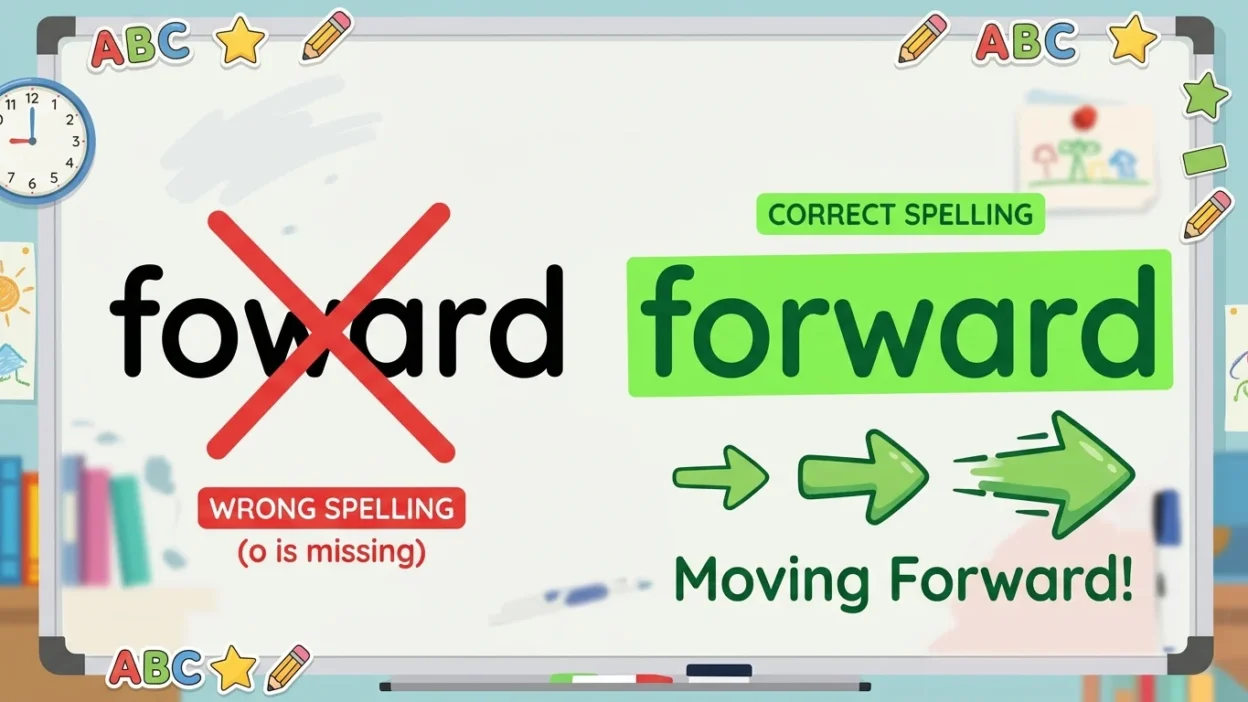
- ✅ Forward = Correct spelling
- ❌ Foward = Incorrect spelling
- Use forward when talking about direction, movement, or progress
- Never use foward in writing
Simple Background Explanation
The word forward comes from Old English. It is made from two parts:
- fore = front
- -ward = direction
So, forward means “toward the front” or “ahead.”
Over time, the spelling changed slightly, but the “r” sound in the middle stayed important.
The form “foward” is just a mistake. It usually happens because:
- People forget the “r”
- The word is spoken quickly
- They type too fast
But in correct English, forward always has the letter “r.”
Clear Explanation of the Difference
What is “Forward”?
Forward means:
- Moving ahead
- In front direction
- Making progress
Examples:
- She stepped forward.
- Let’s move forward with the plan.
- He leaned forward to listen.
What is “Foward”?
Foward:
- ❌ Not a real English word
- ❌ A spelling mistake of “forward”
It should never be used in correct writing.
Comparison Table
| Feature | Forward ✅ | Foward ❌ |
|---|---|---|
| Correct spelling | Yes | No |
| Meaning | Ahead / toward the front | No meaning |
| Used in English | Yes | No |
| Example sentence | “Move forward.” | Incorrect usage |
| Should you use it? | Yes | Never |
Which One to Use and When
Always use forward in all situations.
Use “forward” when:
- Talking about movement
- “He walked forward.”
- Talking about progress
- “We are moving forward.”
- Talking about position
- “She sat forward in her chair.”
- Talking about sending something
- “Please forward this email.”
Never use “foward”
Even in:
- Text messages
- Emails
- Social media
Always check that the “r” is there:
👉 for-ward, not fo-ward
Common Mistakes People Make
1. Dropping the “r”
The most common mistake:
- forward → foward
People simply forget the “r.”
2. Typing too quickly
Fast typing can lead to missing letters.
3. Not noticing pronunciation
In fast speech, “forward” may sound like “foward,” which causes confusion.
4. Not proofreading
Small spelling mistakes often go unnoticed.
Everyday Real Life Examples
In Emails
- “Please forward the message to the team.”
- “I will forward your request.”
In School or Work
- “Let’s move forward with the project.”
- “We are making forward progress.”
In Daily Conversation
- “Take one step forward.”
- “He leaned forward to see better.”
On Social Media
- “Keep moving forward!”
- “Looking forward to the weekend!”
Incorrect Example (Avoid This)
- ❌ “I will foward the email.”
✔ Correct: “I will forward the email.”
Short Learning Section for Students and Beginners
Memory Trick
👉 Forward = “for” + “ward” (both have “r”)
If you remember “for,” you will not forget the “r.”
Practice Exercise
Fill in the blanks:
- Please ______ this message.
- Take a step ______.
- We are moving ______ with the plan.
Answers:
- forward
- forward
- forward
Quick Tip
If you write foward, ask yourself:
👉 “Where is the ‘r’?”
Then fix it to forward.
FAQ
1. Is “foward” ever correct?
No. It is always a spelling mistake.
2. What does “forward” mean?
It means “ahead” or “toward the front.”
3. Can I use “forward” in formal writing?
Yes. It is correct in all types of writing.
4. Why do people write “foward”?
Because they forget the “r” or type too fast.
5. Is “forward” a verb or an adverb?
It can be both:
- Verb: “Please forward the email.”
- Adverb: “Move forward.”
6. Is this sentence correct: “I foward the file”?
No. Correct sentence:
“I forward the file.”
7. How can I remember the spelling?
Remember:
👉 Forward always has “r.”
8. Is “forward” used in daily English?
Yes. It is very common in speaking and writing.
Conclusion
The difference between foward and forward is very simple:
- Forward is correct
- Foward is incorrect
The only thing you need to remember is the missing “r.”
By using the correct spelling, you can:
- Avoid common mistakes
- Write clearly
- Feel more confident in English
Keep practicing, and soon this will feel natural to you.

Weston Maddox is both an author and administrator at SpellCorrect. He oversees site operations while creating accurate, easy-to-understand content focused on correct spelling and proper word usage, helping readers improve writing clarity, precision, and confidence across academic, professional, and everyday English communication.