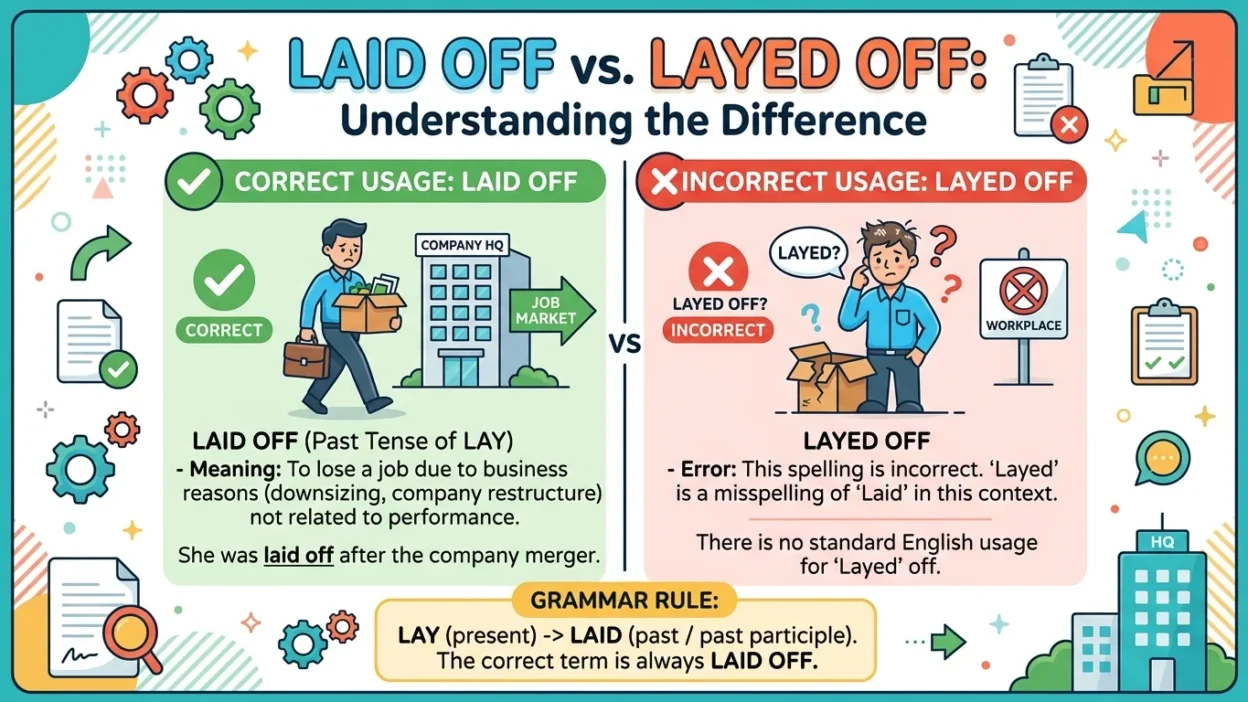
Many learners feel confused about “laid off” and “layed off” because they sound similar and are often mixed up in writing. This confusion usually comes from the verb “lay,” which has an irregular past form.
The truth is simple: one form is correct, and the other is a spelling mistake. Once you understand the verb forms, you will not make this error again.
Quick Answer
- Laid off = correct past form
- Layed off = incorrect spelling
Example:
- He was laid off from his job.
Simple Background Explanation
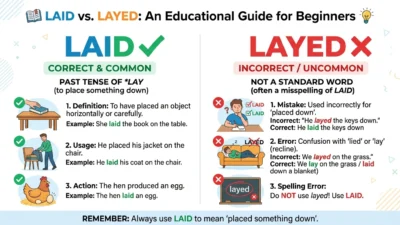
The verb “lay” is irregular:
- Present: lay
- Past: laid
- Past participle: laid
Because of this, we use “laid,” not “layed.”
“Layed” is not a standard English word, which is why “layed off” is incorrect.
Clear Explanation of the Difference
What does “laid off” mean?
Laid off is the correct phrase. It is the past form of “lay off.”
It means:
- To lose a job, usually because the company does not need workers
- To stop employing someone (temporarily or permanently)
Examples:
- He was laid off last month.
- Many workers were laid off during the crisis.
- She got laid off from her company.
What about “layed off”?
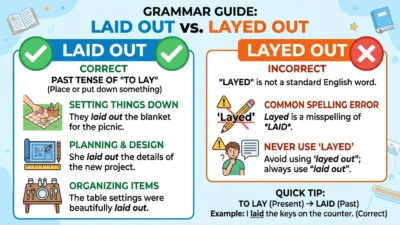
Layed off is incorrect.
❌ He was layed off.
✔ He was laid off.
There is no situation in standard English where “layed” is correct.
Comparison Table
| Phrase | Correct? | Meaning | Example Sentence |
|---|---|---|---|
| Laid off | Yes | Lost a job / removed from work | He was laid off yesterday. |
| Layed off | No | Incorrect spelling | (Avoid using) |
Which One to Use and When
Use laid off when:
- Talking about losing a job
- Referring to past events
- Describing employment changes
Examples:
- She was laid off due to budget cuts.
- They were laid off last year.
Avoid layed off in all situations.
Quick Tip
- Lay → Laid (not layed)
- Always use laid off
Common Mistakes People Make
1. Adding “-ed” to make past tense
❌ lay → layed
✔ lay → laid
Not all verbs follow the regular “-ed” rule.
2. Writing layed off in emails or exams
This is a very common mistake. Always double-check your spelling.
3. Confusing “lay” with “lie”
- Lay → laid
- Lie → lay (different verb)
This adds to confusion, but remember:
laid off is correct.
4. Relying on sound instead of spelling
“Layed” sounds possible, but it is not correct in standard English.
Everyday Real Life Examples
In Work or Business
- The company laid off 50 employees.
- He was laid off due to budget cuts.
In News
- Workers were laid off after the factory closed.
- Many people were laid off during the economic downturn.
In Conversations
- I heard he was laid off.
- She got laid off last week.
In Social Media
- Tough year… got laid off 😔
- Hoping to find a new job after being laid off 💼
In Daily Life
- My friend was laid off recently.
- Several employees were laid off.
Short Learning Section for Students and Beginners
Step 1: Learn the verb
- Lay → laid → laid
Step 2: Apply the rule
- Past tense → laid off
Step 3: Practice
Fill in the blanks:
- He was ______ last year.
- Many workers were ______.
- She got ______ from her job.
- They were ______ during the crisis.
Answers:
- laid off
- laid off
- laid off
- laid off
FAQ
What is the difference between laid off and layed off?
Laid off is correct, while layed off is incorrect.
Is layed a real word?
No, it is not standard English.
What does laid off mean?
It means losing a job, usually due to company reasons.
Why do people write layed?
Because they try to form the past tense by adding “-ed.”
What is the past tense of lay?
The past tense is laid.
Can I use laid off in formal writing?
Yes, it is correct and commonly used.
How can I remember the rule?
Think:
- Lay → Laid (never layed)
Is laid off always about jobs?
Yes, it is mainly used for employment situations.
Conclusion
The difference between laid off and layed off is very simple:
- Laid off is correct
- Layed off is incorrect
By remembering the verb form lay → laid, you can avoid this common mistake and write confidently in both academic and professional English.

Weston Maddox is both an author and administrator at SpellCorrect. He oversees site operations while creating accurate, easy-to-understand content focused on correct spelling and proper word usage, helping readers improve writing clarity, precision, and confidence across academic, professional, and everyday English communication.