Many learners get confused between “awhile” and “a while” because they look almost the same. The only difference is a space, but that small change affects how each form is used in a sentence.
This confusion is very common for students and ESL learners. The good news is that there is one simple rule that makes everything clear. Once you understand it, you will not mix them up again.
Quick Answer
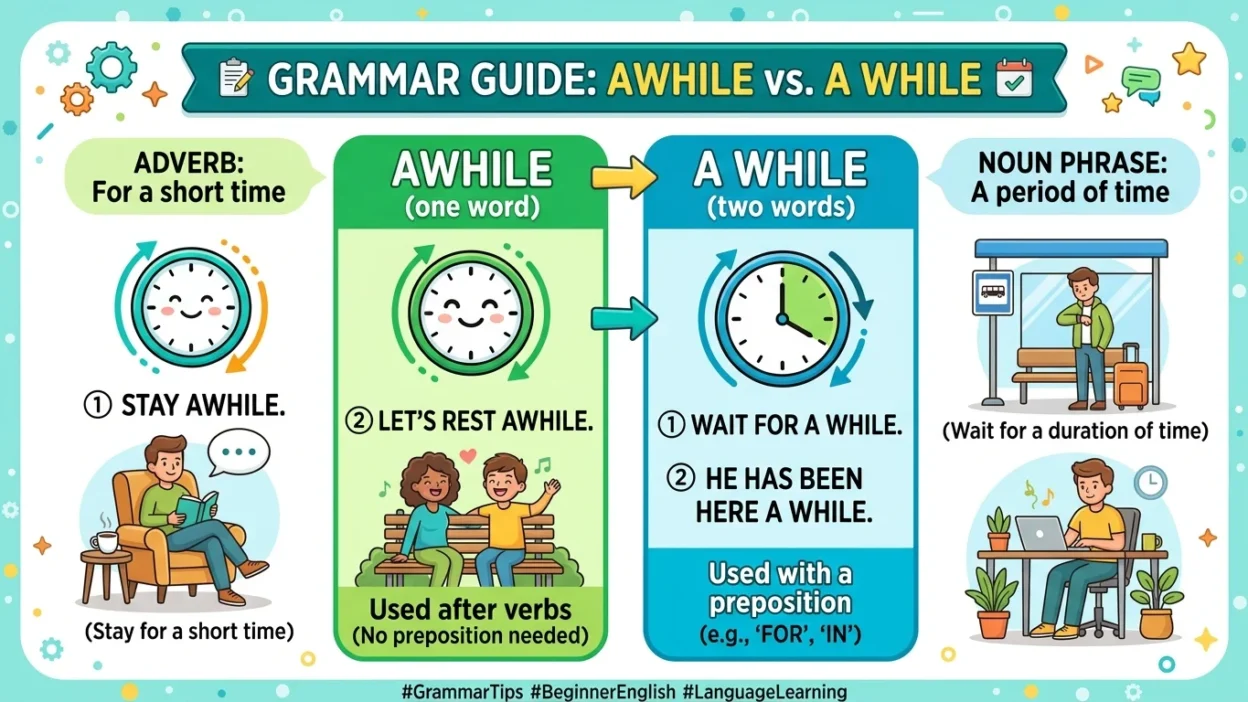
- Awhile = an adverb (means “for a short time”)
- A while = a noun phrase (needs a preposition like “for”)
Examples:
- Sit here awhile.
- Sit here for a while.
Simple Background Explanation
In English, some words can be written as one word or two words, but their grammar changes:
- One word (awhile) → acts like an adverb
- Two words (a while) → acts like a noun phrase
Even though both forms have a similar meaning, they are used in different sentence structures.
Clear Explanation of the Difference
What does “awhile” mean?
Awhile is an adverb. It means “for a short time,” and it does not need a preposition like “for.”
Examples:
- Please stay awhile.
- Sit down and relax awhile.
- He waited awhile before speaking.
You can often replace it with “for a short time.”
What does “a while” mean?
A while is a noun phrase. It refers to a short period of time, and it usually comes after a preposition like “for.”
Examples:
- Stay for a while.
- I haven’t seen you for a while.
- She rested for a while.
Without a preposition, it usually does not sound complete.
Comparison Table
| Form | Type | Meaning | Example Sentence |
|---|---|---|---|
| Awhile | Adverb | For a short time | Sit here awhile. |
| A while | Noun phrase | A short period of time | Sit here for a while. |
Which One to Use and When
Use awhile when:
- You do not need “for”
- The word directly follows a verb
Examples:
- Stay awhile.
- Wait awhile before calling.
Use a while when:
- You use a preposition like “for”
- You need a noun phrase
Examples:
- Stay for a while.
- It has been a while since we met.
Quick Tip
- Awhile = no “for” needed
- A while = usually comes after “for”
Common Mistakes People Make
1. Using awhile after “for”
❌ Stay for awhile.
✔ Stay for a while.
2. Using a while without a preposition
❌ Sit a while.
✔ Sit awhile.
3. Forgetting the grammar role
Remember:
- Awhile = adverb
- A while = noun phrase
4. Overthinking the rule
Keep it simple:
- If “for” is there → a while
- If no “for” → awhile
Everyday Real Life Examples
In Conversations
- Stay awhile and talk.
- Stay for a while before leaving.
In Daily Life
- I will rest awhile.
- I will rest for a while.
In School
- Think awhile before answering.
- We studied for a while.
In Writing
- She paused awhile.
- It has been a while since the last update.
On Social Media
- Taking a break awhile 😌
- Haven’t posted for a while 📱
Short Learning Section for Students and Beginners
Step 1: Ask yourself
- Is there a “for” before it? → a while
- No “for”? → awhile
Step 2: Practice
Fill in the blanks:
- Wait ______ before speaking.
- I stayed for ______.
- Sit down and relax ______.
- It has been ______ since we met.
Answers:
- awhile
- a while
- awhile
- a while
Practice regularly to understand clearly.
FAQ
What is the difference between awhile and a while?
Awhile is an adverb, while a while is a noun phrase.
Can I say “for awhile”?
It is better to say for a while.
Is awhile correct?
Yes, it is correct and commonly used.
When should I use a while?
Use it after prepositions like “for.”
How can I remember the rule?
Think:
- Awhile = no “for”
- A while = with “for”
Can both mean the same thing?
Yes, both refer to a short time but are used differently.
Is “it’s been awhile” correct?
It is better to say it’s been a while.
Can I use both in one sentence?
Yes. Example:
- Sit awhile, then stay for a while longer.
Conclusion
The difference between awhile and a while is simple when you focus on structure:
- Awhile is used without “for”
- A while is used with “for” or as a noun phrase
By remembering this one rule, you can easily use both forms correctly in your writing and speaking.