Many learners feel confused about “payed” and “paid” because both seem like possible past forms of the verb “pay.” In English, we often add -ed to make the past tense, so “payed” looks correct at first.
However, English has irregular verbs, and “pay” is one of them. This is why one form is correct in most situations, while the other is only used in a very special context.
This guide will explain everything in simple English so you can use the correct form with confidence.
Quick Answer
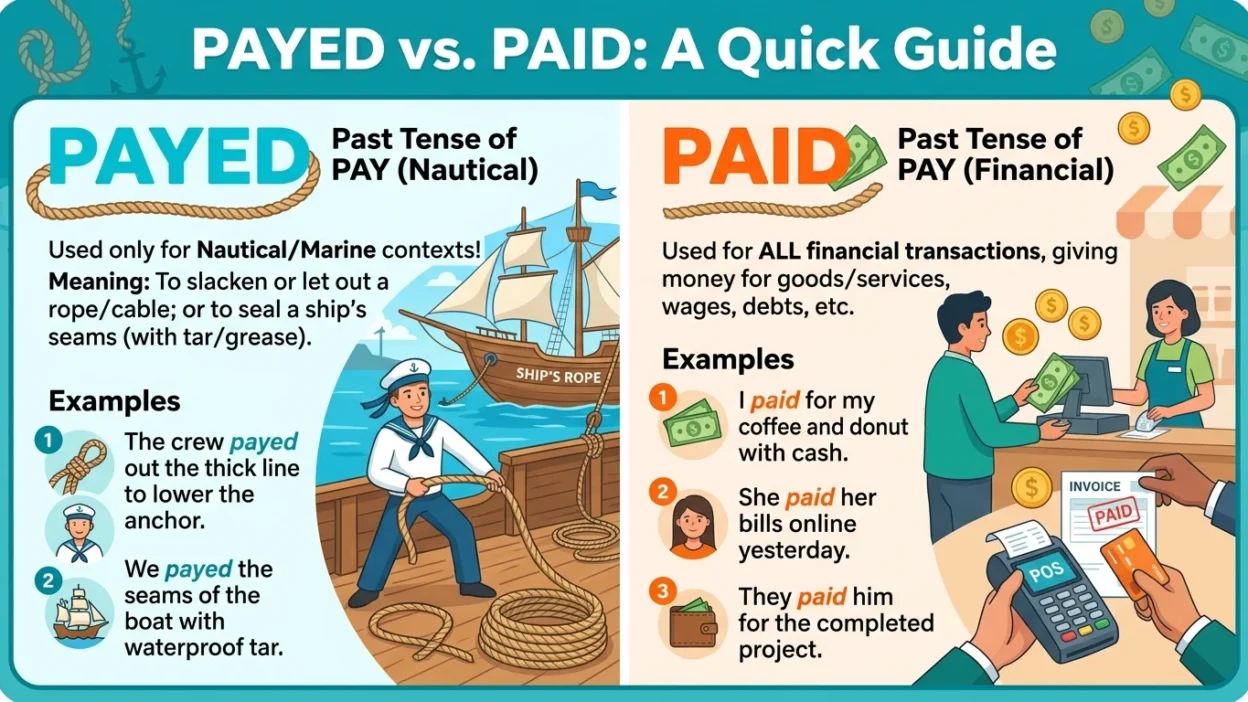
- Paid = correct past tense of “pay” (used in almost all cases)
- Payed = rare, used only in specific nautical (ship-related) contexts
Examples:
- I paid the bill yesterday.
- The crew payed the rope with tar. (rare use)
Simple Background Explanation
The verb “pay” is irregular:
- Present: pay
- Past: paid
- Past participle: paid
So, in everyday English, we always use paid, not “payed.”
The form “payed” exists, but it is used only in technical or maritime language, which most learners do not need in daily communication.
Clear Explanation of the Difference
What does “paid” mean?
Paid is the correct past tense and past participle of “pay.” It is used in almost all situations.
Examples:
- I paid for the groceries.
- She paid her school fees.
- They have paid the rent.
It is used for:
- Money
- Bills
- Salaries
- Services
What does “payed” mean?
Payed is a rare form used in nautical contexts. It refers to covering ropes or ships with tar or letting out rope.
Examples:
- The sailors payed the rope.
- The deck was payed with sealant.
This usage is uncommon and mostly limited to maritime or historical contexts.
Comparison Table
| Word | Correct? | Usage Area | Meaning | Example Sentence |
|---|---|---|---|---|
| Paid | Yes | Everyday English | Past of “pay” (money, actions) | I paid the bill. |
| Payed | Rare | Nautical/technical | Treated rope or ship | The crew payed the rope. |
Which One to Use and When
Use paid when:
- Talking about money
- Referring to past actions of paying
- Writing in everyday English
Examples:
- I paid my fees.
- He paid for dinner.
Use payed only when:
- Talking about ships or ropes
- Using technical maritime language
Examples:
- The sailors payed the ropes.
Quick Tip
- Paid = money (almost always correct)
- Payed = ships/ropes (very rare)
Common Mistakes People Make
1. Writing “payed” instead of “paid”
❌ I payed the bill.
✔ I paid the bill.
2. Adding “-ed” to an irregular verb
Not all verbs follow the regular pattern.
3. Assuming both are common
“Payed” is not used in normal conversation or writing.
4. Ignoring context
Always think about meaning:
- Money → paid
- Ship/rope → payed (rare)
Everyday Real Life Examples
In Daily Life
- I paid for my groceries.
- She paid her bills on time.
In School
- He paid the exam fee.
- Students paid for their books.
In Work or Business
- The company paid its employees.
- They have paid the invoice.
In Conversations
- Did you pay or have you paid already?
- I already paid.
On Social Media
- Finally paid my debt 💸
- Just paid for my new phone 📱
Short Learning Section for Students and Beginners
Step 1: Remember the verb
- Pay → Paid
Step 2: Ignore “payed” (in most cases)
- Use it only in rare technical contexts
Step 3: Practice
Fill in the blanks:
- I ______ the bill yesterday.
- She has ______ the rent.
- They ______ for the tickets.
- The sailors ______ the rope.
Answers:
- paid
- paid
- paid
- payed
FAQ
What is the difference between payed and paid?
Paid is the correct past tense of “pay,” while payed is used only in rare nautical contexts.
Is payed wrong?
It is not completely wrong, but it is not used in normal English.
Which one should I use in exams?
Always use paid.
Why do people write payed?
Because they think all past verbs end with “-ed.”
What is the past tense of pay?
The correct past tense is paid.
Is payed used in daily conversation?
No, it is very rare and mostly technical.
Can both be used in one sentence?
Yes, but only in a special context. Example:
- He paid the workers while the crew payed the rope.
What is the safest option?
Always use paid unless you are writing about ships or ropes.
Conclusion
The difference between payed and paid is simple:
- Paid is correct and used in everyday English
- Payed is rare and used only in technical maritime contexts
If you are unsure, always choose paid. It is the correct and safest option in almost all situations.