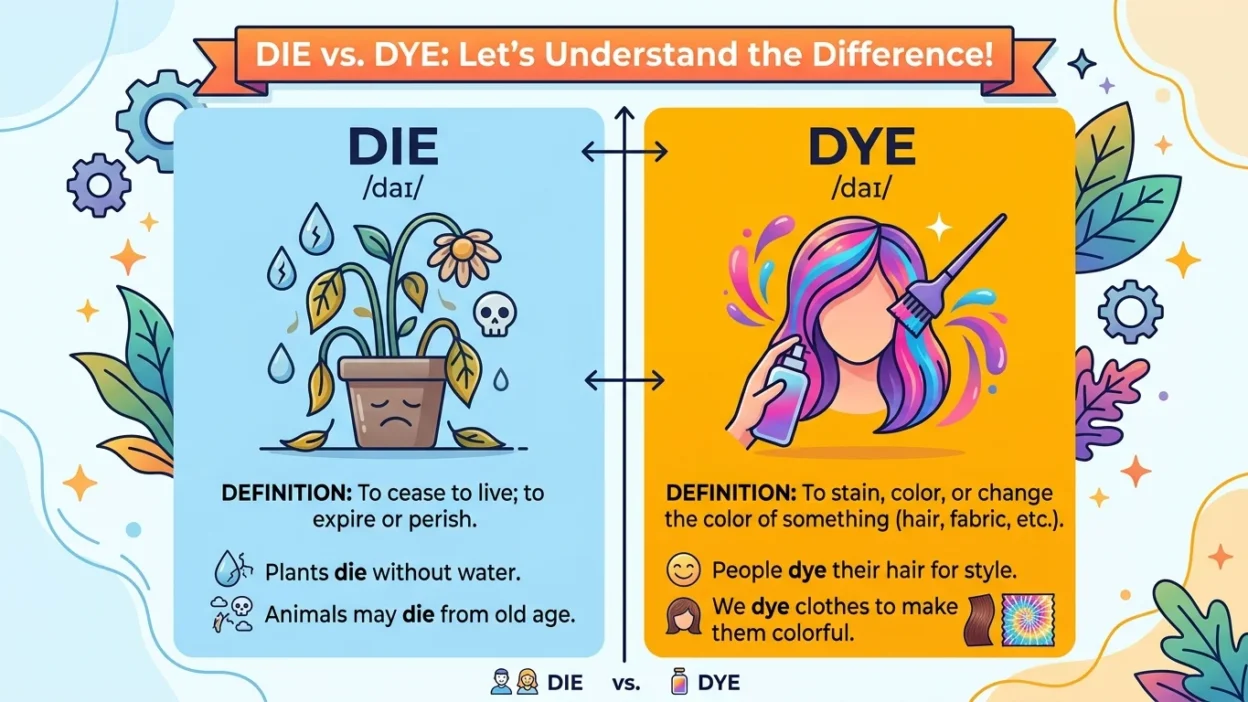
Many learners confuse “die” and “dye” because they sound exactly the same. However, their meanings are completely different. Using the wrong one can lead to serious confusion or even funny mistakes.
This guide explains the difference in very simple English so students, ESL learners, and beginners can understand it clearly and use both words correctly.
Quick Answer
- Die = to stop living
- Dye = to change color
Examples:
- Plants can die without water.
- She will dye her hair red.
Simple Background Explanation
“Die” and “dye” are homophones. This means they sound the same but have different spellings and meanings.
Even though they sound alike, their uses are completely different, so it is important to focus on meaning.
Clear Explanation of the Difference
What does “die” mean?
Die is a verb. It means to stop living or to no longer be alive.
Examples:
- The plant will die without sunlight.
- Many animals die in harsh weather.
It can also be used in a softer or indirect way:
- His phone battery will die soon.
Past forms:
- die → died → died
Examples:
- The battery died yesterday.
- The old tree died last year.
What does “dye” mean?
Dye can be a verb or a noun. It refers to changing the color of something.
Examples (verb):
- She wants to dye her hair blue.
- They dyed the fabric green.
Examples (noun):
- This dye is very strong.
- Natural dye is made from plants.
Past form:
- dye → dyed → dyed
Examples:
- He dyed his shirt black.
Comparison Table
| Word | Type | Meaning | Example Sentence |
|---|---|---|---|
| Die | Verb | To stop living | The plant will die. |
| Dye | Verb/Noun | To change color | She will dye her hair. |
Which One to Use and When
Use die when:
- Talking about life or death
- Referring to something stopping or ending
Examples:
- Fish can die without oxygen.
- My phone might die soon.
Use dye when:
- Talking about color
- Changing the appearance of something
Examples:
- I will dye my clothes.
- She dyed her hair brown.
Quick Tip
- Die = life ends
- Dye = color changes
Common Mistakes People Make
1. Mixing spelling
❌ She will die her hair.
✔ She will dye her hair.
2. Using dye for death
❌ The plant will dye.
✔ The plant will die.
3. Confusing past forms
❌ He die his shirt yesterday.
✔ He dyed his shirt yesterday.
4. Ignoring context
Always check meaning:
- Life → die
- Color → dye
Everyday Real Life Examples
In Daily Life
- My phone will die if I don’t charge it.
- I want to dye my hair.
In Nature
- Plants die without water.
- People use plants to make natural dye.
In Conversations
- Don’t let the battery die.
- She dyed her dress blue.
In School
- Animals can die in extreme conditions.
- Art class used fabric dye.
On Social Media
- My phone is about to die 😅
- Just dyed my hair! 💇♀️
Short Learning Section for Students and Beginners
Step 1: Ask yourself
- Is it about life ending? → die
- Is it about color? → dye
Step 2: Practice
Fill in the blanks:
- The flowers will ______ without water.
- She wants to ______ her hair.
- My phone might ______ soon.
- He ______ his shirt red.
Answers:
- die
- dye
- die
- dyed
Practice these examples to remember easily.
FAQ
What is the difference between die and dye?
Die means to stop living, while dye means to change color.
Do die and dye sound the same?
Yes, they are homophones.
What is the past form of die?
The past form is died.
What is the past form of dye?
The past form is dyed.
Can dye be a noun?
Yes, it can refer to a coloring substance.
Is die only used for humans?
No, it can be used for animals, plants, and even things like batteries.
How can I remember the difference?
Think:
- Die = end of life
- Dye = color
Can both be used in one sentence?
Yes. Example:
- The flowers will die if you don’t dye them properly.
Conclusion
The difference between die and dye is simple when you focus on meaning:
- Die is about life ending
- Dye is about changing color
Even though they sound the same, remembering this key idea will help you use both words correctly in everyday English.