Many learners feel confused about “on to” and “onto” because they look almost the same. The only difference is a space, but that small detail changes the meaning and usage.
This is a very common mistake for students and ESL learners. The good news is that the rule is simple once you understand how each form works. This guide will explain everything clearly so you can use both correctly.
Quick Answer
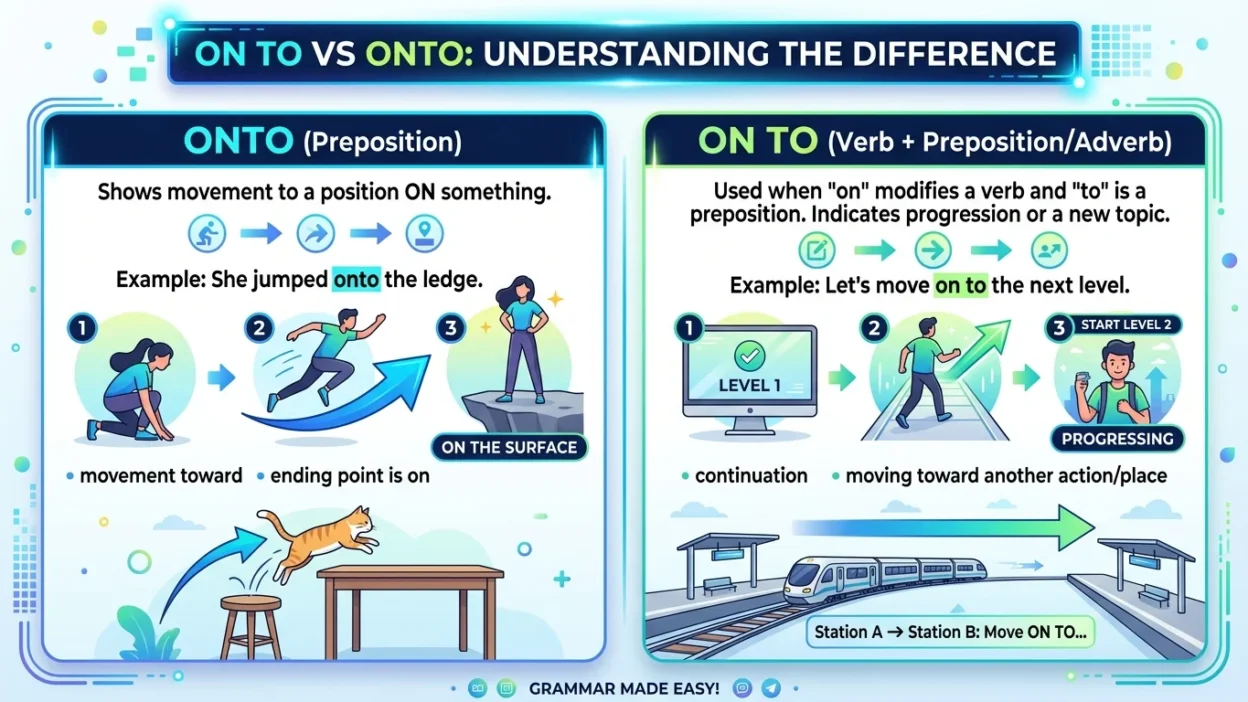
- Onto = movement to a surface
- On to = “on” + “to” used separately (often for moving to the next thing)
Examples:
- The cat jumped onto the table.
- Let’s move on to the next topic.
Simple Background Explanation
In English, some words can be written together or separately, but the meaning changes depending on the structure.
- Onto is a single preposition
- On to is two separate words, each with its own role
Understanding whether you are describing movement or connecting ideas will help you choose the correct form.
Clear Explanation of the Difference
What does “onto” mean?
Onto is a preposition that shows movement toward a surface or position.
Use it when something moves from one place to another and ends up on something.
Examples:
- The child climbed onto the chair.
- The book fell onto the floor.
- He jumped onto the stage.
Think of it as physical movement.
What does “on to” mean?
On to is made of two words:
- On (part of a verb or phrase)
- To (a preposition or part of an infinitive)
It is often used when talking about moving forward to the next step, topic, or action.
Examples:
- Let’s move on to the next lesson.
- She went on to become a doctor.
- We will go on to discuss this later.
Think of it as progress or continuation.
Comparison Table
| Form | Type | Meaning | Example Sentence |
|---|---|---|---|
| Onto | Preposition | Movement to a surface | The cat jumped onto the table. |
| On to | Two-word phrase | Move forward or continue | Let’s move on to the next topic. |
Which One to Use and When
Use onto when:
- There is physical movement
- Something moves to a surface
Examples:
- He stepped onto the platform.
- The ball rolled onto the road.
Use on to when:
- You mean “continue to”
- You are moving to the next step or idea
Examples:
- Let’s go on to the next question.
- She moved on to a new job.
Quick Tip
- Onto = movement (one word)
- On to = next step (two words)
Common Mistakes People Make
1. Using onto for ideas
❌ Let’s move onto the next topic.
✔ Let’s move on to the next topic.
2. Using on to for movement
❌ The cat jumped on to the table.
✔ The cat jumped onto the table.
3. Ignoring the meaning
Many learners choose based on spelling, not meaning. Always think about what the sentence describes.
4. Overthinking the rule
Keep it simple:
- Movement → onto
- Progress → on to
Everyday Real Life Examples
In School
- The teacher moved on to the next chapter.
- The student climbed onto the desk.
In Work or Meetings
- Let’s move on to the next point.
- He stepped onto the stage to speak.
In Daily Life
- The dog jumped onto the bed.
- We went on to visit another place.
In Conversations
- Can we move on to something else?
- She got onto the bus quickly.
On Social Media
- Time to move on to bigger goals 💪
- Cat jumped onto my laptop 😄
Short Learning Section for Students and Beginners
Step 1: Ask yourself
- Is there movement to a surface? → onto
- Is it about the next step or idea? → on to
Step 2: Practice
Fill in the blanks:
- The bird flew ______ the roof.
- Let’s move ______ the next lesson.
- He climbed ______ the wall.
- We will go ______ discuss another topic.
Answers:
- onto
- on to
- onto
- on to
Practice regularly to remember easily.
FAQ
What is the difference between on to and onto?
Onto shows movement to a surface, while on to means moving forward to the next thing.
Can onto be used for ideas?
No. Use on to when talking about ideas or topics.
Is on to always two words?
Yes, when used correctly, it is always written as two separate words.
Which one is used for movement?
Use onto for physical movement.
How can I remember the difference?
Think:
- Onto = one word, movement
- On to = next step
Can I say “move onto the next topic”?
It is better to say move on to the next topic.
Are both forms common?
Yes, both are common but used in different situations.
Can both be used in one sentence?
Yes. Example:
- He jumped onto the stage and moved on to the next act.
Conclusion
The difference between on to and onto is simple when you focus on meaning:
- Onto is used for physical movement
- On to is used for moving forward to the next step
By remembering this easy rule, you can avoid confusion and use both forms correctly in everyday English.