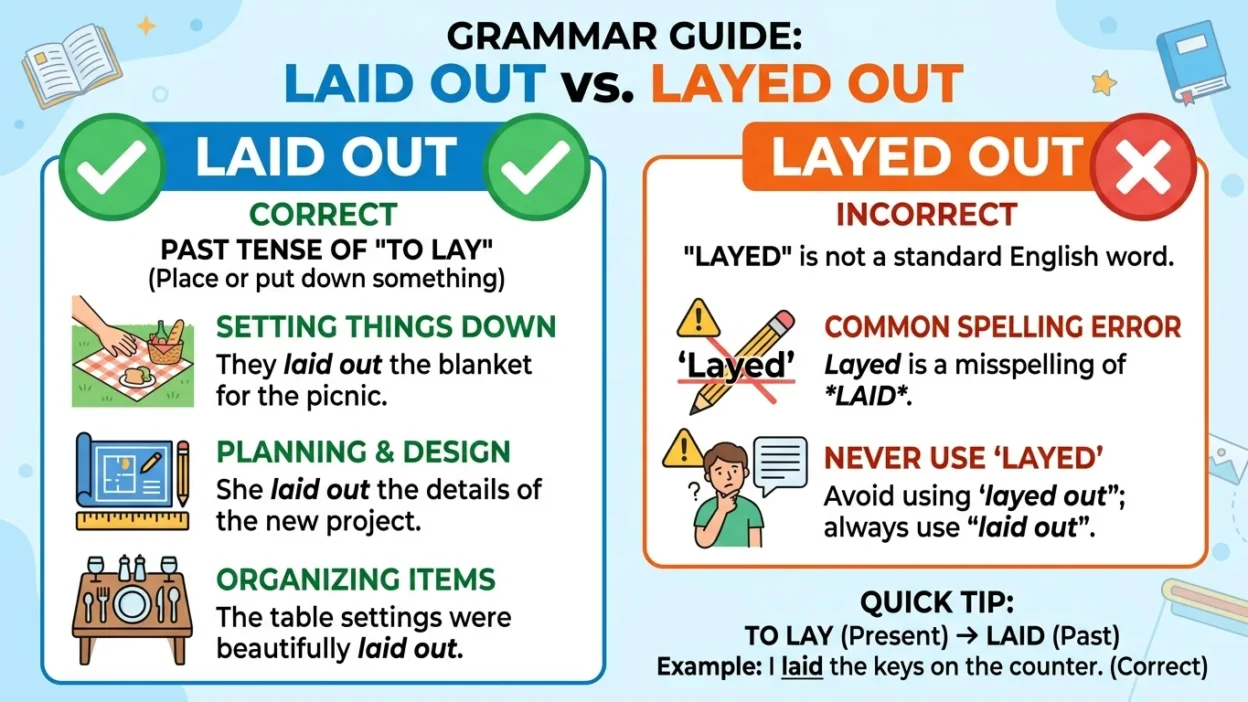
Many learners feel confused about “laid out” and “layed out” because they sound similar and seem like possible past forms of the verb “lay.” Since many English verbs take -ed in the past, “layed” looks correct but it is not.
This guide will explain the difference in very simple English so you can avoid this common mistake and use the correct form every time.
Quick Answer
- Laid out = correct
- Layed out = incorrect
Example:
- She laid out the clothes on the bed.
Simple Background Explanation
The verb “lay” is irregular:
- Present: lay
- Past: laid
- Past participle: laid
Because of this, we never use “layed.” So when forming phrases like “laid out,” we must use the correct past form laid.
Clear Explanation of the Difference
What does “laid out” mean?
Laid out is the correct phrase. It is the past form of “lay out.”
“Lay out” can mean:
- To arrange something carefully
- To spread things out
- To explain something clearly
Examples:
- She laid out the clothes for tomorrow.
- He laid out the tools on the table.
- The teacher laid out the plan clearly.
It can also have informal meanings:
- He was laid out after the game. (very tired or knocked down)
What about “layed out”?
Layed out is incorrect and should not be used.
❌ She layed out the books.
✔ She laid out the books.
There is no standard situation where “layed” is correct.
Comparison Table
| Phrase | Correct? | Meaning | Example Sentence |
|---|---|---|---|
| Laid out | Yes | Arranged or spread out | She laid out the clothes. |
| Layed out | No | Incorrect spelling | (Avoid using) |
Which One to Use and When
Use laid out when:
- Talking about arranging or organizing something
- Referring to past actions
- Writing in correct English
Examples:
- He laid out the documents neatly.
- They laid out the plan step by step.
Avoid layed out in all situations.
Quick Tip
- Lay → Laid (never layed)
- Always use laid out
Common Mistakes People Make
1. Adding “-ed” to an irregular verb
❌ lay → layed
✔ lay → laid
2. Writing layed out in exams or emails
This is a very common mistake. Always double-check.
3. Confusing with “lie”
- Lay → laid (needs an object)
- Lie → lay (past form, different verb)
This confusion often leads to errors.
4. Trusting how it sounds
“Layed” may sound correct, but it is not standard English.
Everyday Real Life Examples
In Daily Life
- She laid out her clothes for the day.
- He laid out the food on the table.
In School
- The teacher laid out the instructions clearly.
- Students laid out their books.
In Work or Office
- He laid out the project plan.
- She laid out the documents neatly.
In Conversations
- I laid out everything for you.
- She laid out the options clearly.
On Social Media
- Outfit laid out for tomorrow 👕
- Just laid out my plans for the week 📅
Short Learning Section for Students and Beginners
Step 1: Remember the verb
- Lay → Laid
Step 2: Apply it
- Past form → laid out
Step 3: Practice
Fill in the blanks:
- She ______ the clothes on the bed.
- He ______ the tools neatly.
- They ______ the plan clearly.
- I ______ everything before leaving.
Answers:
- laid out
- laid out
- laid out
- laid out
FAQ
What is the difference between laid out and layed out?
Laid out is correct, while layed out is incorrect.
Is layed out ever correct?
No, it is not used in standard English.
What does laid out mean?
It means arranged, spread out, or explained clearly.
Why do people write layed out?
Because they think all past verbs end with “-ed.”
What is the past tense of lay?
The past tense is laid.
Can I use laid out in formal writing?
Yes, it is correct in all situations.
How can I remember the rule?
Think:
- Lay → Laid (never layed)
Can laid out have different meanings?
Yes, it can mean arranging, explaining, or even being very tired.
Conclusion
The difference between laid out and layed out is very simple:
- Laid out is correct
- Layed out is incorrect
By remembering the rule lay → laid, you can avoid this common mistake and use the correct phrase confidently in everyday English.

Weston Maddox is both an author and administrator at SpellCorrect. He oversees site operations while creating accurate, easy-to-understand content focused on correct spelling and proper word usage, helping readers improve writing clarity, precision, and confidence across academic, professional, and everyday English communication.