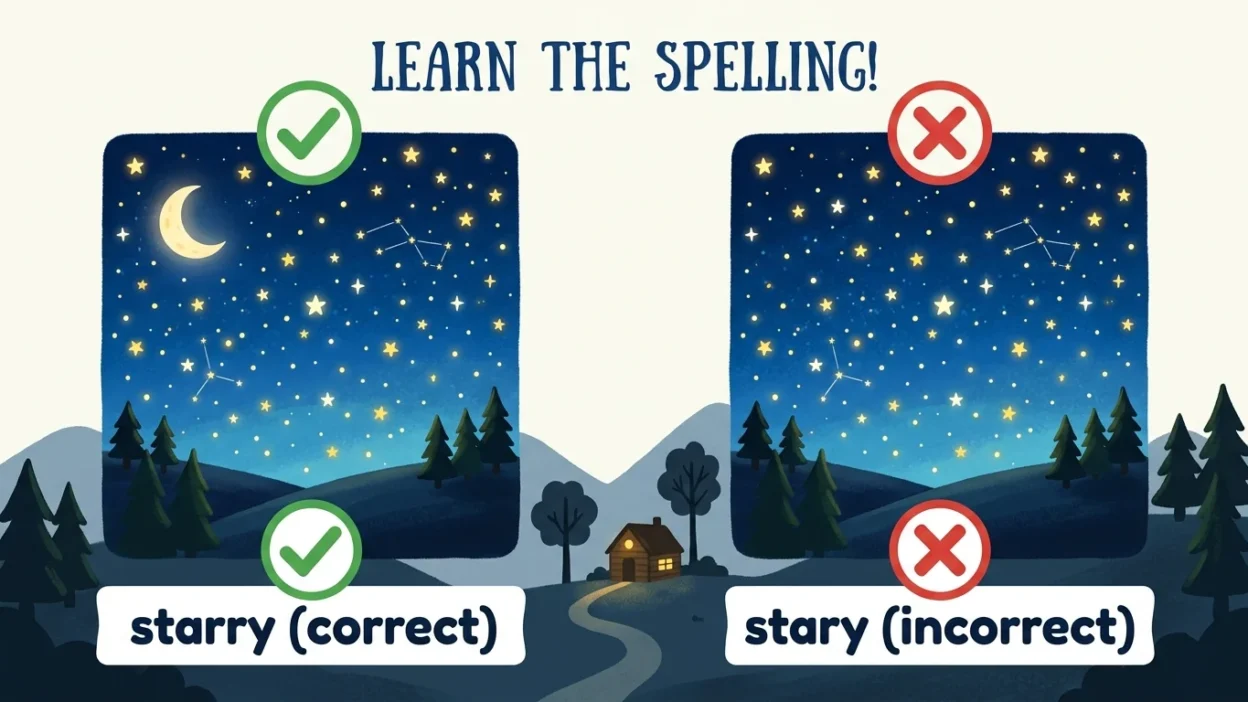
Many learners feel confused when they see “stary” and “starry.” The words look very similar, and they both seem related to the word “star.” So it’s natural to ask: Are both correct? Which one should I use?
The truth is simple but important. This guide will help you understand it clearly so you never make a mistake again.
Quick Answer
- “Starry” is correct.
- “Stary” is incorrect (not a standard English word).
- Always use “starry” when talking about stars or something full of stars.
👉 Simple rule: Use “starry” avoid “stary.”
Simple Origin or Background
The correct word “starry” comes from the noun “star.” When we add “-y” to a noun, it means “full of” or “having that quality.”
- star + y → starry = full of stars
We double the “r” before adding “-y.” That is why:
✔ star → starry
❌ star → stary
This is a common spelling pattern in English.
Clear Explanation of the Difference
Here is the key point:
👉 There is NO real comparison because “stary” is not correct.
“Starry” means:
- Full of stars
- Covered with stars
- Bright like stars
- Sometimes dreamy or romantic
Examples:
- A starry sky = a sky full of stars
- A starry night = a night with many stars
“Stary” is simply a spelling mistake and should not be used.
Comparison Table
| Feature | Stary | Starry |
|---|---|---|
| Correct spelling | ❌ No | ✅ Yes |
| Meaning | None | Full of stars |
| Usage | Incorrect | Correct and common |
| Found in dictionary | ❌ No | ✅ Yes |
| Recommended use | Never use | Always use |
Which One to Use and When
👉 Always use “starry.”
Use “starry” when talking about:
- The night sky
- Beautiful scenes
- Dreams or imagination
- Romantic descriptions
Examples:
- We watched the starry sky.
- It was a calm, starry night.
- She had starry eyes (dreamy or excited).
👉 Never use “stary.”
Common Mistakes People Make
Forgetting to double the “r”
❌ stary
✔ starry
Thinking both are correct
❌ “Stary and starry are both fine.”
✔ Only starry is correct
Typing too fast
People sometimes write “stary” by mistake in messages.
👉 Tip: Always check your spelling.
Not knowing the rule
Many learners do not know that we double the letter before adding “-y.”
Everyday Real Life Examples
In conversations
- “Look at the starry sky tonight!”
- “It’s such a beautiful, starry evening.”
In writing or stories
- The children slept under a starry sky.
- The village looked magical on a starry night.
On social media
- “Loving this starry night ✨”
- “Peaceful walk under the starry sky.”
In daily life
- We enjoyed a quiet, starry evening.
- The desert looked amazing under a starry sky.
👉 In all these examples, “stary” would be wrong.
Short Learning Section for Students and Beginners
Step 1: Start with the base word
Star = a bright object in the sky
Step 2: Add “-y”
Star + y → Starry
Step 3: Remember the spelling rule
👉 Double the “r” → starry
Easy memory tip
👉 “More stars = double ‘r’ = starry.”
Practice
Fill in the blanks:
- It was a ______ night.
- The ______ sky looked beautiful.
✔ Answers:
- starry
- starry
FAQ
Is “stary” a real word?
No, it is not correct.
Is “starry” correct?
Yes, it is the correct spelling.
Why do we double the “r”?
Because of a common spelling rule when adding “-y.”
Can I ever use “stary”?
No, you should not use it.
What does “starry night” mean?
It means a night full of stars.
Is “starry” common in English?
Yes, it is widely used.
What are “starry eyes”?
It means someone looks dreamy or full of hope.
How can I remember it?
Remember: “More stars = double ‘r’ = starry.”
Conclusion
The difference between “stary” and “starry” is very simple. “Starry” is correct and widely used, while “stary” is incorrect and should be avoided. If you always use “starry,” you will never make this mistake again. Keep practicing, and it will soon feel natural.