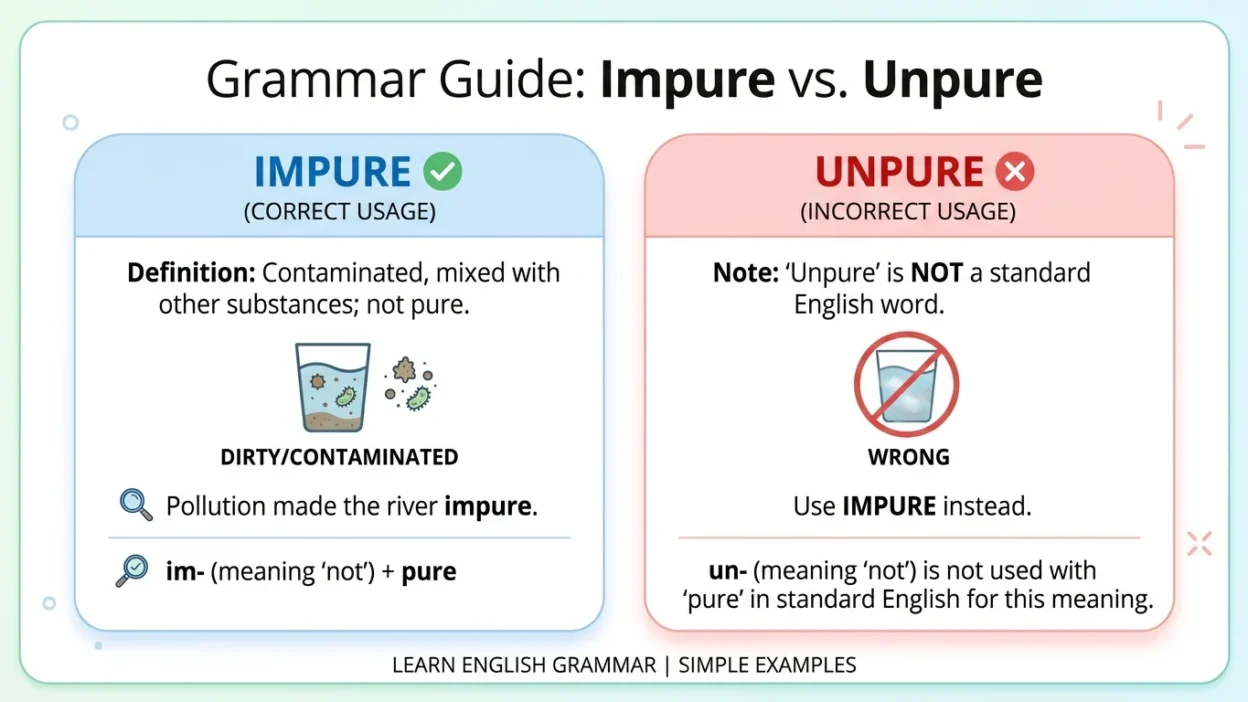
Many learners get confused between “unpure” and “impure.” Both seem to mean “not pure,” so it feels like they should both be correct. This confusion is very common, especially for ESL learners and beginners.
But here’s the truth: English does not always form negative words in the same way. Sometimes we use “un-”, and sometimes we use “im-.” Knowing which one to use can feel tricky at first but it becomes easy once you understand the pattern.
This guide will explain everything in very simple English so you can use the correct word every time.
Quick Answer
- “Impure” is correct.
- “Unpure” is not standard English (incorrect).
- Always use “impure” when you mean “not pure.”
👉 Simple rule: Use “impure,” not “unpure.”
Simple Origin or Background
The word “pure” means:
- Clean
- Not mixed with anything else
- Good or natural
To make negative words in English, we often add prefixes like:
- un- (unhappy, unfair)
- im- (impossible, impolite)
But not all prefixes work with every word.
The word “impure” comes from Latin roots. The prefix “im-” means “not,” and it is the correct form used with “pure.”
That’s why:
✔ pure → impure
❌ pure → unpure (not used in correct English)
Clear Explanation of the Difference
Here is the key idea:
👉 There is no real comparison—because “unpure” is not correct.
What does “impure” mean?
“Impure” means:
- Not clean
- Mixed with something unwanted
- Not morally good (in some contexts)
Examples of meaning:
- Impure water = dirty or mixed water
- Impure metal = metal with other materials in it
- Impure thoughts = not morally clean (used in some contexts)
What about “unpure”?
- It is not standard English
- Native speakers do not use it
- It should be avoided in writing
Comparison Table
| Feature | Unpure | Impure |
|---|---|---|
| Correct spelling | ❌ No | ✅ Yes |
| Meaning | Not standard | Not pure |
| Usage | Incorrect | Correct and common |
| Found in dictionary | ❌ No | ✅ Yes |
| Recommended use | Never use | Always use |
Which One to Use and When
👉 Always use “impure.”
Use “impure” when talking about:
- Water or air
- Food or materials
- Science and chemistry
- Moral or abstract ideas
Examples:
- This water is impure and unsafe.
- The gold is impure.
- The air in the city is impure.
👉 Never use “unpure.”
Common Mistakes People Make
1. Using “un-” with every word
❌ unpure
✔ impure
2. Thinking both forms are correct
❌ “Unpure and impure mean the same and are both fine.”
✔ Only impure is correct
3. Guessing the prefix
Learners often guess whether to use “un-” or “im-.”
👉 Tip: Learn common words like impure as fixed forms.
4. Mixing patterns
Some words use “un-,” others use “im-.” There is no single rule for all words.
Everyday Real Life Examples
In daily life
- The water is impure, so do not drink it.
- This food is impure and not safe.
In school or science
- The sample is impure.
- Impure substances contain other materials.
In general conversation
- The air feels impure today.
- The product is not pure; it is impure.
👉 In all these examples, “unpure” would be incorrect.
Short Learning Section for Students and Beginners
Step 1: Learn the base word
Pure = clean, not mixed
Step 2: Learn the correct negative form
Pure → Impure
Step 3: Avoid the wrong form
❌ Unpure
✔ Impure
Easy memory tip
👉 “Pure becomes impure, not unpure.”
Practice
Fill in the blanks:
- The water is ______.
- This metal is ______.
✔ Answers:
- impure
- impure
FAQ
Is “unpure” a real word?
No, it is not standard English.
Is “impure” correct?
Yes, it is the correct and widely used form.
Why do we use “im-” instead of “un-”?
Because “impure” comes from Latin roots, and that form became standard.
Can I use “unpure” in informal writing?
No, it is best to avoid it completely.
What does “impure water” mean?
It means water that is dirty or mixed with harmful substances.
Are there other words like this?
Yes, like:
- possible → impossible
- polite → impolite
Is this important for exams?
Yes, correct word forms are important in writing and tests.
How can I remember it easily?
Remember: “Impure is correct, unpure is wrong.”
Conclusion
The difference between “unpure” and “impure” is very simple. “Impure” is the correct word, and “unpure” is incorrect and should not be used.
Even though both seem to mean “not pure,” only “impure” is accepted in proper English.
👉 If you remember one rule, remember this: Always use “impure.”

Weston Maddox is both an author and administrator at SpellCorrect. He oversees site operations while creating accurate, easy-to-understand content focused on correct spelling and proper word usage, helping readers improve writing clarity, precision, and confidence across academic, professional, and everyday English communication.