Many learners feel confused between “stole” and “stold.” These words look similar, and both seem like they could be past forms of the verb “steal.”
But English verbs are not always regular. Some verbs change in special ways, and “steal” is one of them.
In this guide, you will learn the correct form in a very simple way. After reading, you will never use the wrong word again.
Quick Answer
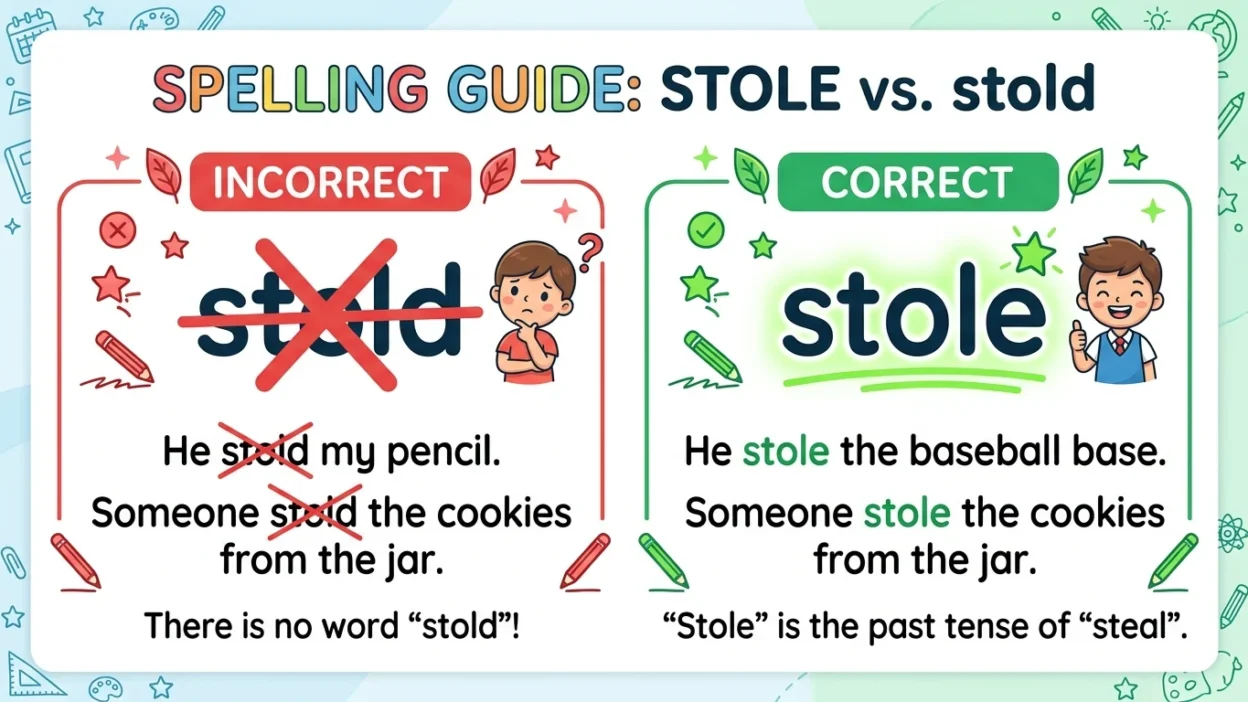
- ✅ Stole = Correct past tense of “steal”
- ❌ Stold = Incorrect word
- Use stole when talking about something taken in the past
- Never use stold
Simple Background Explanation
The verb “steal” is an irregular verb. This means it does not follow the usual “-ed” rule.
For example:
- walk → walked (regular)
- steal → stole (irregular)
The correct forms are:
- Present: steal
- Past: stole
- Past participle: stolen
The word “stold” is a common mistake. It happens because people try to follow patterns like:
- tell → told
- sell → sold
So they think:
- steal → stold ❌
But this is not correct in English.
Clear Explanation of the Difference
What is “Stole”?
Stole is the past tense of “steal.”
It means:
- Took something that does not belong to you (in the past)
Examples:
- He stole my phone.
- Someone stole her bag yesterday.
- The thief stole money from the shop.
What is “Stold”?
Stold:
- ❌ Not a real English word
- ❌ Incorrect past form of “steal”
It should never be used in speaking or writing.
Comparison Table
| Feature | Stole ✅ | Stold ❌ |
|---|---|---|
| Correct spelling | Yes | No |
| Meaning | Past of “steal” | No meaning |
| Used in English | Yes | No |
| Example sentence | “He stole my bag.” | Incorrect usage |
| Should you use it? | Yes | Never |
Which One to Use and When
Always use stole when talking about the past.
Use “stole” when:
- Something was taken in the past
- “He stole my wallet.”
- Talking about crime or wrongdoing
- “They stole a car.”
- Describing past events
- “Someone stole my book last week.”
Never use “stold”
Even in:
- Text messages
- Social media
- Informal writing
You should always avoid stold.
Common Mistakes People Make
1. Following wrong patterns
People think:
- tell → told
- sell → sold
- steal → stold ❌
But this pattern does not apply here.
2. Not knowing irregular verbs
Irregular verbs must be memorized. They do not follow simple rules.
3. Guessing the past form
Learners often guess instead of checking:
- steal → stold ❌
4. Mixing with “stolen”
Some people confuse:
- stole (past)
- stolen (past participle)
Everyday Real Life Examples
In Daily Conversation
- “Someone stole my bike.”
- “He stole money from his friend.”
In News or Stories
- “The thief stole valuable items.”
- “They stole jewelry from the house.”
In School or Writing
- “The character stole food to survive.”
- “He stole the answer during the test.”
Incorrect Example (Avoid This)
- ❌ “He stold my phone.”
✔ Correct: “He stole my phone.”
Short Learning Section for Students and Beginners
Memory Trick
👉 Steal → Stole → Stolen
Think of it like a chain:
- steal (now)
- stole (past)
- stolen (completed action)
Practice Exercise
Fill in the blanks:
- He ______ my bag yesterday.
- Someone ______ my pen in class.
- The thief ______ money last night.
Answers:
- stole
- stole
- stole
Quick Tip
If you think of stold, stop and replace it with stole.
FAQ
1. Is “stold” ever correct?
No. It is always incorrect.
2. What is the past tense of “steal”?
The correct past tense is stole.
3. What is the past participle of “steal”?
It is stolen.
4. Why do people say “stold”?
Because they follow patterns like “told” and “sold.”
5. Can I use “stole” in formal writing?
Yes. It is correct in all types of writing.
6. Is this sentence correct: “He stold my book”?
No. Correct sentence:
“He stole my book.”
7. How can I remember the correct form?
Remember:
👉 Steal → Stole → Stolen
8. Is “stole” commonly used?
Yes. It is a common word in everyday English.
Conclusion
The difference between stole and stold is very clear:
- Stole is correct
- Stold is incorrect
Even though “stold” may seem logical, it is not part of English.
By remembering the correct form, you can:
- Avoid common mistakes
- Speak and write clearly
- Build strong English skills
Keep practicing, and soon this will feel natural to you.

Weston Maddox is both an author and administrator at SpellCorrect. He oversees site operations while creating accurate, easy-to-understand content focused on correct spelling and proper word usage, helping readers improve writing clarity, precision, and confidence across academic, professional, and everyday English communication.