Many learners get confused when writing numbers like 13rd and 13th. Both look similar, and people often guess which ending to use. This confusion happens because English ordinal numbers (like 1st, 2nd, 3rd, 4th) follow patterns but also have some exceptions.
The good news is that this is very easy to understand once you learn one simple rule. Let’s clear the confusion completely.
Quick Answer
- “13th” is correct.
- “13rd” is incorrect.
- Numbers ending in 3 do NOT always use “rd.”
- 11, 12, and 13 are special cases.
👉 Simple rule: Always write “13th,” never “13rd.”
Simple Origin or Background
Ordinal numbers show position or order (like first, second, third, fourth).
In English, we usually add endings like:
- -st (1st)
- -nd (2nd)
- -rd (3rd)
- -th (4th, 5th, etc.)
At first, it seems simple:
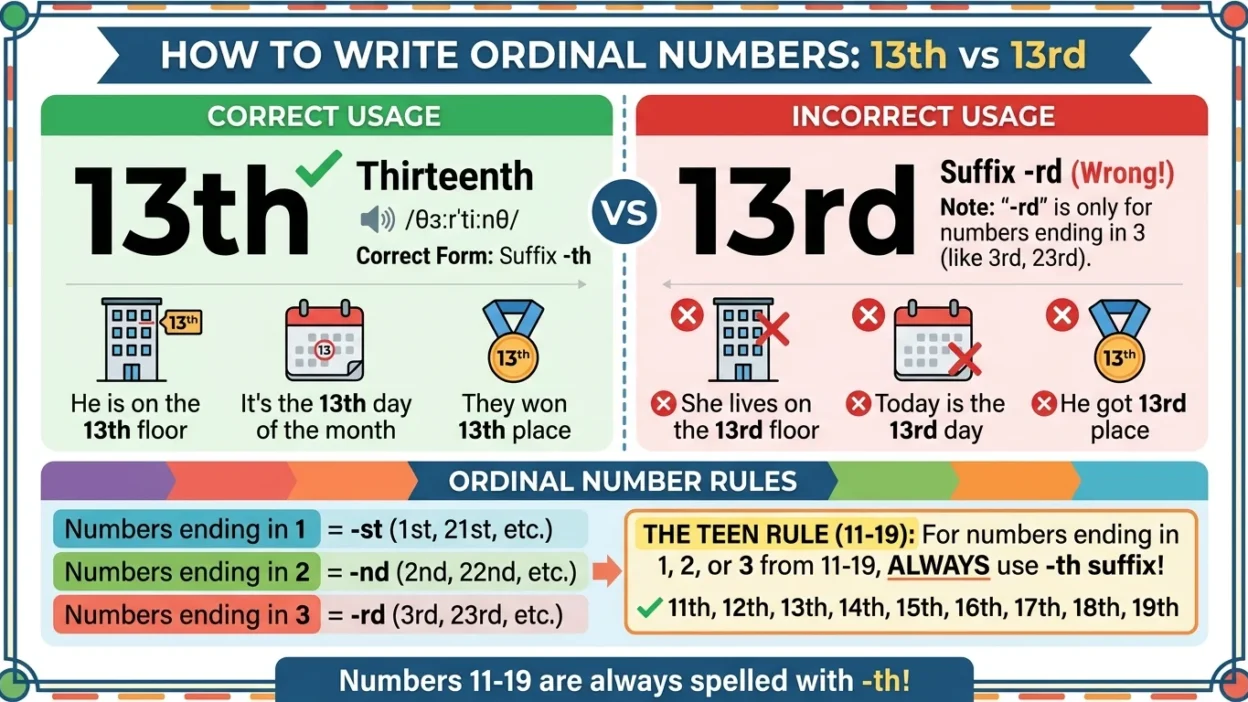
- Numbers ending in 1 → st
- Ending in 2 → nd
- Ending in 3 → rd
But there is an important exception.
👉 Numbers 11, 12, and 13 always use “th.”
Clear Explanation of the Difference
Here is the key idea:
👉 “13rd” is wrong because 13 is a special number.
Even though 13 ends in “3,” it does NOT follow the normal pattern.
Correct forms:
- 11 → 11th
- 12 → 12th
- 13 → 13th
Why?
These numbers come from older forms in English, and they kept the “th” ending.
So:
❌ 13rd (wrong)
✔ 13th (correct)
Comparison Table
| Feature | 13rd | 13th |
|---|---|---|
| Correct form | ❌ No | ✅ Yes |
| Usage | Incorrect | Correct |
| Rule followed | Wrong rule | Correct exception |
| Used in writing | Never | Always |
| Recommended use | Avoid | Use this |
Which One to Use and When
👉 Always use “13th.”
Use it when writing:
- Dates (e.g., June 13th)
- Positions (e.g., 13th place)
- Events (e.g., 13th birthday)
Examples:
- Today is the 13th of March.
- She finished in 13th place.
- It’s his 13th birthday.
👉 Never use “13rd.”
Common Mistakes People Make
1. Following the last number only
❌ 13 ends in 3 → 13rd
✔ Exception rule → 13th
2. Forgetting the special rule
Many learners forget that 11, 12, and 13 are different.
3. Mixing patterns
❌ 11st, 12nd, 13rd
✔ 11th, 12th, 13th
4. Guessing instead of remembering
👉 Tip: Always remember the “11–13 rule.”
Everyday Real Life Examples
In dates
- The meeting is on the 13th.
- My exam is on July 13th.
In school or rankings
- He came in 13th place.
- She is the 13th student on the list.
In daily life
- It’s my 13th attempt.
- This is the 13th time I’ve tried.
👉 In all cases, “13rd” would be incorrect.
Short Learning Section for Students and Beginners
Step 1: Learn basic endings
- 1 → st
- 2 → nd
- 3 → rd
- Others → th
Step 2: Learn the exception
👉 11, 12, 13 → always th
Step 3: Apply the rule
- 11th ✔
- 12th ✔
- 13th ✔
Easy memory tip
👉 “11, 12, 13 break the rule use ‘th’ for all three.”
Practice
Fill in the blanks:
- Today is the ______ (13) day.
- She finished in ______ (13) place.
✔ Answers:
- 13th
- 13th
FAQ
Is “13rd” ever correct?
No, it is always incorrect.
Why is “13th” correct?
Because 13 is part of the special group (11–13) that always uses “th.”
Do all numbers ending in 3 use “rd”?
No. Only numbers like 3, 23, 33 use “rd”—but not 13.
What about 23?
23 → 23rd (this follows the normal rule).
What about 11 and 12?
11 → 11th
12 → 12th
Is this rule important in exams?
Yes, using the correct ordinal form is important in writing and tests.
How can I remember it easily?
Remember: “11, 12, 13 always use ‘th.’”
Can I skip the ending in informal writing?
Sometimes (like “June 13”), but if you use it, it must be correct.
Conclusion
The difference between “13rd” and “13th” is very simple. “13th” is correct, and “13rd” is always wrong.
Even though 13 ends in 3, it follows a special rule. Numbers 11, 12, and 13 always use “th.”
👉 If you remember one thing, remember this: Never write “13rd”—always write “13th.”

Weston Maddox is both an author and administrator at SpellCorrect. He oversees site operations while creating accurate, easy-to-understand content focused on correct spelling and proper word usage, helping readers improve writing clarity, precision, and confidence across academic, professional, and everyday English communication.