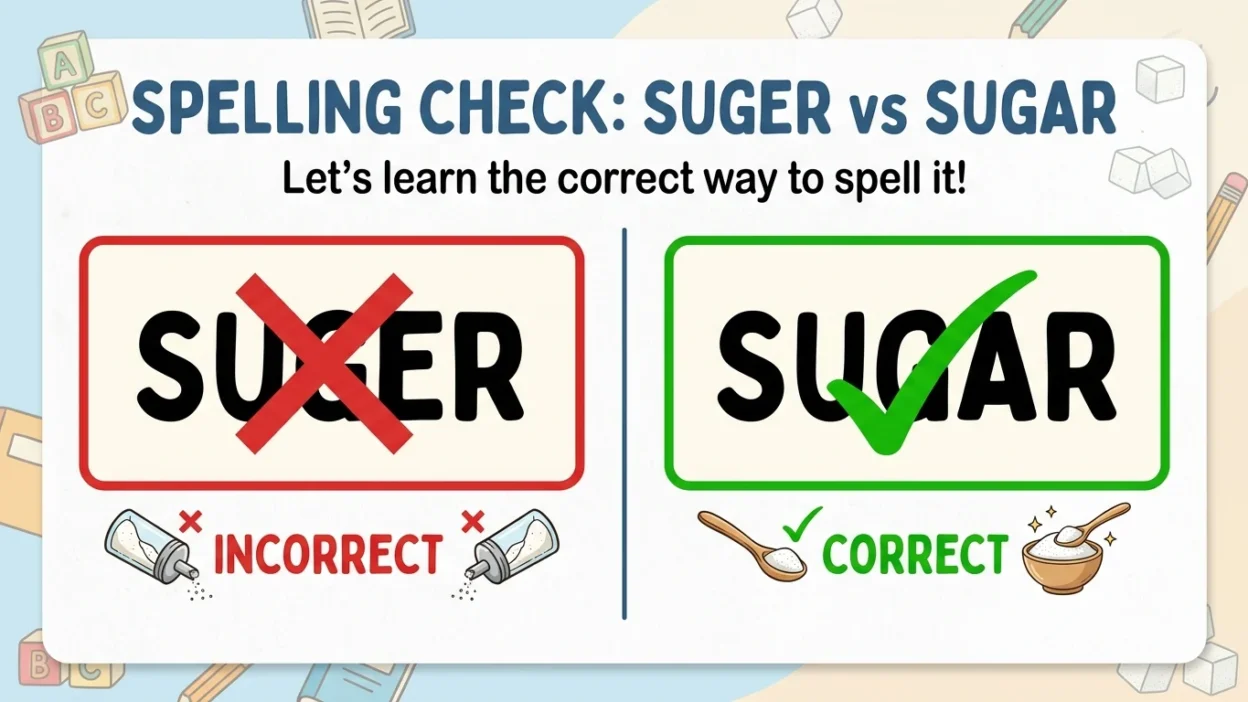
Many learners get confused between “suger” and “sugar.” The reason is simple: both words sound very similar when spoken. Because of this, people often spell it the wrong way, especially in fast writing or typing.
But here’s the important point: only one of these spellings is correct in English. This guide will help you understand the difference clearly and remember the correct form بسهولة.
Quick Answer
- Sugar = ✅ correct spelling
- Suger = ❌ incorrect spelling
- Meaning = a sweet substance used in food and drinks
- 👉 Always use “sugar”
Simple Origin or Background
The word “sugar” comes from older languages like Arabic (sukkar) and Sanskrit (śarkarā). Over time, it entered English and kept a similar sound, but the spelling changed.
Because of pronunciation, some people mistakenly write “suger”, but this spelling is not accepted in standard English.
Clear Explanation of the Difference
The difference is very simple:
- Sugar is the correct word. It is used everywhere in English.
- Suger is a spelling mistake. It is not a real English word.
Even though “suger” may look logical based on sound, English spelling does not always match pronunciation.
👉 So, you should always write “sugar.”
Comparison Table
| Feature | Sugar | Suger |
|---|---|---|
| Spelling | Correct | Incorrect |
| Usage | Common and standard | Not used |
| Meaning | Sweet food substance | No meaning |
| Dictionary | Yes | No |
| Recommended | ✅ Yes | ❌ No |
Which One to Use and When
You should use “sugar” in all situations:
- Writing sentences
- School assignments
- Emails and messages
- Recipes and cooking
Never use “suger,” because it is always considered a mistake.
Common Mistakes People Make
One common mistake is spelling based on sound. Since “sugar” is pronounced like “shoo-gar,” learners sometimes write “suger.”
Another mistake is typing too fast and not checking spelling.
Some people also think both spellings are acceptable. This is not true—only “sugar” is correct.
Everyday Real Life Examples
Daily use:
- “I need some sugar for my tea.”
- “Don’t eat too much sugar.”
In cooking:
- “Add two spoons of sugar.”
- “This cake needs more sugar.”
In messages:
- “Can you buy sugar from the store?”
❌ Incorrect examples:
- “I need suger.”
- “Add more suger.”
Short Learning Section for Students and Beginners
Easy Rule
👉 Sugar = correct
👉 Suger = wrong
Memory Trick
Think:
“Sugar has ‘a’ like ‘sweet taste.’”
Practice
Fill in the blank:
- I like tea with ______.
- This coffee has too much ______.
- We need ______ for the recipe.
✔ Answers:
- sugar
- sugar
- sugar
FAQ
Is “suger” a real word?
No, “suger” is not a correct English word.
Why do people write “suger”?
Because it sounds similar to “sugar,” so people guess the spelling.
Which is correct: suger or sugar?
“Sugar” is the correct spelling.
How do you remember the correct spelling?
Remember that “sugar” has an “a” in the middle.
Can I use “suger” in exams?
No, it will be marked as incorrect.
Is “sugar” used in formal writing?
Yes, it is used in both formal and informal English.
Conclusion
The difference between “suger” and “sugar” is very clear.
- Sugar is the correct and only accepted spelling.
- Suger is a common mistake and should be avoided.
If you want to write correct English, always choose “sugar.” This small spelling detail can make a big difference in your writing accuracy.