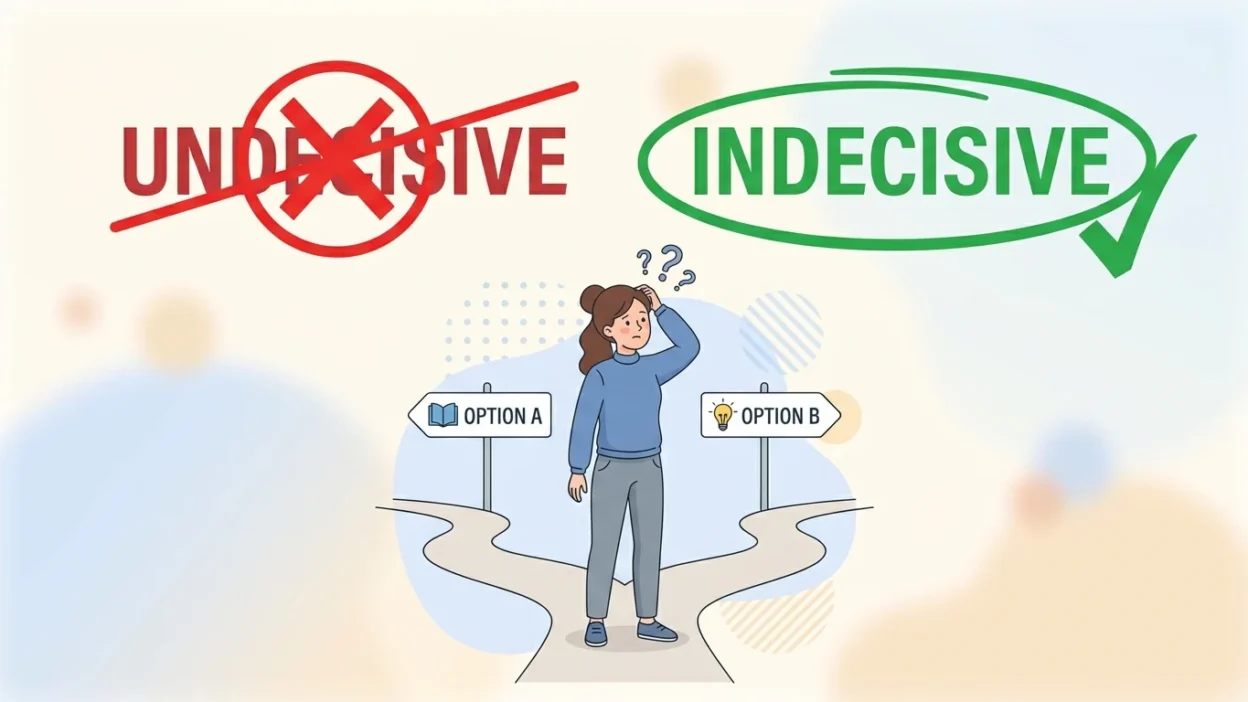
Many learners feel confused between undecisive and indecisive. Both words look similar, and both seem to describe a person who cannot make decisions. Because of this, it is easy to think they are both correct.
This confusion happens because English uses different prefixes like un- and in- to change meanings. Sometimes both prefixes work, but sometimes only one is correct. In this case, only one form is standard in English.
In this article, you will clearly learn which word is correct, why it is correct, and how to use it properly in everyday situations.
Quick Answer
- ✅ Indecisive = correct spelling
- ❌ Undecisive = incorrect (not standard English)
- Use indecisive to describe someone who cannot make decisions
Simple Background Explanation
Let’s start with the correct word: indecisive
What does “indecisive” mean?
It means:
- unable to make decisions
- not sure what to choose
Examples:
- He is indecisive about his career
- She felt indecisive when choosing a dress
Where does the word come from?
The word comes from:
- decide (to choose)
- in- (a prefix meaning “not”)
So:
- indecisive = not able to decide
Why do people write “undecisive”?
People often:
- use the prefix un because it is very common
- think “un ” works with every word
But English does not always follow that pattern.
Clear Explanation of the Difference
What is “indecisive”?
- It is the correct and accepted word
- It means not able to decide
- It is used in both formal and informal English
Example:
- He is very indecisive
What is “undecisive”?
- It is a non-standard form
- It is not correct in standard English
- It should be avoided
So, only one word should be used in correct writing.
Comparison Table
| Feature | Indecisive ✅ | Undecisive ❌ |
|---|---|---|
| Correct spelling | Yes | No |
| Used in English | Yes | No |
| Meaning | Unable to decide | Not correct |
| Word type | Adjective | Incorrect form |
| Example | She is indecisive | Not correct |
Which One to Use and When
Always use indecisive.
Use “indecisive” when:
- Describing someone who cannot decide
- Talking about confusion between choices
Examples:
- I feel indecisive today
- She is indecisive about her plans
- They were indecisive during the meeting
Never use:
- ❌ undecisive
Common Mistakes People Make
1. Using “un-” instead of “in-”
Many learners think:
- undecisive ❌
Because:
- happy → unhappy
But here:
- decide → indecisive
2. Thinking both forms are correct
Some learners believe both words can be used, but only one is standard.
3. Not understanding prefixes
Different words use different prefixes, and they are not always interchangeable.
4. Learning from incorrect sources
Seeing “undecisive” online can create confusion.
5. Guessing instead of checking
Guessing spelling often leads to mistakes.
Everyday Real-Life Examples
In Emails
- I am still indecisive about the final choice
- She seemed indecisive in her reply
In Social Media
- Feeling indecisive today 😅
- Why am I so indecisive about everything?
In School or Work
- He is indecisive during discussions
- The team was indecisive about the plan
In Daily Use
- I am indecisive about what to eat
- She is indecisive about her future
- He felt indecisive in that moment
Short Learning Section for Students and Beginners
Easy Rule
- Use indecisive, not “undecisive”
Memory Trick
Think:
“In-decide → indecisive”
Quick Practice
Fill in the blanks:
- I am ______ about my choice
- She is very ______
- They felt ______ during the meeting
Answers:
- indecisive
- indecisive
- indecisive
FAQ Section
1. Is “undecisive” ever correct?
No, it is not correct in standard English.
2. Why is “indecisive” correct?
Because it follows the correct prefix rule with “in-.”
3. What does “indecisive” mean?
It means not able to make a decision.
4. Is “indecisive” formal or informal?
It is correct in both formal and informal English.
5. Why do people say “undecisive”?
Because they are used to the prefix “un-.”
6. Can prefixes change meaning?
Yes, prefixes like “in ” and “un ” can change meanings.
7. Is “indecisive” an adjective?
Yes, it describes a person or situation.
8. How can I remember the correct word?
Use the memory trick: “In decide → indecisive.”
Conclusion
The confusion between undecisive and indecisive is very common, but the answer is simple.
- Indecisive is correct
- Undecisive is incorrect
Even though “undecisive” may sound natural, it is not the correct form. Always use indecisive to describe someone who cannot make decisions.
With practice, this will become easy, and you will use the correct word with confidence